



PodcastsJan 12, 2026
The latest poscasttest





test


Two men with metal detectors unearthed what is thought to be the oldest Iron Age gold work ever found in Great Britain.

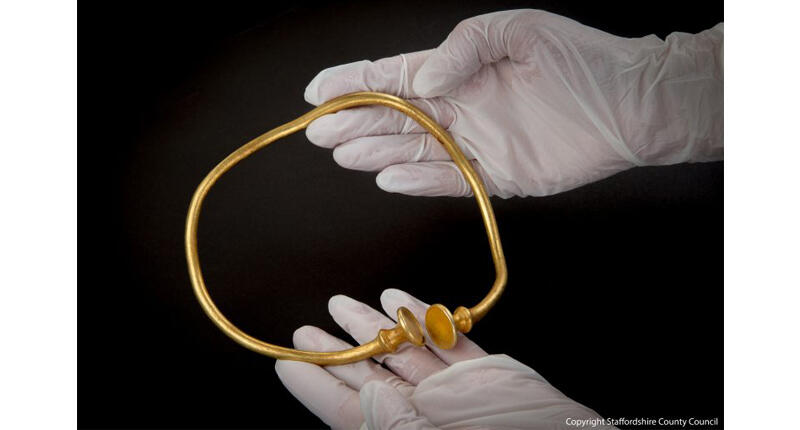
Leekfrith, England--Two men who were metal-detecting in a field in Leekfrith, a civil parish in Staffordshire, England, managed to dig up some important buried treasure.
Mark Hambleton and Joe Kania found what is being referred to as the “Leekfrith Torcs”--three gold necklaces and one bracelet that date to the Iron Age, approximately 2,500 years ago.
The British Museum believes the pieces to be the oldest Iron Age gold work ever found in Great Britain, estimating the work’s origin to date to about 400-250 BC.
“Iron Age jewelry is rare,” Lori Ettlinger Gross, a jewelry author, historian and MA candidate in the History of Design and Curatorial Studies at The New School, said in an interview with National Jeweler.
Gross also noted that much will be learned from where the jewelry was found.
“The thing that is most significant about this discovery is the evidence that it supports,” she said. “As people, as a culture and as individuals, jewelry was an apparent display of the self. It was made and worn because someone wanted to have the world see them a certain way, and in a way that perhaps stated wealth, beauty, or power.”
Julia Farley, curator of British & European Iron Age Collections at the British Museum, told the BBC: “Piecing together how these objects came to be carefully buried in a Staffordshire field will give us an invaluable insight into life in Iron Age Britain. The torcs were probably worn by wealthy and powerful women, perhaps people from the Continent who had married into the local community.”
Both Farley and Gross commented on the excellent condition in which the torcs were found.
Farley told National Jeweler, “I was completely stunned when I saw the torcs for the first time. They’re beautiful objects, and the skill which has gone into making them is incredible.”
Each torc was found about one meter (3.28 feet) apart and not far below the ground.
“As people, as a culture and as individuals, jewelry was an apparent display of the self. It was made and worn because someone wanted to have the world see them a certain way, and in a way that perhaps stated wealth, beauty, or power.” --Jewelry historian Lori Ettlinger GrossHambleton and Kania had permission from the property owner to search the fielded area and upon discovery, turned their finds in to the Portable Antiquities Scheme.



A monthly podcast series for jewelry professionals




From protecting customer data to safeguarding inventory records, it's crucial to learn how to tackle cybersecurity challenges.


Test Podcast With Video. New interview with Ada Lovelace.



Abstract for tests. New Podcast interview with John Lennon, Jimi Hendrix and Jim Morison.

Ahead of the holiday season, Smith delves into the often subconscious reasons people buy luxury products for themselves or their loved ones.

The GMT-Master “Pepsi” belonging to astronaut Edgar Mitchell is a standout in RR Auction’s online “Space Auction,” going on now.

The ads celebrate the mall culture of the ‘80s and ‘90s.

Retail sales associates can access the video series on mobile to refresh their selling skills.

For 25 years, India’s Gem & Jewellery National Relief Foundation has provided aid in the wake of war, natural disasters, and global crises.

The November auction will feature a collection of jewels owned by Ferdinand I, the first king of modern Bulgaria, and his family.

Commercial production has begun underground at the Canadian diamond mine’s A21 pipe.

Deloitte and Adobe Analytics shared their insights on the season, from the retail sales forecast to the role of generative AI.

The Texas-based jeweler collaborated with luxury clothing brand Uncommon Man on men’s bands designed with European influences.

Industry players have found ways to cope with market conditions while working to reshape themselves in the face of emerging realities.

The sales event, in its second year, features a selection of rare diamonds from the miner’s Argyle and Diavik diamond mines.

A portion of the proceeds from the “Always Dream” collection will go to Yamaguchi's foundation, supporting early childhood literacy.

The first in what is slated to be a series of in-depth reports from the consulting company, it focuses on shortening supply chains.





This site uses cookies to give you the best online experience. By continuing to use & browse this site, we assume you agree to our Privacy Policy