


PodcastsJan 12, 2026
The latest poscasttest





test


Snakes have been bent, twisted and bejeweled for adornment’s sake for thousands of years. What is it about this figure--a commonly-feared reptile with scaly skin--that is so appealing to jewelry-makers?

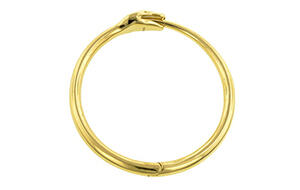
New York--Snakes have been bent, twisted and bejeweled for adornment’s sake for thousands of years.
What is it about this figure--a commonly-feared reptile with scaly skin--that is so appealing to jewelry-makers?
New York jeweler Elizabeth Doyle believes the reptile’s draw lies in the fact that it has held so many different meanings. It is a very powerful symbol that has wound its way through many different cultures and religions.
To the ancient Egyptians, it represented eternal life while others equated the serpent with knowledge. In more modern times, the snake has a darker appeal, the creature that tempted Eve in the Garden of Eden and led to her being cast out of paradise but which many still try to charm.
The ouroboros, the ancient symbol of a snake eating its own tail, magnifies people’s dark fascination with these creatures by what it represents-- something devouring itself in order to survive. “That’s part of the appeal of the ouroboros,” she said. “People fear snakes but they love them.”
Doyle opened Doyle & Doyle, a New York City retail shop, with her sister Irene Pamela in 2000. The store sells vintage jewelry as well as modern collections they design in-house. Their newest collection, set to debut in September, centers on the ouroboros.
Here, Doyle talks with National Jeweler about the history behind the figure of the snake eating its own tail that’s so commonly seen in jewelry.
Where did the word “ouroboros” originate? Doyle said the word “ouroboros” is derived from the Greek terms “ouro,” meaning tail, and “boros,” which translates to eating; so literally, a tail-devouring creature. While the ouroboros is usually a snake eating its own tail, it can be a dragon as well.
When was this figure first used in jewelry? Egyptian jewelry incorporated snakes, including snakes eating their own tail.
The first reference to the ouroboros in text is traced to this time too. Doyle said that a drawing of a snake eating its own tail was discovered in the Enigmatic Book of the Netherworld, the ancient Egyptian funerary text discovered in the tomb of Tutankhamun (King Tut), which dates to the 14th century B.C.
What was the appeal of the snake for jewelry design, and of the ouroboros specifically? Because the snake sheds its skin, ancient people believed that it was regenerating itself, being born again, so the snake came to be equated

It appealed to people’s desire for a long life, vitality and youth--the same desires that exist today--and thus was seen as an auspicious creature to use as adornment.
While it is a symbol of regeneration and eternal life, there’s also a darker side to it, the idea that something has to devour itself in order to survive. “People,” Doyle observed, “really like that balance of evil and good.”
Was there a time period when the ouroboros was most popular? While snake jewelry never really went out of style the serpent motif, including the ouroboros, surged during the Victorian era because Queen Victoria liked snake jewelry and, in fact, received a green enamel snake ring from Prince Albert. The queen was like the Carrie Bradshaw or Oprah of her time; whatever she did, other people followed.
Doyle said ouroboros also were used in Victorian mourning jewelry because it could symbolize one’s eternal bond with another person. These pieces often incorporated turquoise, a gemstone that is symbolic of the idea of forget-me-not in the European tradition.
RELATED CONTENT: The History Behind ... Victorian mourning jewelry
Doyle said it also helped that the Victorian era was the first time jewelry was mass produced, making it available to those outside the upper class.
How can retailers find ouroboros designs to add to their antique or estate jewelry selection, or even their modern stock? If looking for antique ouroboros jewelry, Doyle recommends the Victorian era pieces, as they are easier to find. Georgian examples are scarce, and there’s a greater likelihood of running across fakes.
There are also plenty of modern designers incorporating the snake, including the ouroboros, into their designs.
Besides being a streamlined shape that lends itself easily to bracelets, rings, pendants and earrings, the snake also presents a long, smooth surface on which designers can engrave or etch scales or set gemstones.
“They’ve always been a part of jewelry design,” Doyle said of snakes. “You can do so much with it.”


A monthly podcast series for jewelry professionals




From protecting customer data to safeguarding inventory records, it's crucial to learn how to tackle cybersecurity challenges.


Test Podcast With Video. New interview with Ada Lovelace.



Abstract for tests. New Podcast interview with John Lennon, Jimi Hendrix and Jim Morison.

Ahead of the holiday season, Smith delves into the often subconscious reasons people buy luxury products for themselves or their loved ones.

The GMT-Master “Pepsi” belonging to astronaut Edgar Mitchell is a standout in RR Auction’s online “Space Auction,” going on now.

The ads celebrate the mall culture of the ‘80s and ‘90s.

Retail sales associates can access the video series on mobile to refresh their selling skills.

For 25 years, India’s Gem & Jewellery National Relief Foundation has provided aid in the wake of war, natural disasters, and global crises.

The November auction will feature a collection of jewels owned by Ferdinand I, the first king of modern Bulgaria, and his family.

Commercial production has begun underground at the Canadian diamond mine’s A21 pipe.

Deloitte and Adobe Analytics shared their insights on the season, from the retail sales forecast to the role of generative AI.

The Texas-based jeweler collaborated with luxury clothing brand Uncommon Man on men’s bands designed with European influences.

Industry players have found ways to cope with market conditions while working to reshape themselves in the face of emerging realities.

The sales event, in its second year, features a selection of rare diamonds from the miner’s Argyle and Diavik diamond mines.

A portion of the proceeds from the “Always Dream” collection will go to Yamaguchi's foundation, supporting early childhood literacy.

The first in what is slated to be a series of in-depth reports from the consulting company, it focuses on shortening supply chains.





This site uses cookies to give you the best online experience. By continuing to use & browse this site, we assume you agree to our Privacy Policy