Designer’s Diary: An Appreciation for Craftsmanship
A trip to the Oscar Heyman workshop in New York got Vittoria d’Aste-Surcouf thinking about the difficulty of building something that lasts in this fast-paced world.
A custom fine jewelry designer, Vittoria d’Aste-Surcouf, has a diverse background in art history, events and public relations, jewelry fabrication, sales and fine jewelry rendering. She can be reached at info@vasbijoux.com.
During a quick trip to New York City last November, I was treated to a private tour of the Oscar Heyman fine jewelry showroom and workshop.
Upon my arrival, Tom Heyman, a direct descendant of one of the original Heyman brothers, and various members of his gracious and knowledgeable staff greeted me warmly.
Oscar Heyman was founded in 1921 by Oscar and Nathan Heyman, who immigrated to the United States from Ukraine.
As the tour began, I was led over to a vitrine that housed the loveliest hand-carved jewelry wax models. They had been hand-painted to resemble the pieces they would become one day and were shown to clients prior to the final piece being fabricated.
These carvings were organized and displayed under glass with the same attention given to museum artifacts, and understandably so—they were works of art in and of themselves.
After viewing the vitrines, we continued into the office area which, one month before Christmas, was abuzz with activity.
My main areas of interest were the offices housing Oscar Heyman’s in-house designer and wax carver.
I was told that each wax model is still carved by hand using the design sketches produced only a few feet away. I felt at home in the designer’s creative space since it reminded me of my own studio.
Various objets d’art were arranged around the room for inspiration, and there were different iterations of the same piece pinned on the wall for better viewing and analysis.
The design/art geek in me got really excited, though, when I was shown a filing cabinet containing each hand-rendered and painted design that had ever been created for the jewelry house. Neatly organized and categorized, the entire design history of this company was right there, fitted into a few drawers.
Honestly, I could have sat there all day leafing through these tiny works of art, not only for design inspiration but also to read the handwritten notes from designers from a time long ago.
We, as humans, are naturally drawn to the thought process of creating a thing of beauty.
What were these designers thinking while creating these designs? What inspired them? What type of designer and craftsman collaboration went into making one of these pieces? I could not help but wonder if the secrets were casually scrawled in cursive script on vellum.
I sadly withdrew myself from this little stack of design heaven and was guided past the gemstone area where the vibe, although a short walk away, was distinctly different from what I felt in the design corner.
While the design and wax carving space had an artsy vibe, the gemologists were undeterred and completely focused on the gemstones and diamonds glistening in front of them.
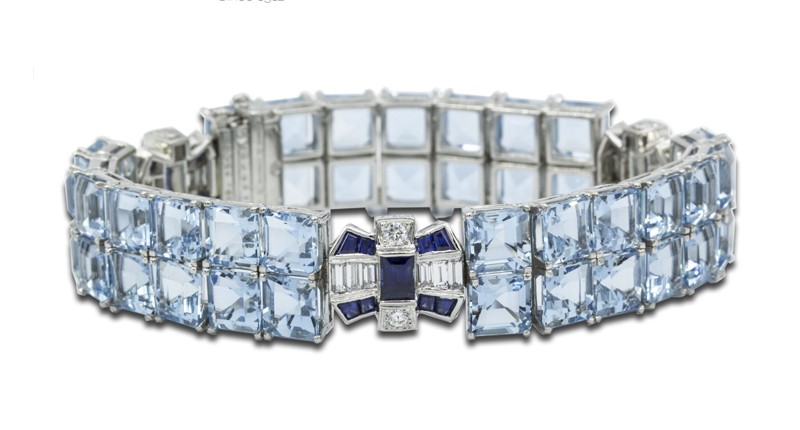
A platinum bracelet with aquamarine, sapphire and white diamonds from Oscar Heyman
I was then guided upstairs to the workshop; this is where the magic happens.
Having been trained on the bench, I felt at home in this space as well.
Oscar Heyman’s jewelry is made in-house. To have your own workshop is every designer’s dream!
In the workshop, you hear various foreign accents gently intermingling with the buzz of flex shafts, steamers and rhythmic hammering. There was a quiet, productive flow that emanated through the space, and I was hesitant to interrupt it.
During my visit to Oscar Heyman, I felt myself wanting to slow down and take mental snapshots of what was in front of me. It dawned on me that I was being offered a rare glimpse through the looking glass into a world that is not a reality for contemporary designers. It was a gift and not something all designers get to see.
I got to witness what established success looks like as well a true legacy, a success and a legacy put in place over time through smart decisions, collaboration and taking time to create versus simply making.
This “older” way of doing things—hand-carved wax models, painted renderings and craftsmanship— passed down through the generations was still vibrant and felt solid to me, particularly given this modern time of competitiveness, social media, shortcuts and emphasis on profits.
After my tour ended, I rolled back out into the cold drizzle on Park Avenue.
I felt excited, uplifted and inspired. However, as I walked towards the Diamond District each light step was replaced by a slightly heavier one.
I could blame it on the dreary New York winter weather, but I know it was more than that. A larger question began to loom over my head: How does one build this type of legacy in today’s world?
Oscar Heyman started in 1912, toward the end of the Belle Époque (Beautiful Age) period, a golden age where there was abundance and a great appreciation for the arts.
There was an exchange of artistic ideas, time to “think” about creative ideas, and a general respect for craftsmanship. The world was slower, and discourse surrounding the best approach to artistry was not considered a waste of time.
Artisans wanted to produce their best and were dedicated to works that were more sculptural in design, instead of cranking out something quick and flat that falls nicely within profit margins.
A conversation like this requires a gathering of minds and a true collaboration between artists and artisans. I began to question my own design business and realized that this is a daily struggle for me.
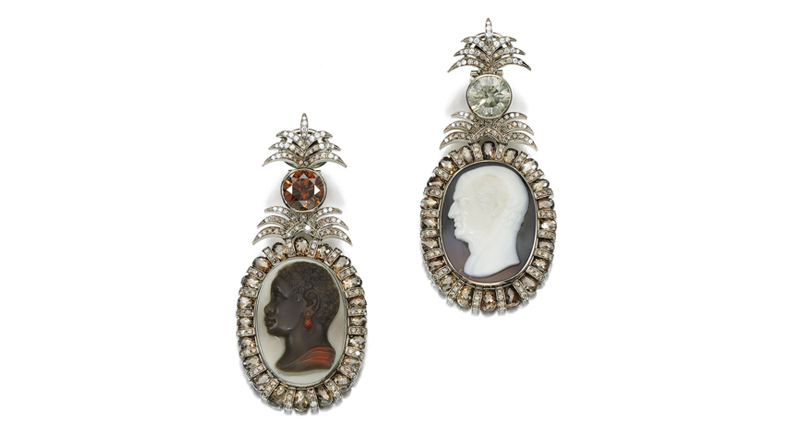
These pineapple-shaped earrings from Hemmerle feature 19th-century cameos surrounded by gray and orange-brown old-mine-cut diamonds. They sold for $88,523 at an auction of Hemmerle jewelry held by Sotheby’s in November 2019.
This opened my thoughts to other heavy-hitter design houses that I admire, like Hemmerle.
The fourth-generation German design house was established in 1893 and is known for its one-of-a-kind pieces that feature unusual materials, spectacular gemstones and rare antiquities.
Hemmerle is unapologetic in its process and admits that each piece can take months to make because the components are not readily available and need to be sourced from the various corners of the world.
Oscar Heyman and Hemmerle can sustain this model of taking one’s time with design and creating everything by hand because they are established jewelry houses seemingly untouched by time and technology.
But how does a young designer continue the artistic discourse and dedication to craftsmanship while dealing with the maelstrom of social media, a barrage of cheaply made jewelry as “competition,” high material and fabrication costs, and pressure to produce a line of jewelry and attend expensive trade shows?
It’s a lot!
Everything in today’s world involves investors, deep pockets and bottom lines. I’m not saying that we should discard technology, obviously; that would be ludicrous since this is the reality we live in. But I wonder if there is a way to slow everything down a bit, to develop more of a flow in conversation between the creative and industrial minds.
All this makes me wonder, too, what type of jewelry houses will be revered in the year 2120.
We know the greats like Oscar Heyman and Hemmerle have already cemented their legacy and will not be swallowed by the sands of time, but who is next?
We look to the past to see what type of model is sustainable in today’s world. But what will the greats of the future have built their legacy on?
I can’t help but wonder if it won’t be the same dedication to design, artistry and craftsmanship (with a side of technology) that we revere today.
Vittoria d’Aste-Surcoufis a custom fine jewelry designer with a background in art history, events, public relations and sales.