Rio Tinto highlighted six "hero" diamonds from its 2019 Argyle Pinks Diamond Tender, its annual sale of the best pink, red and violet stones from its mine in Western Australia.
The story of any diamond begins deep in the ground, about 100 miles below Earth’s surface where the temperature and pressure conditions are just right.
It can take billions of years for the carbon atoms to bond together, the same way in every direction, to create a diamond’s isometric crystal structure.
Click here for the full 2019 State of the Majors issue.
It’s like baking a cake, explains Nathan Renfro, the manager of colored stones at the Gemological Institute of America’s Carlsbad, California, headquarters.
You need to have the right conditions and the right ingredients, and you need to follow the recipe exactly.
But, much like a cake, it’s the unexpected ingredients that can take things to a whole new level.
When nature strays from the traditional natural diamond recipe and throws other elements into the mix, it can create a rare and highly prized natural colored diamond.
A common impurity is nitrogen, Renfro says, which can result in yellow and brown diamonds. If boron is added in, a less common impurity, a blue diamond may form.
Pink diamonds, meanwhile, rise as the result of a structural defect, an increase in the pressure conditions that affect the growth of the diamond and distort its lattice, he says.
If nature deviates too far from the original recipe, the end result is graphite, another carbon-only mineral but with a different formation process, crystal structure and, obviously, value than a diamond.
It can be difficult to estimate just how many natural colored diamonds there are in the world, says Renfro, but “the rarity factor is overwhelming.”
Hidden Gems There are only a few mines in the world notable for producing exceptional natural colored diamonds.
Rio Tinto’s Argyle Mine in Western Australia is known for its breathtaking pink and red diamonds.
The most exceptional are showcased during the company’s annual Argyle Pink Diamonds Tender.
The 2019 assortment of stones, collectively dubbed “The Quest for the Absolute,” features 64 diamonds weighing a combined 56.28 carats.
The best of the best, in terms of size and color, are called “hero” diamonds and are the only stones upon which Rio Tinto bestows individual names.
The heroes of this year’s tender include the Argyle Enigma, a 1.75-carat modified radiant-cut fancy red diamond, and the Argyle Elysian, a 1.20-carat modified cushion-shaped fancy vivid pink.
Rio Tinto has been holding the Argyle Pink Diamonds Tender every year since 1984, but the sale is nearing its final act. The mining company plans to close Argyle in 2020, when “economically viable diamond resources will be exhausted,” it said.
“It’s the end of an era for the colored diamond business,” says Scott West, third-generation wholesaler specializing in natural colored diamonds and an owner of LJ West Diamonds Inc. “They were a big part of the beginning.”
West’s family was there from the start.
His father, Larry West, traveled to Australia in the 1980s to visit the Argyle Mine, long before it was as well-known in the industry as it is today.
Larry saw potential in the mine’s pink diamonds and his company has since accumulated one of the largest collections of natural colored diamonds in the world.
Scott describes the closing of the mine as bittersweet, referring to it as “a living part of the business.”
On the bright side, the mine’s closure means skyrocketing prices for pinks, which he believes will slowly evaporate from the market.
Scott boils it down to basics: supply and demand. The less available something is, the more people will pay to have it.
Price Check So, how do you price a one-of-a-kind marvel of nature?
Well, that can be a bit complicated, says Miri Chen, CEO of the Fancy Color Research Foundation, a nonprofit that promotes the transparency and trade of natural colored diamonds.
The first step is to send the stone to a gemological lab, like GIA, to find its color group. The value of a colored diamond is based in part on the strength of its color, which can range from light fancy to fancy to fancy intense to fancy vivid.
The stronger the color, the more valuable the diamond.
The next step is to analyze other important visual elements including color dispersion and undertone, says Chen.
Color dispersion refers to how color is distributed throughout a stone; an even coloring will boost its value. Diamonds with patchy coloring or a colorless frame will be worth less.
Undertones can affect the value of a colored diamond as well, but they vary from stone to stone and the effect on value can depend somewhat on personal preference.
A pink diamond with a purple undertones, for example, tends to be more aesthetically pleasing and can be sold at a premium whereas a blue diamond with a gray undertones may be discounted.
Auction Stars Jewelry auctions always create a bit of the buzz in the industry—a crowded room of bidders jostling to raise their paddles and place winning bids on some of the most beautiful gems and jewelry in existence—even though sometimes pieces fall short of their sellers’ expectations.
Natural colored diamonds, however, rarely run into that problem.
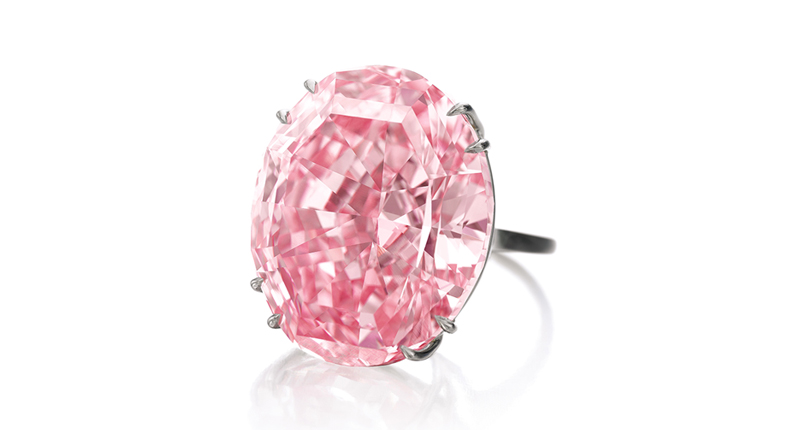
The CTF Pink Star, a 59.60-carat Type IIa pink diamond, sold for $71.18 million.
To date, the top five most expensive jewels ever sold at auction are colored diamonds—three pink and two blue.
In the No. 1 slot is the CTF Pink Star, a 59.60-carat Type IIa pink diamond, sold for $71.18 million, or $1.2 million per carat, to Chow Tai Fook at Sotheby’s Hong Kong jewelry auction in April 2017.
Mined by De Beers in Africa, the oval mixed-cut diamond is the largest internally flawless, fancy vivid pink diamond the Gemological Institute of America has ever graded.
The second-most expensive jewel ever sold at auction is the Oppenheimer Blue, a rectangular-cut 14.62-carat fancy vivid stone set into a platinum ring by Verdura.
An anonymous buyer paid $57.5 million, or about $3.9 million per carat, for the Oppenheimer Blue at Christie’s Geneva in May 2016, surpassing the pre-sale estimate of $45 million by a diamond-paved country mile.
Next up is The Pink Legacy, an 18.96-carat rectangular-cut fancy vivid pink, sold to Swatch Group-owned jeweler Harry Winston for $50.4 million at Christie’s Geneva in November 2018.
Renamed “The Winston Pink Legacy,” it is the most expensive pink diamond ever sold at Christie’s and set a world auction record for highest price-per-carat for a pink diamond, which was $2.7 million per carat.
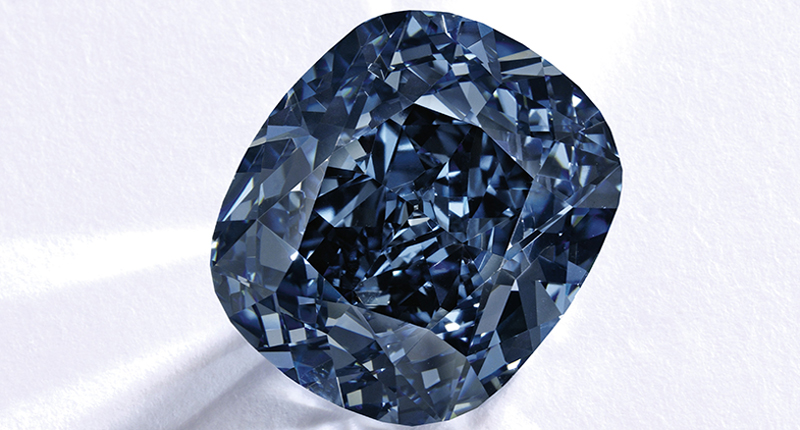
The fourth highest-grossing auction jewel of all time is the “Blue Moon,” a 12.03-carat fancy vivid blue diamond sold for $48.5 million at Sotheby’s Geneva jewelry sale in November 2015. Purchased by a Hong Kong billionaire for his daughter, the diamond set the price-per-carat record for a blue diamond, which was $4 million per carat.
The Graff Pink is No. 5, a 24.78-carat fancy intense pink diamond that sold for $46.2 million at Sotheby’s Geneva sale in November 2010.
The diamond set the world auction record for a fancy intense pink diamond at $1.8 million per carat.
Pricing Trends The best of the best natural colored diamonds can command astronomical amounts of money at auction, skyrocketing past pre-sale estimates time and time again.
The broader market, however, sees more of a “moderate and gradual rise in pricing,” says the Fancy Color Research Foundation’s Chen, noting general market stability.
Overall, prices of fancy color diamonds slipped 0.1 per cent in the second quarter of 2019.
Pink diamonds were the top performers, with prices for the sweet-hued gemstones rising 0.4 percent while blue diamonds dipped about 0.3 percent.
Looking ahead, Chen says: “Although fancy color diamonds are not subjected to common pricing trends, our years of experience gives us an option to make an educated estimation for the next few years.
“In the worst-case scenario, we won’t see any change at all in pricing, or, alternatively, we will witness a moderate increase in all colors.”
Only an “extreme crisis” could cause prices to plummet, she says, which is exactly what happened in 2008 at the onset of the global financial crisis.
When the U.S. Congress rejected the bank bailout bill in September 2008, the Dow Jones Industrial Average suffered the largest point drop in history up until that date, taking fancy colored diamond prices down with it.
However, fancy colored diamond prices bounced back by the end of 2009, says Chen.
In 2010, they made significant moves in the other direction; prices rose as a result of Chinese buyers who began investing heavily in natural colored diamonds, viewing them as a secure asset class and a store of wealth.
The “Blue Moon,” a 12.03-carat fancy vivid blue diamond, sold for $48.5 million.
For the Love of the Stones Referring to a natural colored diamond as an “asset class” is the equivalent of nails on a chalkboard to Alan Bronstein, CEO of Aurora Gems and current president of the Natural Color Diamond Association.
“Nobody, at any level, should buy a natural diamond or natural colored diamond, whether $1,000 or $15 million, on the premise that it will appreciate in value,” he says.
“You can’t be intuitive about what the future holds. You can have a good guess, but you never really know. Past performance is an indicator, but it’s not a guarantee of future performance.”
Bronstein is certainly not alone in his views on colored diamonds and promises of future value.
Earlier this year, New Orleans Saints quarterback Drew Brees won a $6.1 million judgement against a San Diego jeweler, Vahid Moradi of CJ Charles Jewelers, after suing the jeweler for selling him colored diamonds that were allegedly overvalued and marketing them as good investments.
One of the causes of action in the lawsuit that Brees prevailed on was breach of fiduciary duty, as the court found that Moradi had essentially become an investment advisor by giving Brees advice on what to buy, which is something industry experts warn against.
Jewelers Vigilance Committee President Tiffany Stevens said in general, JVC advises against making promises about how much jewelry and gemstones will be worth in the future.
“Everyone has to make their own business decisions about how they are doing their own branding and marketing but, from our point of view, we would advise against people speculating on future value.
“If you do something that seems like you’re guaranteeing it, you could really get yourself in hot water if you’re viewed as an investment adviser.”
Bronstein, a diamond dealer, asserts he has never had to make a hard sell on any natural colored diamond.
It is the customer’s connection to the stone—the way the natural beauty speaks to him or her—that makes all the difference, he says.
Born in the Bronx, Bronstein got his start as a colored diamond broker in the 1980s. At the time, he says, there was only a page or so for gemology students to read through about fancy colored diamonds.
He recalls meeting with powerful brokers, watching them open pouches of the stones and spread them out across the floor, their eyes aglow as they showed off their collections like kids in a schoolyard.
Bronstein still brings that joy and excitement to the table.
“If anyone is in love and infatuated with colored diamonds, it’s me,” he says.
Looking to share his own collections with the public, Bronstein has curated museum exhibitions of natural fancy colored diamonds.
The Aurora Pyramid of Hope, a collection of 296 natural colored diamonds amassed by Bronstein and fellow collector Harry Rodman, has been displayed in several museums, including the Smithsonian Institution in Washington, D.C. and the American Museum of Natural History in New York.
The diamonds weigh a combined 267.45 carats and span 12 color varieties.
The exhibitions are an opportunity to bring the public into a world that can be insular, usually reserved only for the industry experts and those rich enough to afford such treasures.
Bronstein sees that changing as consumers become more empowered and the market moves toward transparency.
“There’s only one reason to buy anything. It’s because you love it and because it makes you happy.”
Lenore Fedowis the associate editor, news at National Jeweler, covering the retail beat and the business side of jewelry.