




PodcastsJan 12, 2026
The latest poscasttest






test


An artist made one of LJ West’s stones “disappear” to make statements on contrast, value and the monopolization of materials in the art world.

New York—There is a $2 million diamond on display at the New York Stock Exchange right now, but you can’t really see it.
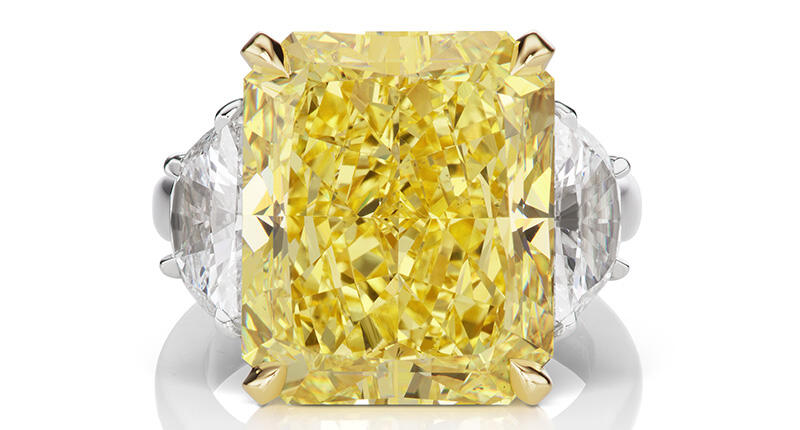
On Friday, the New York Stock Exchange and MIT opened “The Redemption of Vanity,” a work by conceptual artist Diemut Strebe that involved coating a 16.78-carat vivid yellow diamond with carbon nanotubes, muting the diamond’s color, flattening its lines and making it essentially invisible against a black background.
The stone is from the collection of L.J. West Diamonds Inc., a New York-based company that specializes in natural colored diamonds.
In an interview at the stock exchange Friday, the Boston-based Strebe said her project has numerous aspects to it, standing as a statement on contrast, value and the monopolization of materials in the art world.
There is, first, the juxtaposition of the two materials, the “unification of extreme opposites,” she said.
While both the diamond and the tubes are made of the same element, carbon, one absorbs light while the other reflects it.
The patented carbon nanotube technology used in Redemption was developed by Professor Brian Wardle and his necstlab (pronounced “next lab”) research group at the Massachusetts Institute of Technology. (Strebe is the Ida Ely Rubin Artist in Residence at MIT.)
Any object covered with CNT material is flattened out, reduced to a black silhouette, and, in the case, of a diamond, loses its sparkle.
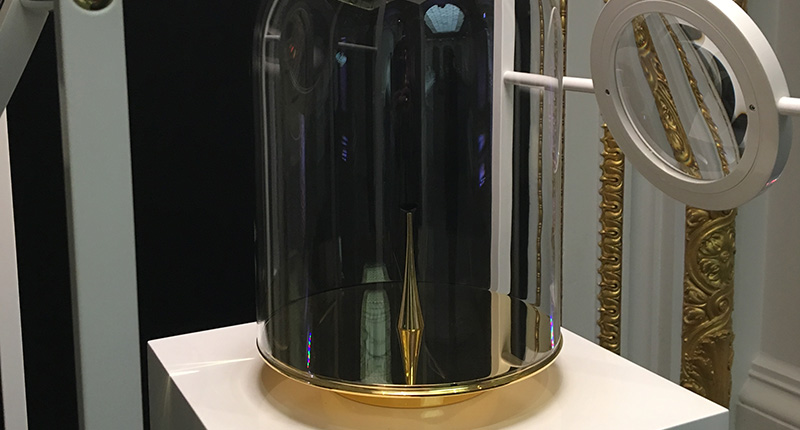
At the New York Stock Exchange, the now-shrouded-in-black stone sits at one end of the Board Room, an opulent turn-of-the-century event space located two levels above the trading floor.
On display to the left of the diamond is a juxtaposing image indeed—a giant screen displays a rotating, 360-degree image of the 16.78-carat vivid yellow radiant-cut stone, sparkling in its polished state.
Secondly, Strebe said she wanted the work to be a statement on the arbitrary and man-made nature of value, a topic that artists—she mentioned specifically French artist Yves Klein, who once organized an exhibition that consisted of nothing but an empty room—have been creating works around for decades. 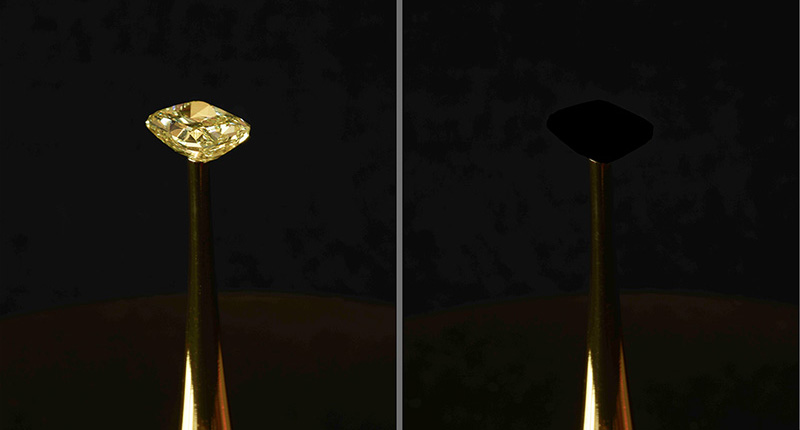
In looking at The Redemption of Vanity, one might say the artist has devalued this diamond by concealing what is considered, in the diamond world at least, to be valuable about it—its





A monthly podcast series for jewelry professionals


From protecting customer data to safeguarding inventory records, it's crucial to learn how to tackle cybersecurity challenges.


Test Podcast With Video. New interview with Ada Lovelace.



Abstract for tests. New Podcast interview with John Lennon, Jimi Hendrix and Jim Morison.

Ahead of the holiday season, Smith delves into the often subconscious reasons people buy luxury products for themselves or their loved ones.

The GMT-Master “Pepsi” belonging to astronaut Edgar Mitchell is a standout in RR Auction’s online “Space Auction,” going on now.

The ads celebrate the mall culture of the ‘80s and ‘90s.

Retail sales associates can access the video series on mobile to refresh their selling skills.

For 25 years, India’s Gem & Jewellery National Relief Foundation has provided aid in the wake of war, natural disasters, and global crises.

The November auction will feature a collection of jewels owned by Ferdinand I, the first king of modern Bulgaria, and his family.

Deloitte and Adobe Analytics shared their insights on the season, from the retail sales forecast to the role of generative AI.

The Texas-based jeweler collaborated with luxury clothing brand Uncommon Man on men’s bands designed with European influences.

The sales event, in its second year, features a selection of rare diamonds from the miner’s Argyle and Diavik diamond mines.

A portion of the proceeds from the “Always Dream” collection will go to Yamaguchi's foundation, supporting early childhood literacy.

The first in what is slated to be a series of in-depth reports from the consulting company, it focuses on shortening supply chains.

The company said Benjamin Clymer will return to his role as head of the watch news website, which will maintain editorial independence.





This site uses cookies to give you the best online experience. By continuing to use & browse this site, we assume you agree to our Privacy Policy