Taking action to ensure it accurately differentiates between lab-grown diamonds and their mined counterparts is the biggest challenge the industry faces.
A shot inside one of the laboratories operated by De Beers’s International Institute of Diamond Grading and Research. The workers shown here are using the first version of the Automated Melee Screener, developed to detect man-made diamonds in packets of small diamonds.
Although there is no way of knowing how many undisclosed lab-grown diamonds are circulating, analyst Chaim Even-Zohar estimates approximately $750 million worth of gem-quality man-made diamonds entered the supply chain in 2016.
Click here to read the full story in the State of the Majors issue.
He describes the volume of undisclosed lab-grown melee—diamonds sized from a miniscule 0.001 carats to 0.18 carats used in every type of jewelry—entering the market as “staggering.”
Others also believe there is a reasonable likelihood of discovering undisclosed lab-grown stones in the pipeline.
“Based on our experience of testing jewelry and parcels, we suspect the risk of finding synthetics in the supply chain is reasonably high at the moment,” says Tom Moses, executive vice president and chief laboratory and research officer at the Gemological Institute of America.
Just one high-profile case of a consumer discovering the expensive ring they saved up for contained an undisclosed lab-grown diamond could have huge ramifications for consumer trust in an industry already working hard to stay relevant to millennials.
It is bound to happen before too long and, in fact, it probably already has.
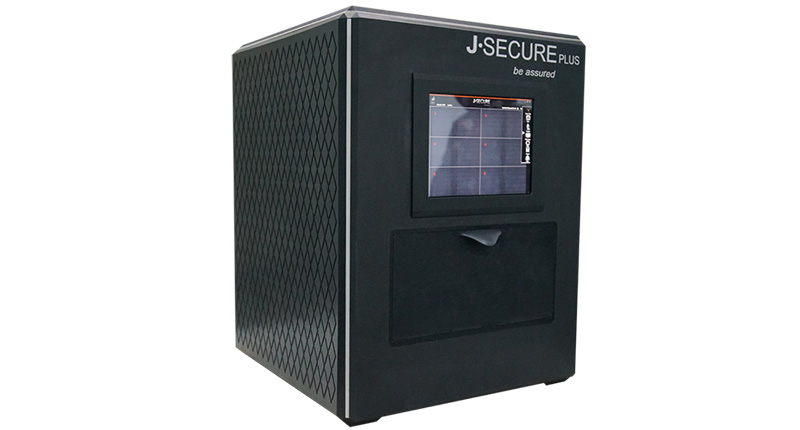
David Skuza of DRC Techno, a Surat, India-based gemological research and development company founded by sightholder Dharmanandan Diamonds, says every customer who has used the company’s J-Secure Plus machine has found undisclosed lab-grown diamonds.
One customer recently tested a fancy diamond bracelet with rounds and baguettes. They discovered the baguettes to be lab grown, a big surprise.
“Every retailer, manufacturer, wholesaler and diamond company that has tested or bought our machine finds undisclosed lab-grown diamonds. High-end or mass-market, it makes no difference. The contamination is everywhere.”
“Every retailer, manufacturer, wholesaler and diamond company that has tested or bought our machine finds undisclosed lab-grown diamonds,” says David Skuza of DRC Techno of the company’s J-Secure Plus, pictured here. “High-end or mass-market, it makes no difference.”
He has endless examples of this “contamination.”
They include a gem lab, which Skuza will not publicly identify for confidentiality reasons, that quality controls more than 1,000 stones on a weekly basis for a major reseller and regularly finds more than 5 percent of its diamond products containing undisclosed man-made diamonds.
He also cites an example in which a customer checking a 5-carat parcel of 0.02-carat diamonds at the recent JCK Las Vegas show discovered that nearly 75 percent of the diamonds he had just purchased were man-made.
Taking Action Although the battle against undisclosed lab-grown diamonds feels a bit like fighting terrorism—those who want to cause disruption are always one step ahead of those seeking to curtail it—the industry is far from powerless.
Manufacturers and dealers should use all the means at their disposal to stem the flow of undisclosed lab-grown stones further down the supply chain. But, retailers must also do their part to prevent these stones from ending up in the hands of unsuspecting end consumers.
Jonathan Kendall, president of the International Institute of Diamond Grading & Research (IIDGR), a De Beers Group company, says the first piece of advice for retailers who suspect they might have received undisclosed lab-grown diamonds is not to panic.
The second is to review what safeguards they have in place regarding the products they sell, noting that, “Every individual business is responsible for the integrity of its merchandise.”
Retailers can try to ensure all the diamonds they buy and sell come with an objective grading report. However, not all goods have grading reports. In such cases, they can send out their inventory to any of the major labs for testing. However, this can add up in cost—both for the testing and the associated administrative costs—and time, putting a real strain on smaller businesses in particular.
An alternative is to invest in one of the diamond detection machines geared toward retailers that allow jewelers to test their inventory, including mounted jewelry, on an as-needed and just-in-time basis.
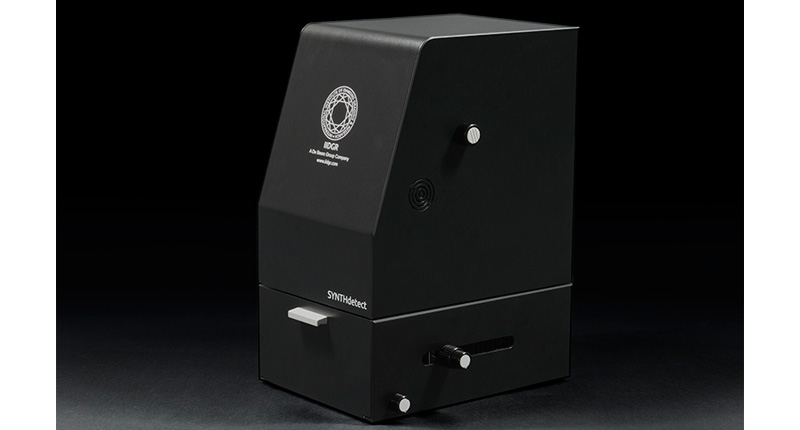
IIDGR’s SYNTHdetect identifies diamonds as natural, rather than looking for signs that the stone is man-made, which the lab’s Jonathan Kendall says is “a major step forward in technology.”
HRD Antwerp produces the D-Screen, a portable piece of equipment that distinguishes lab-grown stones from natural diamonds. The machine can also determine if a stone has undergone high-pressure, high-temperature (HPHT) treatment to improve or enhance its color.
The D-Screen can check all diamond cuts and can scan up to 200 stones, from 0.2 carats to 10 carats in D to J colors, an hour, with immediate results.
IIDGR has just released the SYNTHdetect. Designed for back-office use by jewelry manufacturers and retailers, SYNTHdetect (and the second version of the lab’s automated melee screener, AMS2) works by identifying diamonds as natural, rather than looking for telltale signs of lab-grown origin. This, says Kendall, is “a major step forward in technology.”
IIDGR says it has the industry’s lowest referral rate, around 0.05 percent, compared with other screening products that can have a referral rate approaching 10 percent. The referral rate has to do with those diamonds that the machine cannot 100 percent verify as not being lab-grown and, therefore, must be sent to a gemological lab for further testing. The low referral rate of SYNTHdetect is designed to save retailers both time and money.
IIDGR also offers the lower-cost PhosView ($4,500 versus $16,250 for SYNTHdetect). This is a more basic machine that analyzes parcels of polished diamonds to determine if they contain potential HPHT-grown diamonds only.
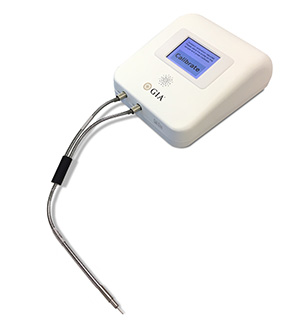
GIA is already taking orders for its soon-to-be-released GIA iD100 (pictured above), an easy-to-operate desktop instrument that identifies mounted and loose natural colorless diamonds.
The instrument combines advanced spectroscopic technology and GIA’s extensive research into natural and man-made diamonds to uncover all lab-grown diamonds—made with both the HPHT and chemical vapor deposition processes—and all simulants. The lab is conducting further research to extend the capabilities of the instrument to identify pink diamonds and other gem material.
Finally, DRC Techno’s J-Screen Plus identifies CVD and HPHT lab-grown diamonds and can be used on loose or mounted stones as small as 0.003 carats in any shape. The easy-to-understand results mean that testing can be done by someone with no gemology training.
The company also markets the D-Screen Plus, which works on colorless or near-colorless HPHT and CVD lab-grown diamonds in all shapes and sizes from 0.003 to 10 carats (the machine can screen larger stones and fancy shapes with some mechanical add-ons). While it is primarily aimed at loose stones, D-Screen Plus can also scan set jewelry as long as the diamonds are visible.
The Melee over Melee While retailers can check larger stones and small amounts of melee, checking large quantities of tiny stones requires more specialized equipment.
For self-testing melee, HRD Antwerp has the M-Screen. This super-fast, automated screening device checks round, brilliant diamonds from 0.5 points to 20 points to identify potential lab-grown diamonds, potential HPHT color-enhanced stones, and diamond simulants. Developed by WTOCD, the Antwerp Scientific Research Centre for Diamonds, it feeds, screens and sorts at least three diamonds per second, or 11,000 diamonds an hour. Depending on the size of the stones and batch, the machine can sort an astounding 15,000 diamonds an hour.
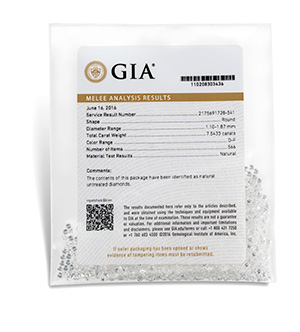
The GIA now has a Melee Analysis Service, which scans small stones to separate natural, untreated diamonds from simulants and potentially man-made or treated diamonds. The diamonds are returned in a sealed package, as seen above. Earlier this year, IIDGR launched the AMS2, the second generation of its automated melee screening machine. It is up to 10 times faster than the company’s first melee screening machine and has a substantially reduced referral rate. This minimizes the need for additional and expensive secondary testing. With a price tag of $45,000, it is primarily for those involved in polished diamond wholesale rather than retailers.
Retailers who deal in large amounts of melee can send parcels to the labs to be tested if they have suspicions about what they are buying.
And if their parcel gets flagged as containing lab-grown diamonds, they should not be surprised.
Earlier this year, for example, the GIA lab in Mumbai reported that almost a third of a parcel of melee screened using its Diamond Analysis Service were undisclosed lab-grown diamonds. Put another way, 101 out of the 323 diamonds were man-made.
Another equipment maker, Hong Kong-headquartered Diamond Services, recently announced its New York lab had detected multiple single-cut lab-grown diamonds sized from 0.0025-0.005 carats mounted in jewelry. (Single-cut stones have 16 to 18 facets, compared with the 57 or 58 facets of a full-cut stone.)
“To the best of my knowledge, this is the first time that a synthetic single-cut stone has been detected mounted in jewelry,” Joseph Kuzi, Diamond Services founder and managing director, said in a press release. “What this means is that almost no diamond can be taken at face value.”
A Cause for Optimism While the number of undisclosed lab-grown diamonds being discovered is disquieting, the industry seems to be taking the right steps to make sure consumers get the products they want, which might mean lab-grown rather than mined diamonds.
According to Moses, the use of lab-grown diamonds and their marketing to consumers makes accurate identification and disclosure even more important so buyers can make an informed decision about their choices.
Jonathan Kendall agrees. “With this also comes the added pressure of consumers becoming more aware on the topic of undisclosed synthetics. That’s why testing is so important—it becomes a valuable tool for any business to be able to provide that level of assurance and confidence. With millennials increasingly demanding greater levels of product information, the need to provide this guarantee will only increase.”
One country taking the need for guarantees further is India.
The chairman of the country’s Gem and Jewellery Export Promotion Council (GJEPC), Praveenshankar Pandya, recently announced the establishment of an “International Diamond Monitoring Committee” to eliminate supply chain infiltration of undisclosed lab-grown diamonds. The GJEPC said it will offer to pay half of the cost of detection machines for its members to help cut down on the number of undisclosed man-made stones traveling further down the pipeline.
While there is no way to prevent every single undisclosed lab-grown diamond from entering the pipeline, the fact so many businesses are investing in detection machinery is a cause for optimism.
But, it is important not to get complacent. The battle against undisclosed man-made diamonds will continue to be waged as long as diamond-makers find new ways to improve production and unscrupulous players insist on compromising the integrity of the industry.