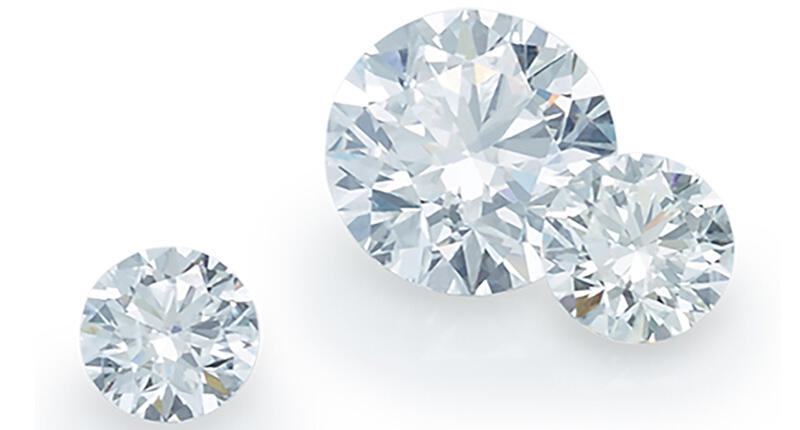
The word “cultured” can now be used to describe lab-grown diamonds, though it must be used in conjunction with other qualifying terms. Alterations to the accepted terms for man-made diamonds were one of the major revisions the FTC made to its Jewelry Guides.
New York—The Federal Trade Commission dropped the final version of its revised Jewelry Guides Tuesday, relaxing the rules surrounding lab-grown diamonds and metal alloys while creating standards for describing “composite” gemstones like lead glass-filled rubies.
The Jewelry Guides are guidelines the FTC provides on the terms used in marketing and advertising gems and jewelry.
While they are not official laws or regulations, JVC President Tiffany Stevens said those that do not follow the guidelines run the risk of being sued by a competitor, sued by a consumer and/or hit with civil penalties by the FTC.
The publication of the final version of the Jewelry Guides follows six years of back-and-forth between the industry and the commission, and many of the changes included do not vary greatly from the proposed changes the FTC released in 2016.
On Tuesday, National Jeweler spoke with Stevens and JVC Senior Counsel Sara Yood about the most significant changes to the guides, starting with the contentious battle over the terminology used to describe man-made diamonds.
1. The FTC is allowing the use of the word “cultured” in connection with lab-grown diamonds, but not by itself.
The FTC said cultured can be used in connection with lab-grown diamonds as long as it is “immediately accompanied, with equal conspicuousness” by one of the following terms: laboratory-created, laboratory-grown, [manufacturer name]-created, or by some other word or phrase of “like meaning.”
The commission said it received a total of 21 comments on this issue, and none of the commenters agreed with its position.
Lab-grown diamond sellers, like the Diamond Foundry and the International Grown Diamond Association, advocated for the use of the word cultured by itself, while other organizations, including the JVC and the Diamond Producers Association, pushed back against it.
They argued that lab-grown diamonds are not “natural” and using the word cultured would mislead consumers into associating the man-made stones with the organic process used to cultivate pearls.
In the end, the FTC opted to allow “cultured” into the lab-grown diamond lexicon but not without additional qualification.
2. “Synthetic” was removed from the recommended language for lab-grown diamonds, but that doesn’t mean it can’t be used.
Here’s what the FTC’s revised Jewelry Guides state about the use of the term synthetic: “Given the likelihood of consumer confusion, the final Guides do not include ‘synthetic’ among the examples of terms that marketers may non-deceptively use to qualify claims about man-made diamonds, thus eliminating the contradiction ... However, the commission does not ‘prohibit’ marketers from ever using ‘synthetic.’
“It lacks a sufficient basis for doing so because the evidence does not establish that the term would be deceptive in every instance. If a marketer uses ‘synthetic’ to imply that a competitor’s lab-grown diamond is not an actual diamond, however, this would be deceptive.”
Despite the elimination of the word synthetic, Stevens said overall the new guides allow for a wider range of terms to describe lab-grown diamonds.
Before, the guides advised marketers to stick to four terms when describing man-made diamonds: laboratory-grown, laboratory-created, [manufacturer name]-created and synthetic.
Now, marketers can use the first three above as well as other terms as long as they “clearly and conspicuously convey” that stone is not a mined diamond, the FTC said.
3. The word “natural” has been removed from the FTC’s official definition of a diamond.
The FTC originally defined a diamond as “a natural mineral consisting essentially of pure carbon crystallized in the isometric system.”
The Diamond Foundry advocated for the removal of the word “natural” and the FTC agreed, writing: “When the commission first used this definition in 1956, there was only one type of diamond product on the market—natural stones mined from the earth. Since then, technological advances have made it possible to create diamonds in a laboratory. These stones have essentially the same optical, physical, and chemical properties as mined diamonds. Thus, they are diamonds.”
Yood, however, said this is not as consequential as it may seem. The FTC is essentially saying that because the definition precedes the diamond section of the guides, and since diamonds are no longer just mined, it is removing “natural” so that the guidelines that follow apply to all diamonds, whether natural or man-made.
The FTC still holds that the terms real, genuine, natural and precious cannot be used for lab-grown stones.
“So if you are using the word ‘diamond’ unqualified, you are still talking about a natural diamond,” Yood said.
4. There is no longer a minimum fineness threshold to use the terms “gold” and “silver.”
Previously, Yood said, jewelry needed to be 10 karats or higher to be called gold in the United States, but that is no longer the case.
The FTC’s revised guides eliminated that threshold, meaning now 8-karat, or even 5- or 6-karat material, can be sold as gold in the U.S.
Held over, however, is the rule on karat fineness disclosure. Yood said if marketers describe jewelry simply as “gold,” then they are essentially saying it is 24-karat gold. The karat weight (14K, 18K, etc.) must be included with each piece that is not 24-karat gold.
In changing the rules, the FTC cited a 2016 Harris study that indicated a majority of consumers understand that the amount of gold in an alloy impacts its color, likelihood of tarnishing and corroding, overall durability, and resale value.
The study, “suggests most consumers will understand that a product containing less gold than traditional gold jewelry may perform differently from higher karat gold—i.e., that an 8K ring would have different color, performance, and resale value than a 14K ring,” the FTC wrote.
Regarding silver, there was a 925-parts-per-1000 minimum for sterling silver. Now, she said, there can be alloys under that amount, though a piece still has to be .925 to be called sterling silver and the fineness of the silver still has to be included with each piece, just as the karat weight of the gold does.
5. Rhodium plating must now be disclosed.
Yood said the JVC backed this change because many consumers who purchase white gold aren’t aware that it is rhodium plated, and that the plating will wear off but can easily be reapplied.
“This (change) is about consumers understanding the product they are purchasing and understanding that when it does wear away, it actually can be fixed,” she said.
6. There are now guidelines for describing what are known as composite gemstones.
Prior to the revision, the Jewelry Guides were not clear in regards to describing “composite” gems.
While the JVC is still seeking clarification on this section, what is clear is that it is no longer enough to just use the term lead glass-filled ruby.
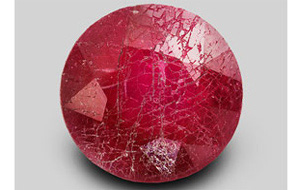
This file photo from American Gemological Laboratories shows a lead glass-filled ruby that was damaged during jewelry repair. Rules regarding the terms that can be used for composite gems, like lead glass-filled rubies, were among the changes included in the FTC’s revised Jewelry Guides.
Composite gems also cannot be described as treated or have any of the approved terms for lab-grown stones applied to them.
The FTC said the terms that are acceptable are: composite, hybrid or manufactured, as long as the terms are “effectively qualified to convey that the product does not have the same properties as the named stone and that it requires special care.”
7. “Yellow emerald” and “green amethyst” are no longer acceptable terms.
The “misrepresentation” of various varieties of minerals was another area addressed by the FTC in revising the Jewelry Guides.
Citing consumer confusion over the value of certain gemstones, the JVC pushed for, and won, a modification to the guides in which marketers are cautioned not to mark or describe a product using an incorrect varietal name.
The two examples mentioned throughout the section are “yellow emerald,” which is sometimes—but should not be—used to describe the gemstone more accurately known as golden beryl or heliodor, and “green amethyst,” which should be referred to using its correct name, prasiolite.
8. There is a new section on disclosure of treatments for pearls and cultured pearls specifically.
Under the old guides, the rules about treatment disclosure for colored gemstones—that treatments that are not permanent, need special care and/or have an effect on value—were generally applied to pearls too.
Yood said the JVC advocated for the FTC to add a separate section for pearls, and they did.
A complete version of the revised Jewelry Guides is available on the FTC’s website.
Stevens, the JVC president, said the committee is working on translating the new Jewelry Guides, which are 150-plus pages and rife with legalese, into a document that is compact and readable.
In addition, the JVC plans to hold a webinar highlighting the main changes to the guides in the future and will be speaking about them at upcoming jewelry trade shows and other jewelry events.
Michelle Graffis the editor-in-chief at National Jeweler, directing the publication’s coverage both online and in print.