Analysis of the Majors: This Is What Innovation Looks Like
In this article from the 2019 “State of the Majors,” we take a step outside the metaphorical jewelry box to see how non-jewelry retailers are tackling retail reinvention.
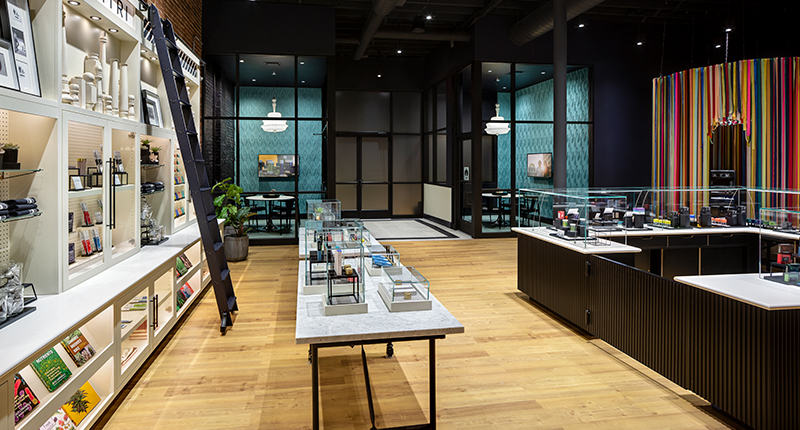
One example of innovation in retail are the cannabis dispensaries designed by Tempe, Arizona-based High Road Design Studio. Pictured here is Elevate, a space the company designed in Los Angeles. (Photo credit: Cadan Photography, Richard Cadan)
As with last year, the majority of North America’s largest sellers of fine jewelry saw sales rise year-over-year. But that does not mean retail, particularly jewelry retail, is without its challenges.
One of the biggest among them is ensuring your store’s physical footprint is right-sized, modernized and aligned with your online presence.
Click here to read the full story in the State of the Majors issue.
In this analysis of National Jeweler’s exclusive “$100 Million Supersellers” and “Top 50 Specialty Jewelers” lists from the 2019 “State of the Majors,” we examine how the largest sellers of jewelry and watches fared in 2018 while also taking a step outside the metaphorical jewelry box to see how non-jewelry retailers are tackling store innovation.
The leading five sellers of fine jewelry remained virtually unchanged from last year.
Signet Jewelers Ltd. ($5.64 billion in sales in North America) and Walmart Inc. ($2.76 billion) held onto the No. 1 and No. 2 spots, respectively.
Tiffany & Co. (No. 3, $1.62 billion) and Costco (No. 4, $1.59 billion) also remained in the top five.
The only change was luxury conglomerate Richemont, which owns Cartier and Van Cleef & Arpels along with a bevy of watch brands including Baume & Mercier and Vacheron Constantin.
According to researcher Edahn Golan’s calculations, North American watch and jewelry sales for the luxury conglomerate rose 22 percent year-over-year, pushing it to fifth place on the list and displacing Macy’s Inc., which slipped to No. 6 with $1.49 billion in sales.
Regardless of where they fall on the list this year, retailers of all sizes are grappling with the same questions: How many stores are needed?
What are consumers really looking for when they come into a store today? And what does it mean to have a store that’s also an “experience?”
To get answers to the second and third questions, National Jeweler consulted with retail design experts and visited a couple of non-jewelry retail stores.
What’s In, What’s Out Ask Norman Roberts what’s trending in retail design, and he’ll give you a pretty short answer—there is not one definitive trend.
Roberts is vice president and creative managing director in the New York office of FRCH Nelson, an architecture firm that specializes in retail. His roster of jewelry-specific projects includes major players like Neiman Marcus and Tiffany & Co., plus multiple remodels for independent London Jewelers.
He says there aren’t many specific, sweeping trends he can point to right now and say, “Everyone in retail is using this color,” or “Every successful store in America is crafting their showcases in this type of wood.”
A couple of micro-trends do come to mind for him, though. Dove gray is popular, as is the monochromatic look.
Eclectic is another word that kept popping up—and not just in reference to inventory.
“We’re living in an age where retailers, if they’re doing a good job, are really trying not to look like the [retailer] next door.” — Norman Roberts, FRCH Nelson
Roberts says for a long time in retail, the trend was for uniformity in a space.
The same metal or wood was used throughout a store, for example. Retailers would never have dreamed of placing mismatched showcases or two different kinds of flooring in their stores.
Today, they feel free to mix it up a little bit more, picking furniture, fixtures and palettes that coordinate with an area’s purpose, much like rooms in a home, rather than worrying about the whole store looking the same.
Roberts can also pinpoint one look that’s on the way out—the aesthetic best described as the “hipster,” “Brooklyn” or “ye ole shop” look, complete with distressed wood and tin ceilings.
“That’s definitely past its prime a little bit now. I think it got a little overextended.”
But overall, there’s not one look that rises above the rest in retail right now, and for good reason—retailers are trying to be unique.
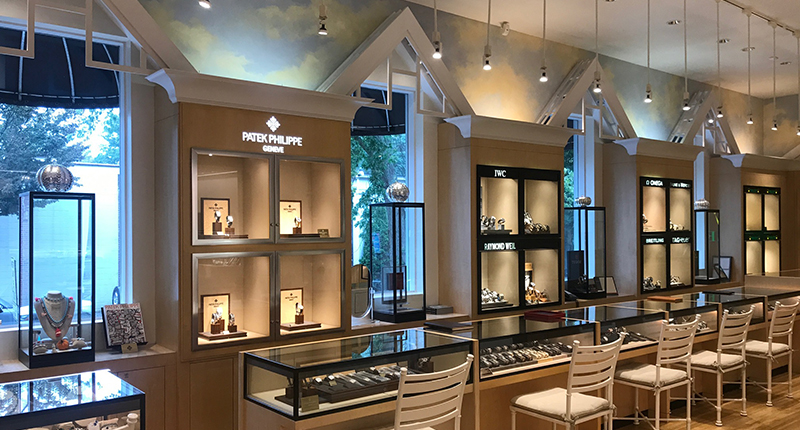
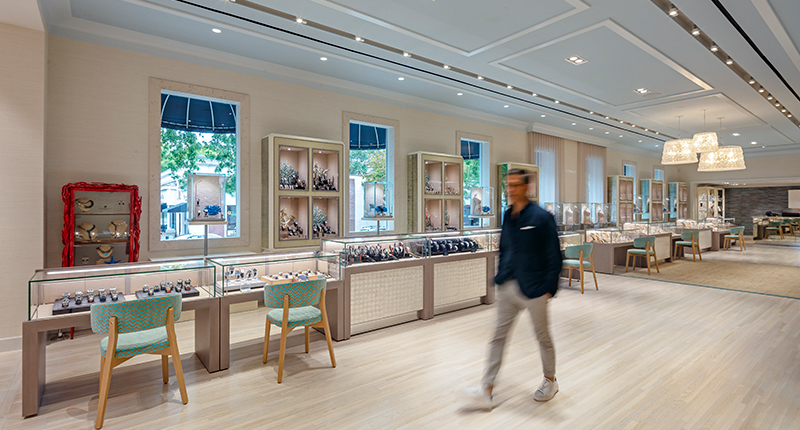
One of the jewelry retailers Norman Roberts worked with is independent London Jewelers. This is a shot of the retailer’s East Hampton, New York store before and after (below) FRCH Nelson’s retail redesign. (Photo credit, for both: Andrea Brizzi)
“We’re living in an age where retailers, if they’re doing a good job, are really trying not to look like the [retailer] next door,” Roberts says.
What they are doing, though, is creating retail spaces that are inviting and designed in a way that makes customers connect with them emotionally. Many have a more residential feel. With comfortable seating, coffee tables, cell phone charging stations and “residential lights,” such as sconces, chandeliers and table lights, stores are evolving from emphasizing commerce to conveying comfort and convenience.
Retailers are designing spaces to have a “less intimidating and more inviting” vibe, but Roberts acknowledges that aura can be tougher for jewelers to achieve.
So perhaps the industry’s best bet is to look outside for inspiration.
A Fifth Avenue Safari At the Jewelers of America National Convention in July, presenter Ken Nisch, chair of Southfield, Michigan-based design firm JGA, told attendees at his education session titled “Making the In-Store Experience Memorable” that they should embark on a “retail safari” to explore a variety of shops, not just other jewelry stores.
And so National Jeweler did just that, with a bona fide award-winning jeweler in tow.
This reporter ducked out of the convention one day with Calhoun Jewelers owner Cathy Calhoun, who had just been inducted into National Jeweler’s Retailer Hall of Fame (and who has been a pioneer in experiential retailing in the jewelry industry). We headed across town in a cab, to Fifth Avenue and 52nd Street.
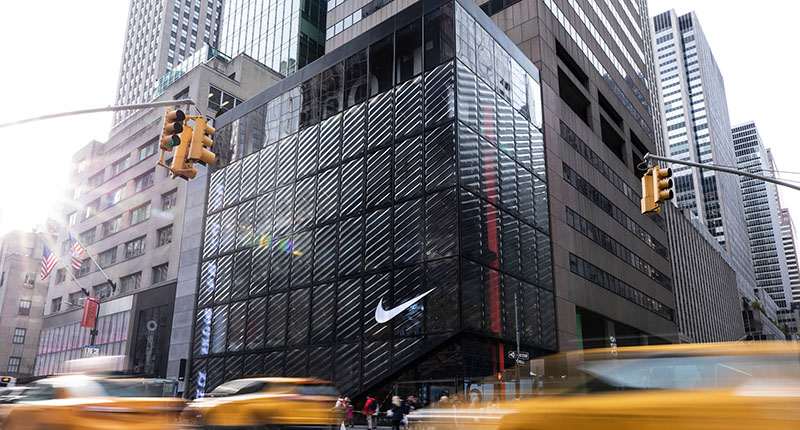
A shot of the exterior of the Nike House of Innovation 000 in New York, released by Nike around the time the store opened (Photo courtesy of Nike)
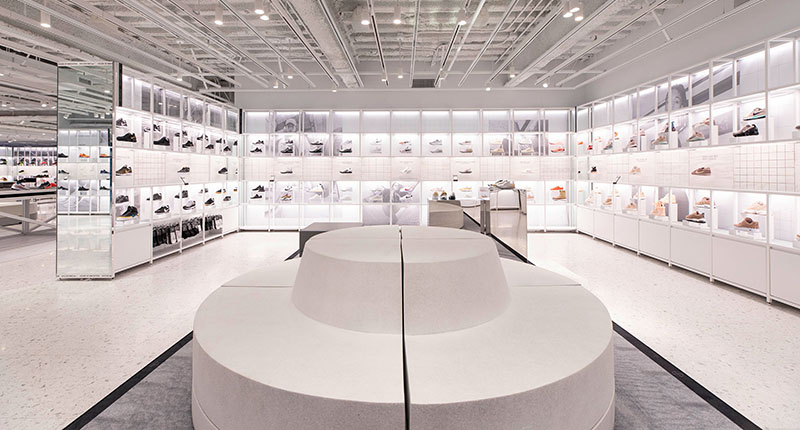
There, opposite the venerable old Cartier mansion, which was the height of experiential retailing a century ago and was recently renovated, sits the Nike House of Innovation 000, a 68,000-square-foot, six-level space that Nike described as “the pinnacle expression of modern retail” when it opened in November 2018 and that FRCH Nelson’s Roberts says is a “really important space in the history of retail.”
Calhoun and I spent a couple hours exploring the store, walking the ramps from the first level to the fifth, with the jeweler finding elements she could incorporate in her stores all the way up.
There was the seating in the bright-white Sneakerlab, which was so busy it looked like LaGuardia Airport in the midst of a throng of flight delays—but more fun. It was comfortable and featured changeable modules, which hit on a point Nisch had emphasized during his talk at the JA convention.
When retailers ask him how often they should renovate, he said: “Every morning.”
He didn’t mean a full-scale store overhaul but, rather, that retailers should think about having little things they can switch up all the time. It’s a smaller-scale version of the famed retail store Story, which completely transforms on a regular basis.
Calhoun liked the idea of changeable seating for her new store in Carmel-by-the-Sea, California.
“A big key is this seating set-up,” she said as we stood off to the side in the Sneakerlab, out of the crowd scrambling for shoes. “You can just sit and hang.”
“It’s comfortable,” she added, before keying in on an even better word, one the jewelry industry has had a difficult time embracing—casual.
The seating in the Sneakerlab is soft—it gives way, kind of like a training mat—and is modular. (Photo courtesy of Nike)
Jewelry store seating, Calhoun noted, “always looks formal. Maybe we’re doing it all wrong.”
On the fourth floor with the Sneakerlab was a digital “coming soon” board displaying yet-to-be-released Nike shoes. Why not have that feature in a jewelry store showing new pieces and when they’ll be available, Calhoun wondered?
On the top floor, Nike featured gear and a training program for runners who are participating in an upcoming local event, the 2019 New York City Marathon. This is something else a jeweler could do, she observed: tie their products into relevant local events.
Then there were the digital innovations in Nike’s House of Innovation.
Despite the fact that the store was as busy as a major airport, there weren’t long check-out lines because customers can make purchases using their smartphones via the Nike app. They can also use the app to request clothes be brought to a dressing room or shoes to one of the pick-up areas located throughout the store.
“We as jewelers really need to get our acts together,” Calhoun said as we neared the end of our store tour. “We’re totally left by the wayside already, and we know it.”
Heading for Higher Ground The weekend following the convention, I ventured out on another retail safari, this time with friends who were in from out of town.
They wanted to go to a CBD store on Broadway just north of the Flatiron Building to pick up some cannabidiol-infused products.
For the uninitiated: cannabidiol is one of the chemical compounds found in the cannabis plant; it can also be extracted from hemp, a plant in the cannabis family. Cannabidiol, which does not cause a high, is known for its therapeutic properties and, as of this writing, is legal to sell in New York City in some forms.
What I found was a retail space that, overall, could be described as calming, an aura in line with what the shop sells—essentially, wellness products.
Natural light flooded the front of the store. There was soft music playing, a nicely scented candle burning and a quiet area in the back for meditating, complete with a skylight that let in just enough sunlight. The saleswomen were friendly and helpful.
It was an unexpected stop on my Saturday but set me up for my already-scheduled interview the following week with Megan Stone, founder and owner of Tempe, Arizona-based High Road Design Studio.
Stone started her company in 2013 and, as some readers might have already guessed by the name, she and her three employees specialize in designing cannabis dispensaries in states where it is legal for medical and/or recreational uses.
High Road landed on design:retail magazine’s “Design Firms of the Year” list for 2018, and it’s easy to understand why when scrolling though images online of the various dispensaries she and her team have designed; they’re beautiful, modern-looking spaces.
Opinions about the increasing legality of cannabis aside, it’s clear that there are similarities between designing dispensaries and designing jewelry stores.
Both, Stone points out, involve showcasing small, delicate, high-cost items in a way that elevates their perceived value.
They also both involve keeping merchandise secure while at the same time making the shopping experience engaging and comfortable.
And dispensaries have the added challenge of being all-cash businesses. (Banks are federally insured so will not take on cannabis transactions while it remains outlawed on a federal level.)
One of the cannabis dispensaries designed by High Road Design Studio, Maitri in southwestern Pennsylvania. (Photo credit: Cadan Photography, Richard Cadan)
When Stone starts on a new project, she says the first thing she does is what all retail store owners should do when looking to redesign a space—she dives into the stories of the store’s clients.
Who is coming into the store, and why? How can we make them comfortable in the environment?
That means the dispensary she designs in Pennsylvania, where weed became legal for medicinal purposes only three years ago, is going to be completely different from a space she creates in Los Angeles, a more mature market where both medical and recreational use are allowed.
To combat the inaccessibility of the product, Stone has employed several tactics.
She says she has put out vape cartridges sans the oil or non-medical gummies for display. That way, customers can engage with the product while the most valuable part remains under lock and key, not unlike the way some jewelry stores have brass-and-glass models that customers can handle freely.
She’s also employed an idea she borrowed from lingerie chain Victoria’s Secret, which displays its innerwear on tabletops, with drawers on the sides for additional stock that’s sorted by size.
Stone says High Road can install a showcase with a glass top and drawers that’s similar in form and function.
Customers can see the various strains of cannabis available through the glass and can pull out the drawers to smell it or see the bud up close. When they decide on a particular strain, out of the locked case it comes.
Bringing It All Home While making the rounds of other types of retail stores is a worthwhile exercise for jewelers, there are some design elements they cannot copy because of security concerns.
“There’s a very different relationship in the space because from a design standpoint, you have to deal with a lot of locked cases,” FRCH Nelson’s Roberts says when asked about the challenges inherent in a designing a fine jewelry store.
Also, jewelry shopping traditionally was “fairly intimidating,” he says. “It’s a big purchase, there’s a lot of technical information.”
But the fact merchandise needs to be secured and explained doesn’t mean showcases have to be a mile long and positioned in such a way that staff and customers are separated.
Roberts says in some recent jewelry store renovations, the firm incorporated both 360-degree showcases (showcases that are freestanding and customer-facing on all sides) and single-sided showcases where customer and associate are next to each other and can have what he calls a “shoulder-to-shoulder” relationship while looking at pieces.
“Customers … looked at screens before they come, and they’ll look at screens when they leave. When they come to a store, they’re going there to talk to someone, to touch and to feel.” — Norman Roberts, FRCH Nelson
This makes customers, including the growing number of women shopping for themselves, feel like it’s more of a partnership and less like they’re on the receiving end of a lecture being delivered at arm’s length.
There is one element of modern retail, however, that Roberts does not like to incorporate too much of when designing jewelry stores—electronic screens.
High Road’s Stone says the same about too much in-store technology, noting that it can be a nuisance to maintain.
While technology is important behind the scenes and for salespeople to have at their fingertips to answer technical and inventory questions, Roberts believes jewelry stores don’t need screens everywhere.
They also don’t need to have the check-out-and-go technology used at the Nike House of Innovation or at Amazon Go, the e-commerce giant’s cashier-less grocery stores.
“In a luxury space, people still want more of a [sales associate-] involved experience,” he says, particularly at the conclusion of their shopping venture.
The final boxing, wrapping up and paying for a piece of jewelry should be special, something executed with a bit of ceremony.
It’s what the customer is looking for when she or he decides against an online purchase and chooses an in-store visit.
“Customers walk in with a lot of technology in their pockets,” Roberts says. “They looked at screens before they come, and they’ll look at screens when they leave. When they come to a store, they’re going there to talk to someone, to touch and to feel.”
Michelle Graffis the editor-in-chief at National Jeweler, directing the publication’s coverage both online and in print.