It’s been a tumultuous four years for jewelry retailers since National Jeweler last published its report on North America’s largest sellers of fine jewelry.
Clockwise from top left: Signet Jewelers, Tiffany & Co., Macy’s and Birks are among the 25 retailers that made National Jeweler’s 2016 list of $100 Million Supersellers.
Let’s start with the biggest change of all: Signet Jewelers Ltd. acquiring Zale Corp. in 2014, after years of both chains swallowing up independent regional players such as J.B. Robinson, Gordon’s and Weisfield Jewelers. Signet and Zale each were ringing up more than $2 billion in sales annually at their stores nationwide, which, combined, totaled more than 3,500 doors.
Click here to read the full story in the State of the Majors issue.
But there wasn’t room in the industry for two players of this size, and Zale was absorbed by its longtime rival. It was a move that Janos Consultants founder Ben Janowski calls the “culmination of consolidation,” the zenith in a string of acquisitions among the country’s major chains that began back in the 1980s. Both he and industry analyst Ken Gassman agree--it was a long time coming in jewelry.
The industry, say these analysts, was late to the party of retail consolidations that already had compressed myriad other categories, including consumer electronics, hardware, office and pet supplies.
Signet, with 3,122 stores and $5.8 billion in sales for its fiscal 2016 year (ended Jan. 30, 2016), sits atop both of National Jeweler’s lists, the “$100 Million Supersellers” and “Top 50 North American Retail Jewelry Chains by Store Count.” Other chains aren’t even close.
The company sold twice as much fine jewelry as its closest competitor last year (Wal-Mart Stores Inc.,with an estimated $2.54 billion in jewelry sales for fiscal 2016, ending Jan. 31, 2016). Signet also had nearly 10 times as many stores as the next specialty jewelry chain (Fred Meyer Jewelers, with 323).
It’s good to be king, or so Mel Brooks and Tom Petty tell us. And indeed, Signet does have some advantages that allow it to maintain the title of world’s largest retailer of diamond jewelry by sales volume. The company is a De Beers sightholder, member of the Alrosa Alliance and Rio Tinto Select Diamantaire. The company also has its own cutting and polishing factory in Botswana, as well as a liaison office in Mumbai, giving it a consistent supply of diamonds in the qualities it needs.
A retailer of this size also wields tremendous buying power and has a big marketing budget, allowing Signet to dominate the airwaves and internet, keeping phrases such as “Every kiss begins with Kay” and “He went to Jared” top of mind among consumers.
However, being in retail today presents many challenges, whether it’s a chain the size of Kay Jewelers, a retailer with rock-solid brand equity like Tiffany & Co., or a one-store mom-and-pop shop.
Retailers today must give consumers--who can buy almost anything from the comfort of their couches--a reason to come into stores and compete for their dollars in a culture with a shrinking middle class and a growing desire for experiences over ownership of material objects.
“Retail,” Janowski observes, “has become the province of the daring.”
The “Third Wave” When examining National Jeweler’s 2016 “$100 Million Supersellers” list (analyzing 2015 sales), the first thing some readers might scan for are the online-only retailers, long the nemesis of brick-and-mortar store owners.
How many more are on this list versus the list National Jeweler published four years ago? And how many brick-and-mortar stores got bumped off because of them?
The 2016 “$100 Million Supersellers” list contains four online-only retailers: Amazon.com Inc. (No. 9), Blue Nile Inc. (No. 19), JamesAllen.com (No. 28) and Overstock.com Inc. (No. 34). That’s two more than were on the list in 2012, with James Allen and Overstock the newcomers.
There are two ways to look at these additions.
Yes, the number of online-only retailers that are $100 million supersellers technically has doubled, and Amazon has moved up seven spots, from No. 16 in 2012 to No. 9 this year.
However, their number remains relatively low--four out of 35 companies, or 11 percent of the list--and Gassman maintains his longheld theory that for the foreseeable future, the amount of jewelry bought online will cap at 10 percent, meaning that he expects 90 percent of jewelry purchases still will take place in stores.
Then there’s what we’ll call the “third wave” factor.
“At the end of the day, we must be able to engage our customers wherever and whenever they choose to (shop). And therefore we see omnichannel being a critical part of the jewelry experience.” --Mark Light, CEO, Signet Jewelers
In its recent white paper, “Alibaba Saves the Store,” customer experience and marketing agency WD Partners introduced its theory about the three waves of retail in the United States.
The first wave began in the late 1700s, when the first formal stores began to replace market bazaars. It consisted of mom-and-pop merchants with an emphasis on quality, personal service and ties to the local community.
The second wave of retail came crashing in around 1950, with the rise of mass-market retailers, malls and, later, the explosion of big-box retailers like Target and Walmart.
According to WD Partners, that wave now is receding as technology and “digital native” consumers push retail into its third wave, characterized by a desire for quality items, an outstanding shopping experience and personalized customer service, says Lee Peterson, WD Partners’ executive vice president of brand strategy and design.
“The third wave is all about what we are calling ‘better is better,’” better product, better employees, better store design, he says.
That means it’s not just about online vs. off-line but, rather, which companies are better at checking all the boxes, delivering the right product at the right time and in the way the customer wants to receive it.
That’s why brick-and-mortar retailers are upgrading their websites and giving customers the chance to buy online and pick up in store, or buy online while in the store and have it delivered to their homes.
At Signet, CEO Mark Light said in an email interview with National Jeweler, its goal is to create an omnichannel experience that’s best in class, knowing that “customers interact with us first online.”
The focus online is on personalization, showing customers products based on what they bought or looked at and aligning the online and in-store buying experiences.
“At the end of the day,” Light says, “we must be able to engage our customers wherever and whenever they choose to (shop). And therefore we see omnichannel being a critical part of the jewelry experience.”
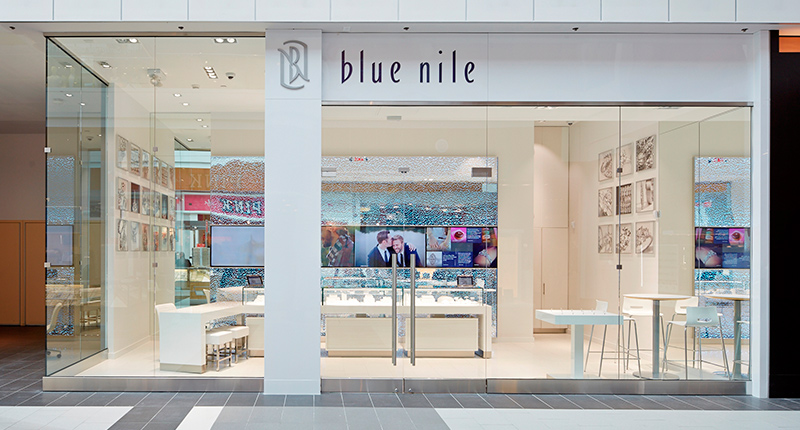
Online retailer Blue Nile opened its first “webroom” at the Roosevelt Field mall in Garden City, N.Y. in June 2015. It is slated to have a total of five brick-and-mortar locations by the end of 2016.
The need to provide the desired experience also is why online-only retailers have been experimenting with brick-and-mortar spaces.
As of this writing, Amazon reportedly is planning to open more pop-up shops and Blue Nile is set to have a total of five “webrooms” by the end of 2016.
“It’s becoming clear that a segment of our customers wants our … experience in a physical environment,” Blue Nile CEO Harvey Kanter, who declined to be interviewed for this story, said on the company’s August 2016 earnings call. “We are bringing the online and off-line worlds together.”
Direct Distribution The desire to deliver a very specific experience to consumers also is why many formerly wholesale-only suppliers and brands say they are now selling direct online or opening their own stores.
Giuliano Iannaccone, a partner at the New York law firm of Tarter, Krinsky & Drogin LLP, who chairs the firm’s international and retail practice groups, points to a pivotal scene in the movie Joy to explain why many brands are taking their business direct to consumers.
In the film, Jennifer Lawrence plays self-made millionaire Joy Mangano, who puts her family’s security on the line to produce the self-wringing mop that she invented.
But Mangano’s big break on QVC almost is ruined when the home shopping host selling her mop is a terrible flop.
He doesn’t know how to “push” the mop, both literally and figuratively, so Mangano takes control. She convinces QVC to let her present the mop to the public; she is the one who invented it, after all, and she is the one who knows exactly how to sell it. It works.
“That exemplifies in a very simplistic and very direct way what drives the shift from letting someone else handle your mop and doing it yourself,” Iannaccone says.
Brands say they know that today’s consumers, particularly the all-important millennial crowd, are much more selective about the brands with which they do business.
Their reasoning for going direct, through an e-commerce site or with brick-and-mortar locations, is to make sure brand messages are communicated clearly and merchandise is displayed in a way that best embodies the spirit of the brand.
These companies are not abandoning their retail partners entirely, but they’re not entrusting their entire business to them either.
It should come as no surprise, then, that a few of the jewelry industry’s most well-known wholesale brands are now “Supersellers” and sizable chains in their own right.
According to National Jeweler’s 2016 “$100 Million Supersellers” list, Swarovski AG, for example, sold an estimated $138 million in its 150 North American stores in 2015.
David Yurman Enterprises LLC, started by David Yurman, the sculptor-turned-jewelry designer who once traveled the country himself to sell his silver jewelry to independent jewelers, now has more than 40 of its own stores in North America.
Then there’s Pandora, the Danish bead and jewelry brand that’s the subject of ire among many independent jewelers. Retailers feel they built up the brand only to have Pandora pull the rug--or, more precisely, the beads--out from under them by opening a competing shop next door.
In 2015, Pandora sold $116 million in beads and other jewelry at the 51 company stores it now operates in North America, ranking No. 32 on the Supersellers list and No. 20 on the Top 50 by store count list.
On its quarterly earnings calls, Pandora continually stresses the importance of company-owned and –operated concept stores and heavily branded shop-in-shops over placing its product into the showcases at less heavily branded retail stores.
“The writing’s on the wall. There’s going to be a lot fewer stores (going forward). I don’t care what category you are in.” --Lee Peterson, WD Partners
Another reason that brands are going direct to the public is due to the growing availability of retail space, Iannaccone says.
It’s no secret that malls, particularly those serving middle- and working-class Americans, have fallen on hard times. Eerily sad photos of these one-time cultural centerpieces in ruinous condition are all over the internet.
But it’s not just mall stores that are struggling.
As WD Partners’ Peterson put it, “The writing’s on the wall. There’s going to be a lot fewer stores, a lot fewer stores (going forward). I don’t care what category you are in.”
Jewelers Board of Trade data, which includes the big chain jewelers as well as mom-and-pop shops, shows that the number of retail jewelers/repairers that closed their doors in 2015 was 760, up 24 percent from 2014.
The widespread store closures mean there’ll be a lot of retail space available in a market where demand is soft, bringing down prices and perhaps encouraging physical experimentation, whether it’s a pop-up shop from Amazon, a webroom from Blue Nile or a permanent store with a new concept.
“In a situation where more square footage becomes available at more affordable prices, it might facilitate the decision to say, ‘you know what, let’s try it out,’” Iannaccone says. “Innovative companies are very good at capturing opportunity, and this is an opportunity.”
Michelle Graffis the editor-in-chief at National Jeweler, directing the publication’s coverage both online and in print.