Rose-cut cabochon Montana sapphires from Columbia Gem House. In her State of the Majors story, Associate Editor Lauren McLemore highlights non-traditional gemstone cuts and other trends shaping the colored gemstone market.
Editor’s Note: This story first appeared in the print edition of the 2024 State of the Majors. Click here to see the full issue.
With endless rows of showcases, enthusiastic vendors, and seemingly bottomless inventories to peruse, the Tucson gem, mineral, and fossil shows attract onlookers, buyers, and designers from all corners of the colored gemstone universe.
At AGTA GemFair Tucson 2024, conversations with exhibitors and the organization’s education sessions brought color and clarity to the current state of the market.
Here are the top takeaways from a week of sit-downs and seminars with the experts in the desert. A Taste for Finer Things “If you see a gemstone, especially in finer quality at this [Tucson] show, this is the time to buy it,” Stuart Robertson, president of Gemworld International Inc., encouraged the audience during an education session on the near-term outlook for the gemstone market.
Robertson, who is also research director for the company’s publication, GemGuide, addressed the audience alongside GemGuide Editor-in-Chief Brecken Branstrator.
Though the room was full of people tuning in to get a broad overview of the gemstone market, several attendees were also hoping for a discussion on the higher-than-usual prices.
Robertson’s early remarks addressed the topic, stating that right now, in the fine and extra fine gem-quality categories, there’s simply not enough material to produce the type of pressure needed to push prices down.
“Our biggest concern right now with the market is that [it has] simply nowhere close to the production levels it had before the pandemic, so the idea that an influx of material is going to help alleviate price pressures is unrealistic,” said Robertson.
“If anything, prices will hold stable, possibly even continue to move up in those categories, because there just isn’t the production to support any negative movement.”
One category still heavily affected by lags in production due to pandemic challenges is pearls. The State of Pearls “Pearls, in general, were probably the most hard-hit of any product during the pandemic,” Robertson said.
Information on the gem wasn’t included in his original presentation, but the topic quickly came up during the Q&A that followed.
“Pearl prices are very high now because they lost entire seasons of production [during the pandemic] in most of the main categories—Tahitian, South Sea, and Akoya,” he explained.
His expectation is that pearl prices will remain high for about three to four years before moderating.
Back in October 2023, Ray Mastoloni of pearl company Mastoloni confirmed a production-related shortage of the above-mentioned goods in Europe and the United States, where pearls also are trending in fashion.
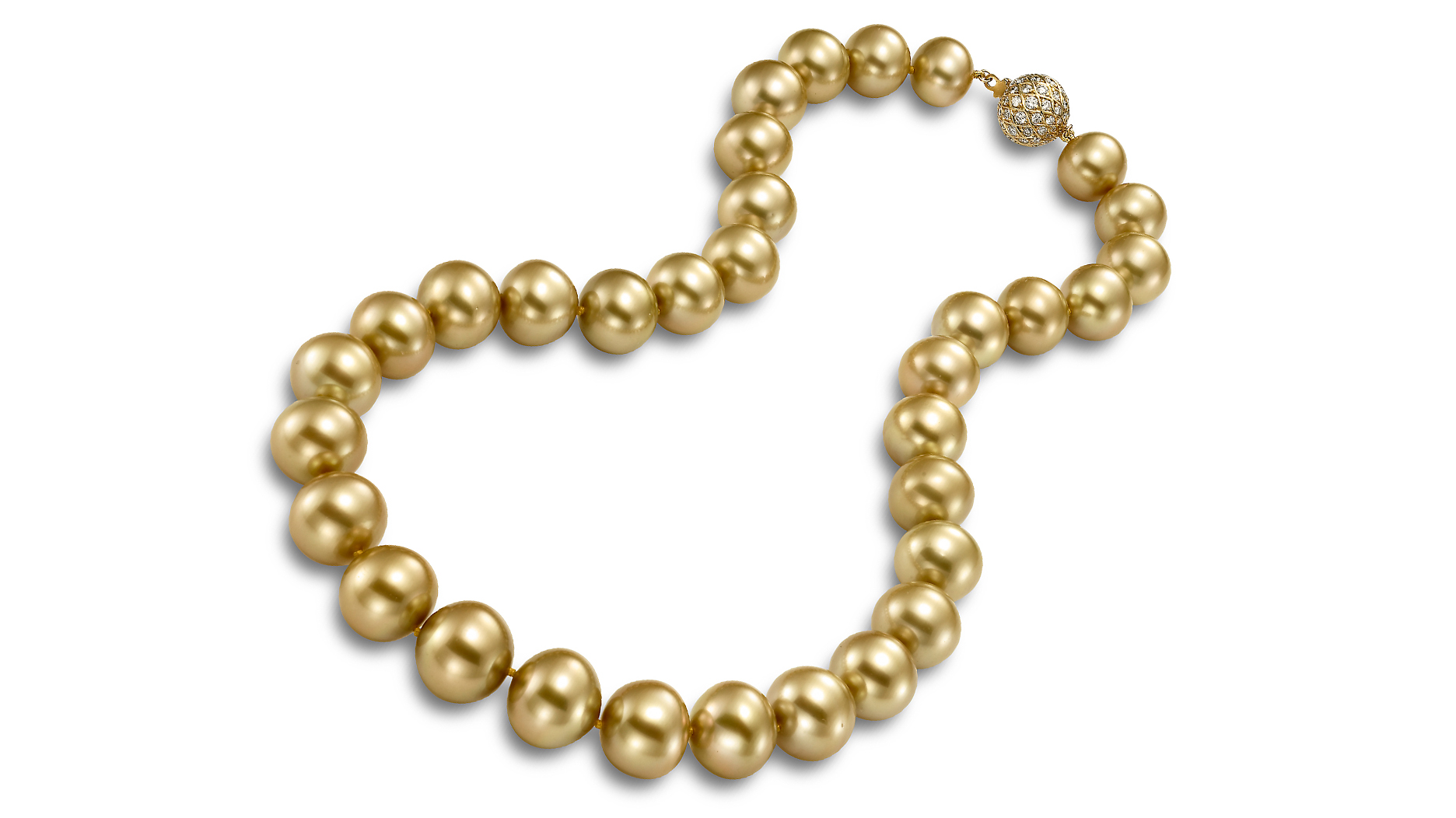
A strand of golden South Sea pearls from Mastoloni
Perhaps inconveniently, the precious gem was simultaneously gaining popularity in another region.
“There has become a huge demand for these pearls from China. The Chinese market is very hot on pearls at the moment, and they’ve been buying up anything [of a reasonable quality] they can get their hands on,” Mastoloni said in an interview with National Jeweler late last year. “It’s forced the price way, way high, and the Chinese are paying huge prices for goods.
“Because of our relationships [with suppliers], we still get merchandise. We don’t get a lot, but we get enough.”
While there’s a typical ebb and flow to the market, Mastoloni noted that it’s unusual to have such high demand centralized in one place.
Joshua Israileff, vice president of operations for his family’s pearl supply business, ASBA USA, witnessed the oddity firsthand.
“By the time we arrived in Hong Kong in September, it was like people pushing [each other] over for hot cakes,” he says.
He says his mother, Dominique Israileff, said she’s never seen it like this in the 40 years she’s been in the business.
“There was a demand unlike [anything] we’ve ever seen,” Joshua adds. “We get it, they’re selling a lot, but we don’t get why.”
Joshua theorizes the mania is, in part, related to the production delay.
He also cites the extraordinary influence of Chinese actress and influencer Ni Ni, who embarked on a unique, pearl-focused social media campaign while promoting her latest film, “Lost in the Stars.”
Joshua says the annual Robert Wan auction, scheduled to take place in Hong Kong in September, was canceled a day ahead of time because a private Chinese dealer paid significantly above the asking price for all the Tahitian pearls offered.
“It’s definitely between 50 and 100 percent more expensive [to buy pearls],” he says. “What you really can’t find anymore is the gem-[quality] goods. The super-nice stuff, that’s the stuff that’s getting harder.”
The Elusive ‘Big Three’ Like high-end pearls, top-quality gemstones are also getting more difficult to obtain.
AGTA CEO John W. Ford Sr. also commented on rising prices in the opening session of GemFair’s education series, which he presented with Martin Rapaport, chairman of the Rapaport Group.
“In general, the [rising] price of fine gemstones across the board is just [astounding]—there doesn’t seem to be an end to it. There are transaction prices I’ve never seen happening before that are happening,” Ford told the audience.
Rubies, sapphires and, to a lesser extent, emeralds, commonly referred to as the “Big Three,” are seeing the biggest jump.
“They’re all up, but sapphires would probably give you the most sticker shock as you’re walking around the show,” Ford said.
Sapphires, particularly blue sapphires, continue to be the top seller in the Western market, Robertson said in his presentation with Branstrator.
“Blue sapphire prices we see, at the very least, having support now in the finest qualities and probably ticking upward.”
Rubies are a different conversation. Without supply of Burmese material, ruby is regarded as basically a one-source stone at this point, Robertson said.
“[Ruby] has gotten expensive enough to really limit its accessibility in the larger part of our industry,” he said. “It’s a specialized market at this point. Sophisticated buyers recognize the rarity of fine ruby.
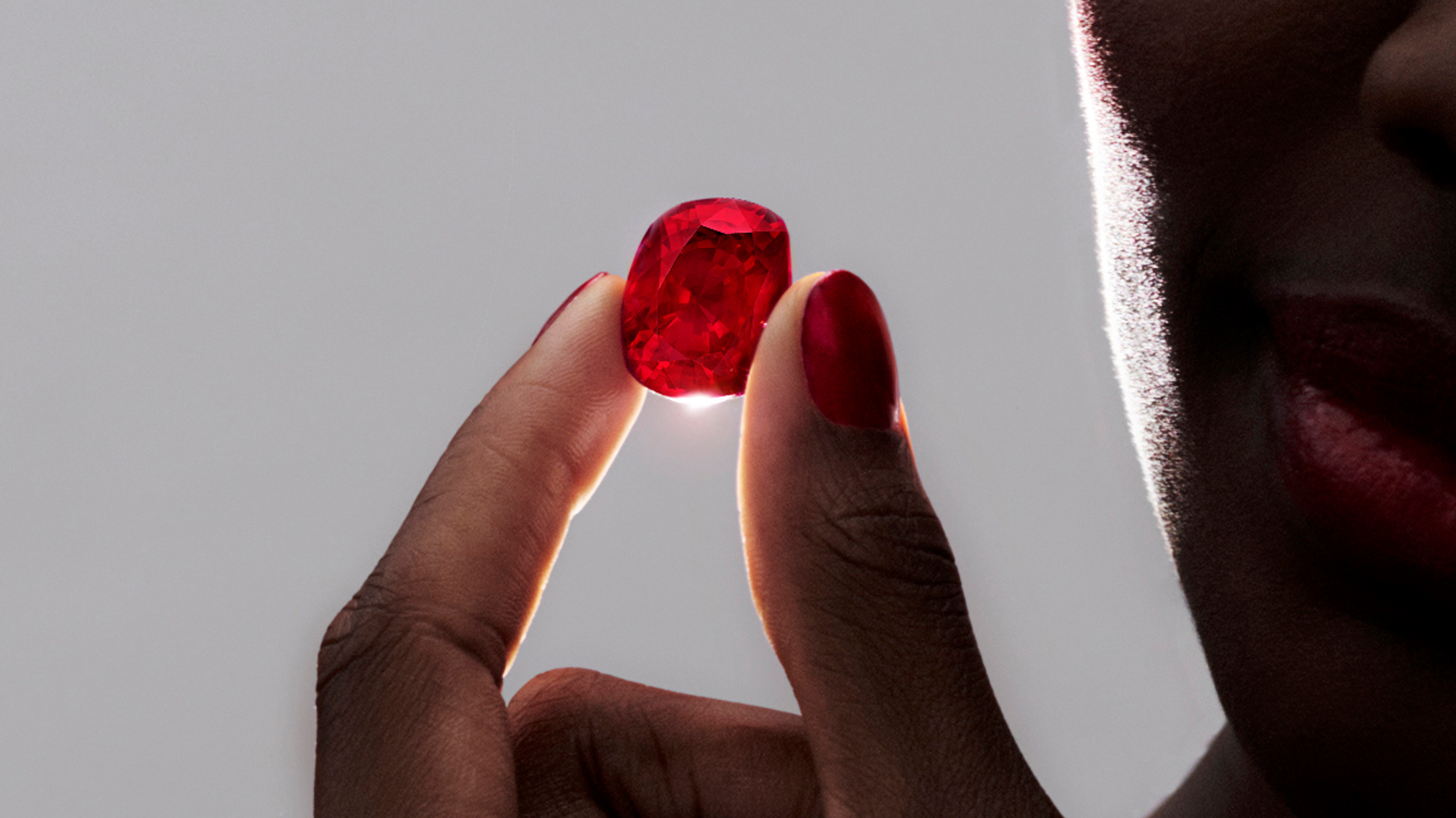
The Mozambican ruby “Estrela de Fura 55.22” sold in June 2023 for $34.8 million ($630,288 per carat), a world record for any colored gemstone sold at auction.
“Ruby [prices], we think, have probably leveled off but will find support in the high end just because of the mechanics of how it’s put forward.”
The Big Three’s price spike appears to be leading to increased interest in—and, on some level, increased prices of—gemstones of similar colors, as some in the market search for alternatives.
For example, red spinels, which can look like rubies, garnered much interest at the show.
David Nassi, president of 100% Natural Ltd., notes the increased attention on the gemstone.
“Blue sapphire [prices] are up, I would say, at least 50 percent as well,” he confirms. “But to me, the other things that are increasing at a faster pace are spinels and other alternatives to Burma rubies and sapphires.”
Robertson isn’t surprised by the trend. He said there is interest in spinel along with other similarly colored gemstones typically offered at lower price points, like rhodolite garnet and rubellite.
A Diamond Alternative The topic of high prices leading consumers to look elsewhere sounds similar to conversations happening in the diamond market right now, as lab-grown diamonds are positioned as a price-conscious alternative to natural diamonds.
However, lab-grown stones don’t have the same kind of appeal as alternatives in the colored stone market, which saw those disruptions a century ago.
“What we see at AGTA, of course, is expansion and demand for color. We think it’s going to go into the wedding ring market.”— John W. Ford Sr., AGTA
“We’ve already worked all of that out of our system. Synthetics are just another category in the colored stone industry. They’re not a threat to it at all,” Robertson said during his presentation.
In fact, natural colored gemstones are expected to become preferable to lab-grown diamonds for buyers seeking a less expensive alternative to a natural diamond.
“What we see at AGTA, of course, is expansion and demand for color. We think it’s going to go into the wedding ring market. We think there's going to be some changes far as people going for lab-created diamonds [opting for color instead]; we see that expansion happening,” the association’s CEO Ford said in his presentation at GemFair.
While Jennifer Lopez's natural green diamond engagement ring from Ben Affleck is well-known, non-diamond natural colored gemstones are gaining popularity as alternative engagement ring choices in pop culture. Take, for example, the sapphire-studded engagement ring actress Zooey Deschanel received last year from partner Jonathan Scott.
Branstrator, who presented alongside Robertson, said, “More brands are entering the colored stone market than ever before, I think especially designers who traditionally were using only diamonds, so good news for us.”
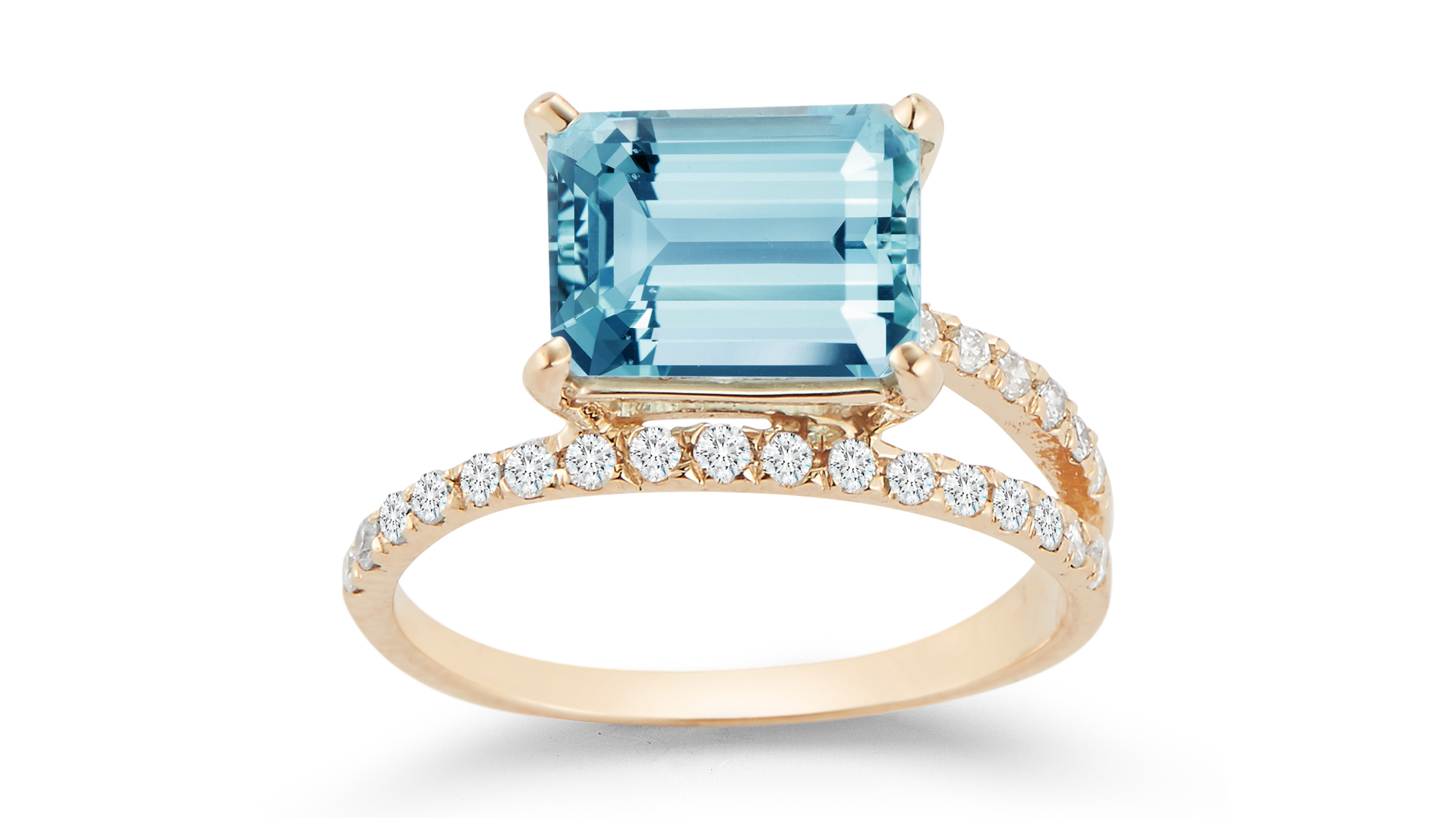
A blue topaz engagement ring from Mateo New York
While red spinel’s price jump is partially attributed to it being an economical option for a ruby-colored gemstone, people are also beginning to find value in stones with colors beyond red, blue, and green.
As accessibility to the Big Three dwindles, the shift appears to coincide with another, steadily rising, trend—a growing desire for individuality.
Something No One Else Has Branstrator clocked the timely intersection of trends last year.
“We started hearing in the fall, especially at the Hong Kong show, that there was some price resistance happening to some of the more expensive stones, and I think that that’s going to combine with this trend we’ve seen of consumers wanting new and interesting stones,” she said.
The colored stone industry is in the midst of what should be its greatest opportunity, according to Robertson, who noted the “enormous amount” of new stones and colors that have become more visible and more accepted in society in the last few decades.
Much of the growing interest in spinel is due to the colors in its palette that resemble, well, nothing else.
“People are realizing spinels have all these other colors, like these bright, vivid pinks and blues, and it’s generating a lot more attention,” Nassi, of 100% Natural Ltd., says.
“Now, you see the pink spinels, the bright spinels, are priced even higher than the reds, which were traditionally the strongest [color of] spinel.”
Nassi thinks this is a good thing, a signal of open-mindedness about gemstones.
“People are, I think, having a more independent view of stones … people are starting to think for themselves and say, ‘I like that color and that’s attractive to me,’” he says.
Robertson confirms, having said in his talk, “We shouldn’t focus on our own interpretations of what material should be; the consumer market is hungry and has an appetite for really unusual material now, and the gemstone palette is so wide as far as its colors that it is the time to really be adventurous with what gets put forward in front of the consumer.”
He touched on several gems that are expected to continue to generate interest.
Zircon, which comes in nearly every color of the rainbow, is popular among both young designers and more traditional independent retailers.
Robertson also mentioned tourmaline, tsavorite garnet, beryl, and topaz.
Related stories will be right here …
It should be no surprise that sapphires also are benefiting from consumer interest in gemstones with a wide-ranging palette. Blue sapphires are doing well, per usual, but there’s also a demand for padparadscha, though availability is limited.
One type of sapphire sourced in the United States stands out for its uniqueness and variety of color options.
“Montana sapphire is a very popular sapphire right now, especially in the North American market,” Robertson said. “We do think this is going to again be a year where Montana performs particularly well.”
Imperfectly Perfect Stones It isn’t just new colors being sought after; it’s a whole range of material the market hasn’t pushed in the past.
Especially among designers, there’s a call for something a bit more interesting, even if that means selecting less-than-perfect stones that traditionally would have been rejected for their flaws.
“We’d categorize this almost as a movement,” says Natasha Braunwart, brand and CSR manager at Washington-based wholesaler Columbia Gem House.
“We also think there’s a bit of a retro-inspired or even Etruscan-inspired [design trend] surfacing in the design world that celebrates the flaws and the organic details of the gems rather than the perfectly flawless style.”— Natasha Braunwart, Columbia Gem House
There’s less of what her father, Columbia Gem House founder Eric Braunwart, has seen in terms of that race to obtain a perfectly cut, perfectly clear gem with no flaws.
A common result of a less-than-flawless gemstone? A cabochon cut.
In these, Columbia Gem House offers a variety, including bullet cabs, cone-cut cabs, and another style they call arch cabs.
Natasha says throughout the Tucson show, they received a number of requests for creative cabochons and will be doing custom cutting for customers.
The company even ordered additional cabochons in the middle of the show because of specific requests, particularly calibrated mini-cabs in 1.5-2 or 3 mm sizes, Natasha notes.
She sees both big and small designers, “moving away from a flawless perfect gem toward a more natural realm.”
At the show, the company also offered two new carved gemstone collections, “Occult” and “Zodiac,” which generated interest.
“On one hand, I think working with cabochons, particularly those that are carved, allows designers to get really creative [and] offer a unique piece in an accessible price range,” Natasha says.
While it can be cost effective, it’s also an artistic choice.
“We also think there’s a bit of a retro-inspired or even Etruscan-inspired [design trend] surfacing in the design world that celebrates the flaws and the organic details of the gems rather than the perfectly flawless style,” she says.
Branstrator also sees unique cuts becoming more popular, even beyond the typical “fun cuts,” like kites and hexagons.
“I think that’s leading to this growing appreciation with independent designers who are finding their own designs, their own cuts, new ways to do things,” she said in her AGTA talk.
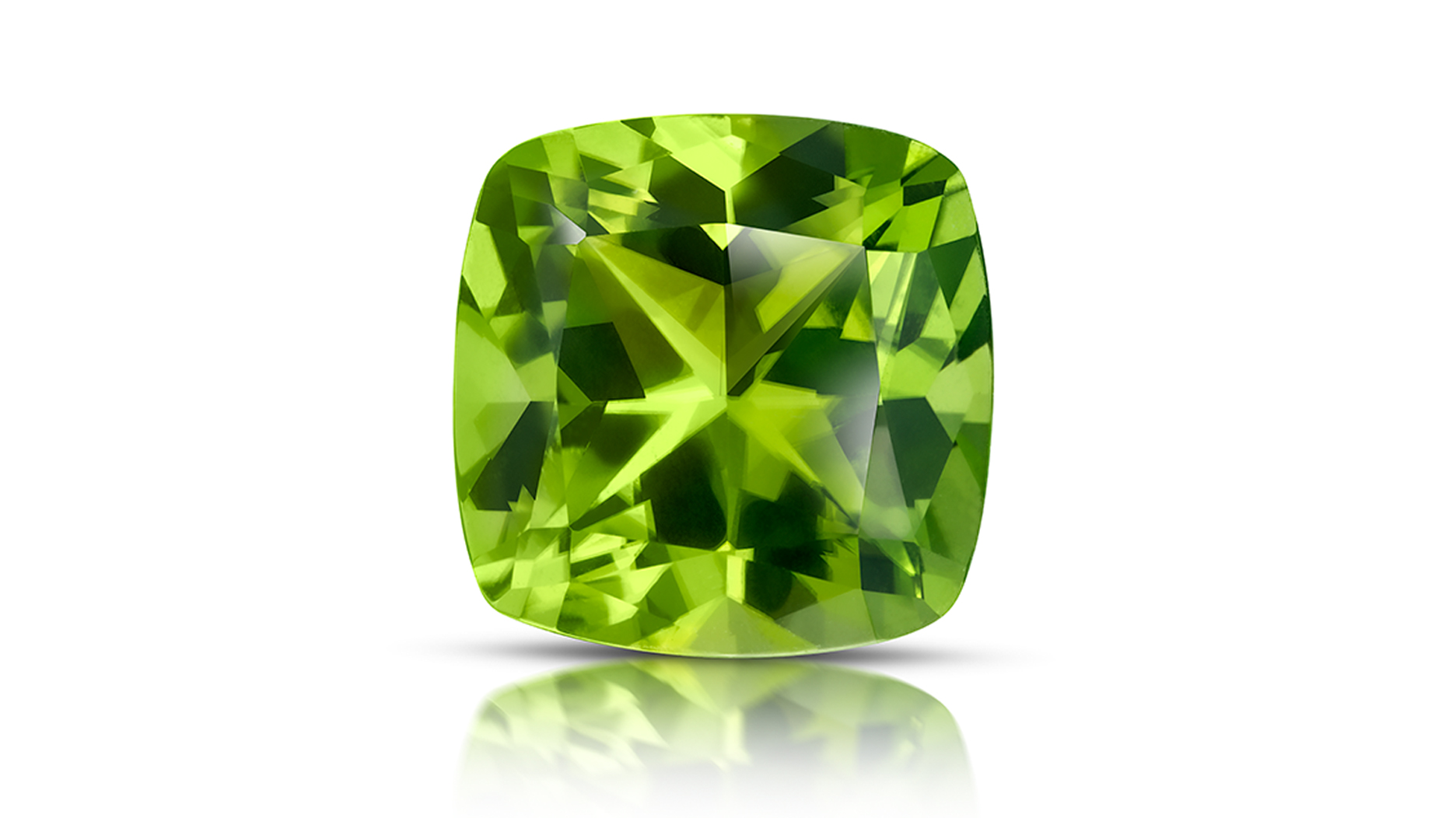
Another trend she noted was the emergence of re-marketed cuts for traditional stones, such as the “Fuli Cut” from peridot miner Fuli gemstones, which is based on an antique cushion.
Peridot miner Fuli Gemstones introduced the "Fuli Cut," which is based on an antique cushion, in 2023.
Navneet Gems, which exhibited at the GJX show, said it had a great response to its recently debuted portrait-cut rubies.
“I think cutting is going to be a really interesting space to watch this coming year,” Branstrator said. The Story Makes the Sale Some credit for recent purchasing trends undoubtedly has to go to the creative marketing behind the gemstones.
Imperfect stones require a bit of leaning in. For example, instead of avoiding drawing attention to a gemstone’s inclusions, maybe a seller chooses to enhance and market its interesting clarity characteristics.
“Like, with sapphire, maybe [a cutter] puts the growth zone right under the table and you market that as an interesting component to the stone rather than trying to hide it,” Branstrator said.
Unsurprisingly, responsible sourcing also remains a hot topic in marketing, as more and more designers and retailers are conscious of where their stones are coming from and use that information as part of their storytelling.
“I think we’re going to see a lot more people at later ends of the supply chain traveling to the source to understand exactly how that’s working. We’ve also seen a few more companies launch within the past year to offer this service to interested designers and retailers,” Branstrator said, mentioning the nonprofit Gem Legacy as an example.
While telling the stories around how and where gemstones are sourced is becoming more prevalent in the fine jewelry industry, the rules around the use of terms such as “responsibly sourced,” “sustainable,” “recycled,” and “eco-friendly” are set for an overhaul.
In late 2022, the Federal Trade Commission voted unanimously to revise its “Green Guides,” the guidelines that dictate the use of environmental claims in marketing, for the first time since 2012.
It opened up the process to public comment, accepting input on the guides through late April 2023.
Sara Yood, deputy general counsel at the Jewelers Vigilance Committee, says the FTC has not provided any updates on when it expects to respond to the comments, nor has it said anything publicly on the topic since mid-May, when it held a recycling workshop in Washington, D.C.
She says the FTC can proceed in one of three ways: releasing a draft set of revised guidelines for review and comment, releasing an additional set of questions for review and comment, or holding additional workshops on particular topics.
“Unfortunately, we have no idea when this will happen, but it is eagerly anticipated,” Yood says.
In the meantime, one undeniably “green” practice—that of buying and selling existing jewelry—continues to gain momentum in fine jewelry as consumers, particularly younger consumers, aim to fulfill their desire for something that’s both unique and sustainable.
“[AGTA’s] largest growing segment of membership is estate dealers,” Ford said during his talk at the show.
“Some of those goods are being repurposed in melee. Some of the goods are hopefully generational and they’ll find that next new home. The market is changing; the world is changing.”