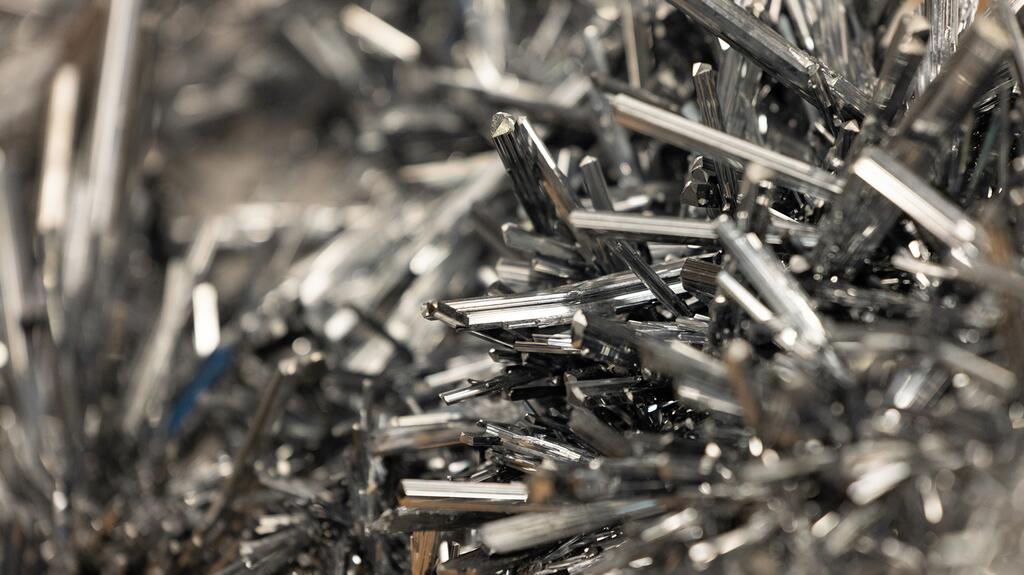
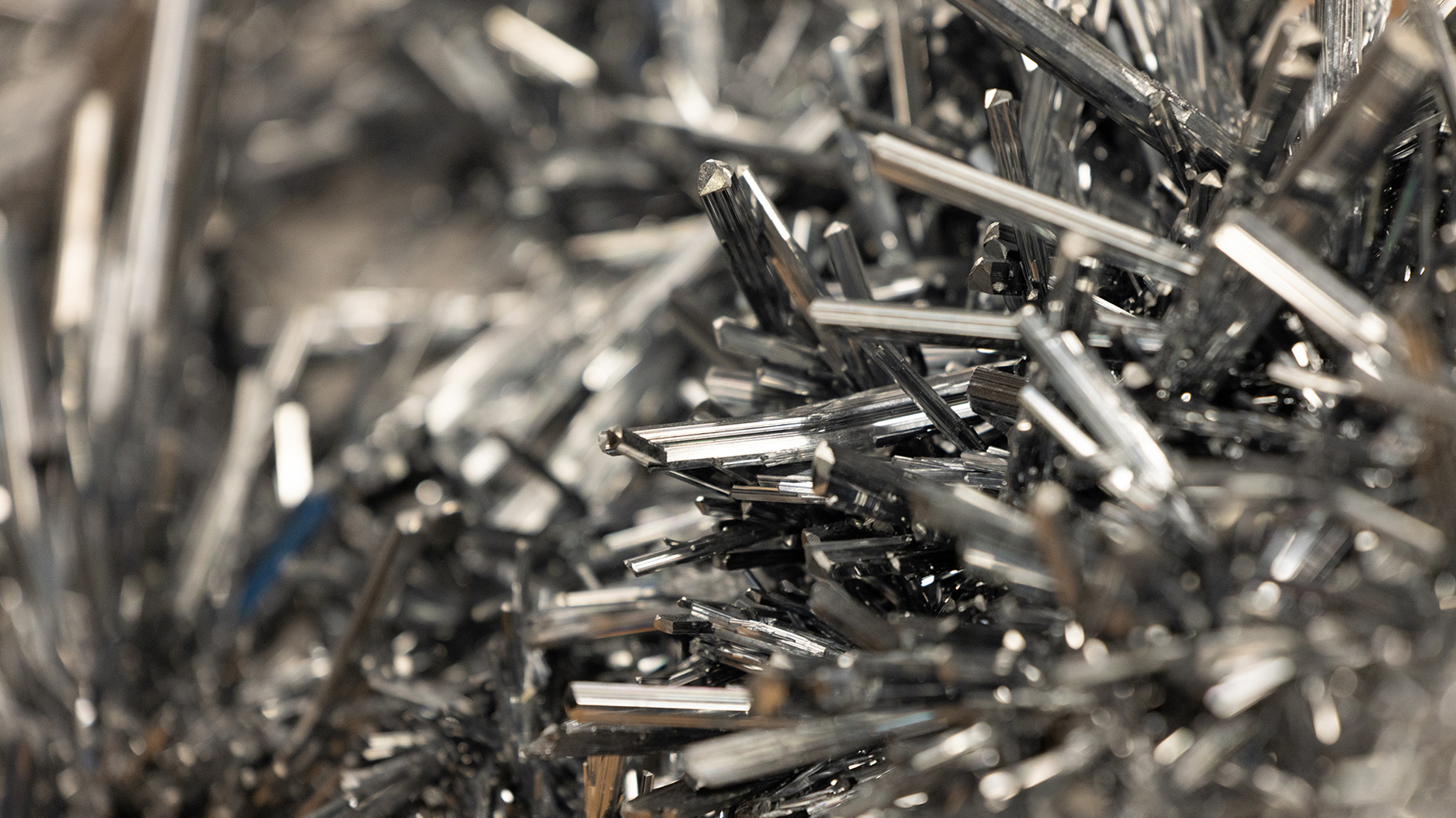
A specimen of the rare mineral stibnite, measuring 39.5 inches long, 16.5 inches wide and 17 inches thick, has been donated to the University of Arizona Alfie Norville Gem and Mineral Museum’s permanent collection. (Credit: Chris Richards/The University of Arizona)
Tucson, Ariz.—A large specimen of the rare mineral stibnite has joined the University of Arizona Alfie Norville Gem and Mineral Museum’s permanent collection and is on display now for public viewing.
Its unveiling coincided with the annual Tucson gem and minerals shows, celebrated via a reception on Jan. 25 at the museum.
The specimen was extracted in 2003 from the Wuling Mine in the Jiangxi province in southeastern China and donated by Robert Lavinsky, a world-renowned mineral collector and science education advocate.
Stibnite is a compound of antimony and sulfur originating roughly 130 million years ago, the museum said, and visually, it appears opaque and metallic gray with long spear-like prismatic crystals.
Stibnite is a compound of antimony and sulfur, and its name comes from the Latin word "stibium," meaning antimony.
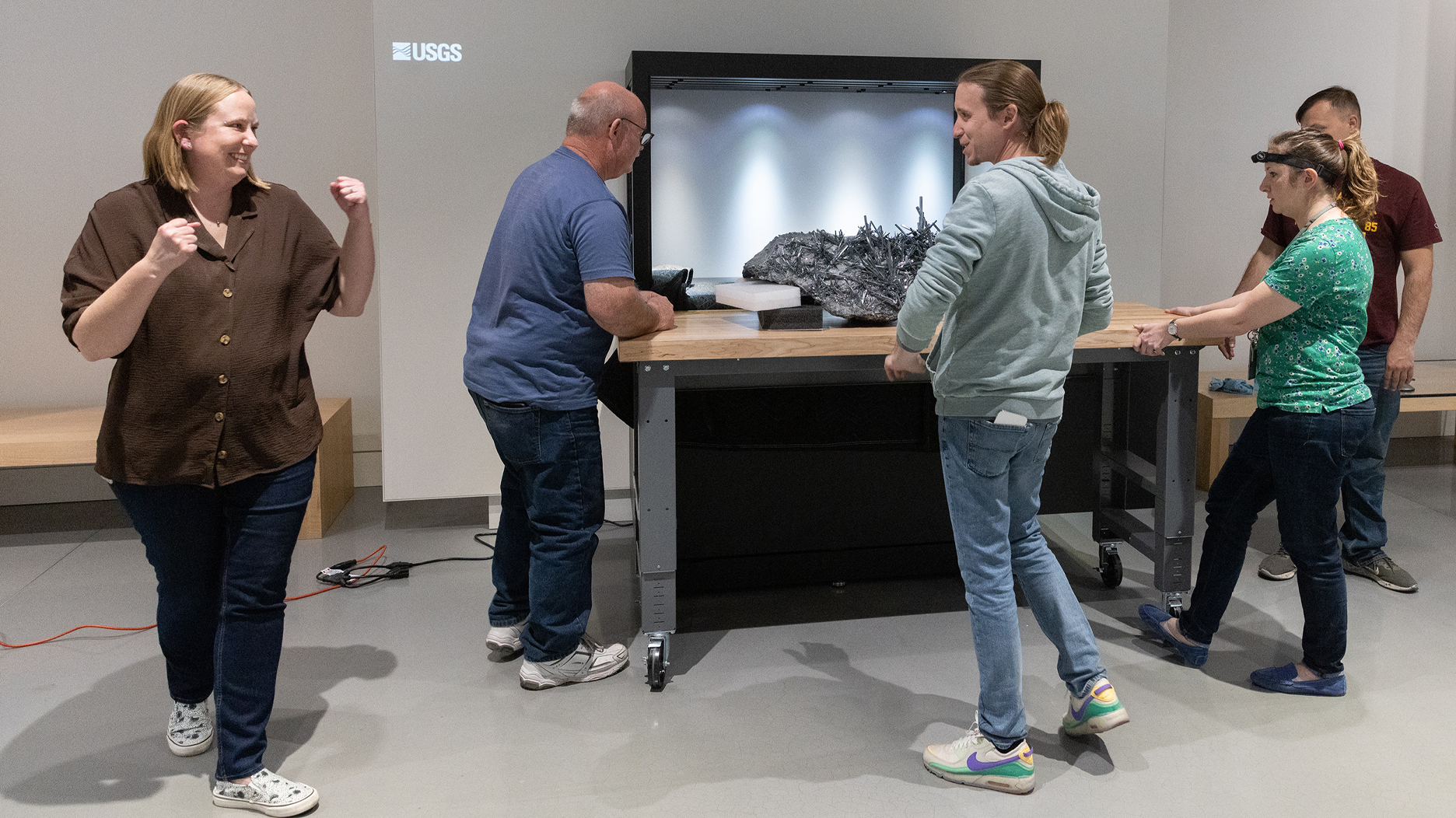
The donated specimen is 39.5 inches long, 16.5 inches wide and 17 inches thick, which the museum said is exceptionally rare for its size, intricacy, and quality. Only a handful of such specimens exist in the world, all of which were extracted from the Wuling Mine in the early 2000s, according to appraisers.
Stibnite is brittle and soft, and it has a Mohs hardness scale—the measurement mineralogists use to grade the relative hardness of minerals—rating of 2 out of 10. Because of this, stibnite crystals are not often found intact.
The mineral’s history dates back centuries. As early as 3100 B.C., ancient Egyptians powdered stibnite to use as eyeshadow and to treat eye infections, the museum said, while in ancient Rome, stibnite was associated with Pluto, ruler of the underworld.
Later, the Prophet Muhammad claimed stibnite cleared one's vision and promoted hair growth.
By 1832, French mineralogist François Sulpice Beudant officially named the mineral "stibnite," derived from the Latin word "stibium," meaning antimony.
"The rare and intricate beauty and geological significance of this stibnite specimen serve as a powerful educational tool, fostering curiosity and exploration in the fields of geology, chemistry and natural history," said Violetta Wolf, director of the Alfie Norville Gem and Mineral Museum.
Violetta Wolf, director of the Alfie Norville Gem and Mineral Museum, (far left) celebrates as museum staff maneuver the stibnite specimen into its display case. (Credit: Chris Richards/The University of Arizona)
Related stories will be right here …
"I am incredibly thankful to Dr. Lavinsky," said University of Arizona President Robert C. Robbins.
"His generous donation of the incredible stibnite piece places the University of Arizona Alfie Norville Gem and Mineral Museum at the forefront of global mineral exhibits and boosts the museum's ability to provide a unique opportunity for individuals of all ages to engage with the history and importance of minerals."
Along with being a longtime supporter of the University of Arizona, Lavinsky is the owner, founder and president of The Arkenstone, an online purveyor of minerals, and of the Dallas Mineral Collecting Symposium.
He is also a mineral dealer, collector and consultant who works with museums and private collectors around the world.
Lavinsky has been actively involved in mineral education and has made significant donations to various institutions, including the Smithsonian Institution, the Perot Museum of Nature and Science in Dallas, museums in Los Angeles and Santa Barbara, California, and numerous museums in China.
In recognition of Lavinsky's contributions to the field, a rare copper mineral from South Africa is named "lavinskyite" in his honor.
Lavinsky has also donated a stibnite to the Peabody Museum of Natural History at Yale University.
"Both Yale and the University of Arizona share my vision of a 'beauty first' approach to education, displaying valuable specimens of minerals as inspirational works of natural art," Lavinsky said.
"As a lifelong collector, it is an honor to make this joint donation to two such worthy museums and to share the inspiration and awe that these specimens evoke in me."
John-Paul Roczniak, president and CEO of the University of Arizona Foundation, said the donation was “an incredible addition” to the museum’s mineral collection.
"Thank you to Dr. Lavinsky and others who have made significant gifts to the museum's collection. The Alfie is a treasure of a facility, and an incredible point of pride for the university and Tucson community," Roczniak said.