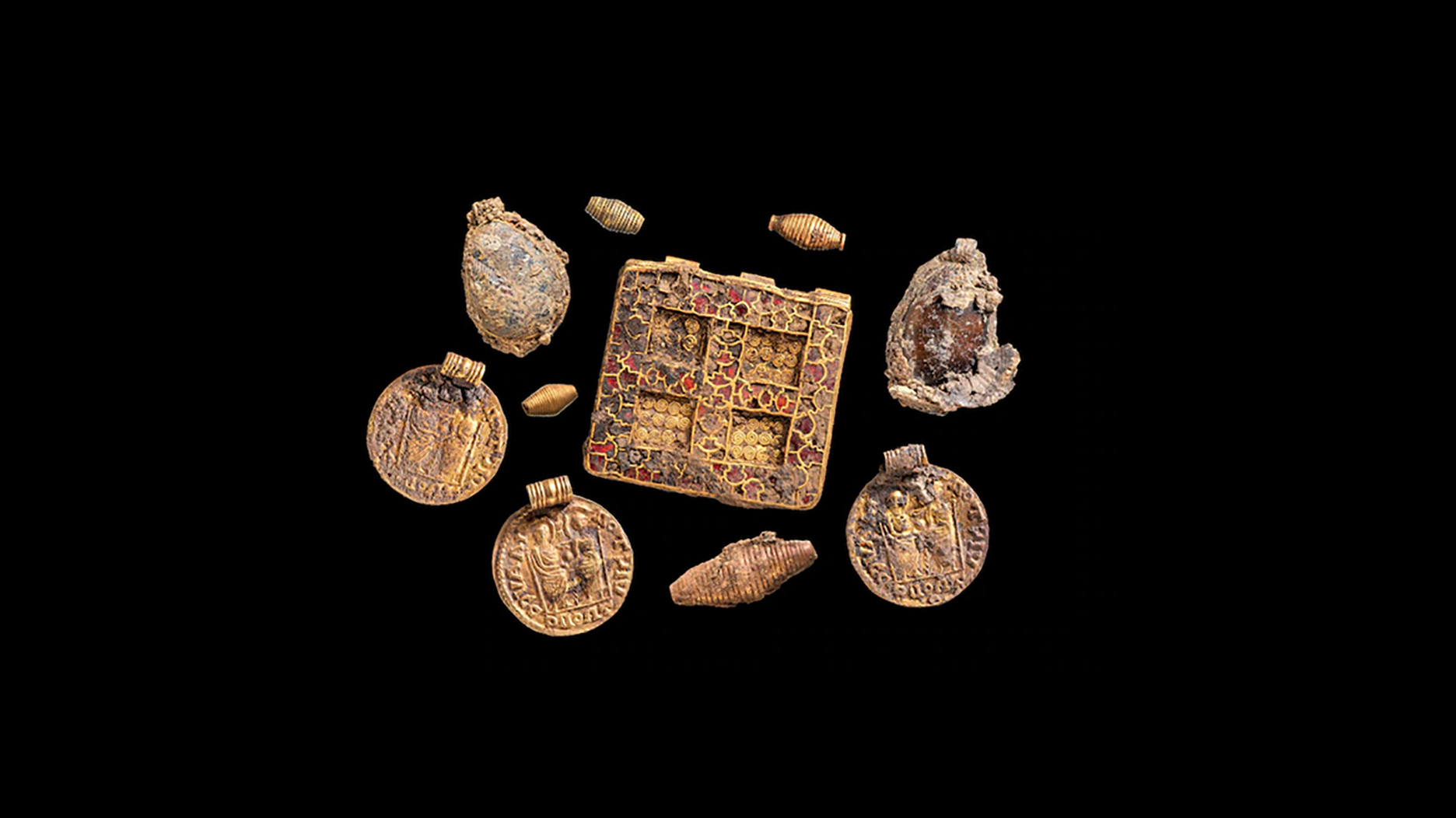
Archaeologists discovered this ornate gold necklace believed to be more than 1,300 years old at a burial site in Northamptonshire, England. (Image courtesy of The Museum of London Archaeology)
London—Archaeologists have discovered an ornate gold necklace believed to be more than 1,300 years old at a burial site in the U.K.
The Museum of London Archaeology announced the findings in a press release last week, naming the hoard the necklace is a part of the “Harpole Treasure.”
The Vistry Group, a U.K.-based house building company, had commissioned a search of an area in Northamptonshire before beginning construction.
The dig had been “pretty unremarkable” until the team spotted a glimmer of gold.
“When the first glints of gold started to emerge from the soil, we knew this was something significant. However, we didn’t quite realize how special this was going to be,” said MOLA Site Supervisor Levente-Bence Balázs.
In April, the team uncovered a necklace dating back to 630-670 AD. It has several pendants, including gold Roman coins, gemstones set in gold, and decorated glass pendants set in gold.
The pendants are spaced out by gold beads.
At the center of the necklace is a large rectangular pendant made of red garnets and gold with a cross motif.
“We think that it was originally half of a hinge clasp before it was reused in this necklace,” said the museum.
A closer look at the beads and pendants on the necklace (Image courtesy of The Museum of London Archaeology)
For jewelry historian and antiques expert Tanzy Ward of Zanathia Jewelry, the necklace is both a treasure and a helpful research tool.
“The intricate details on the pendants gives us more insight on the traditional designs and artistic craftsmanship that was superior in early Medieval times,” said Ward.
“Additionally, the jewelry of this era was one of the major influences in early Victorian Era styles as well. Finding a remarkable piece of this caliber is amazing to study and compare with later jewelry designs that tried to reproduce the aesthetic of the Medieval Era.”
A similar necklace, called the “Desborough necklace,” was discovered in the same area in 1876. It is considered to be the finest of its kind and is currently stored in the British Museum.
While similar necklaces have been found, this necklace is notable for its variety of pendants and that it’s believed to be intact.
Related stories will be right here …
“It isn’t clear if [the Desborough necklace] is complete, because the workmen had portioned the pendants and beads amongst themselves before being persuaded to hand them over for a small reward. We know that the Harpole Treasure necklace is complete.”
The museum believes the site is that of a female burial. While no significant human remains were found, similar necklaces have been discovered at female burial sites from this period and “extravagant burials” are nearly exclusive to women during this period.
Aside from the necklace, the team also found other treasures that gave them insight into who this woman might have been.
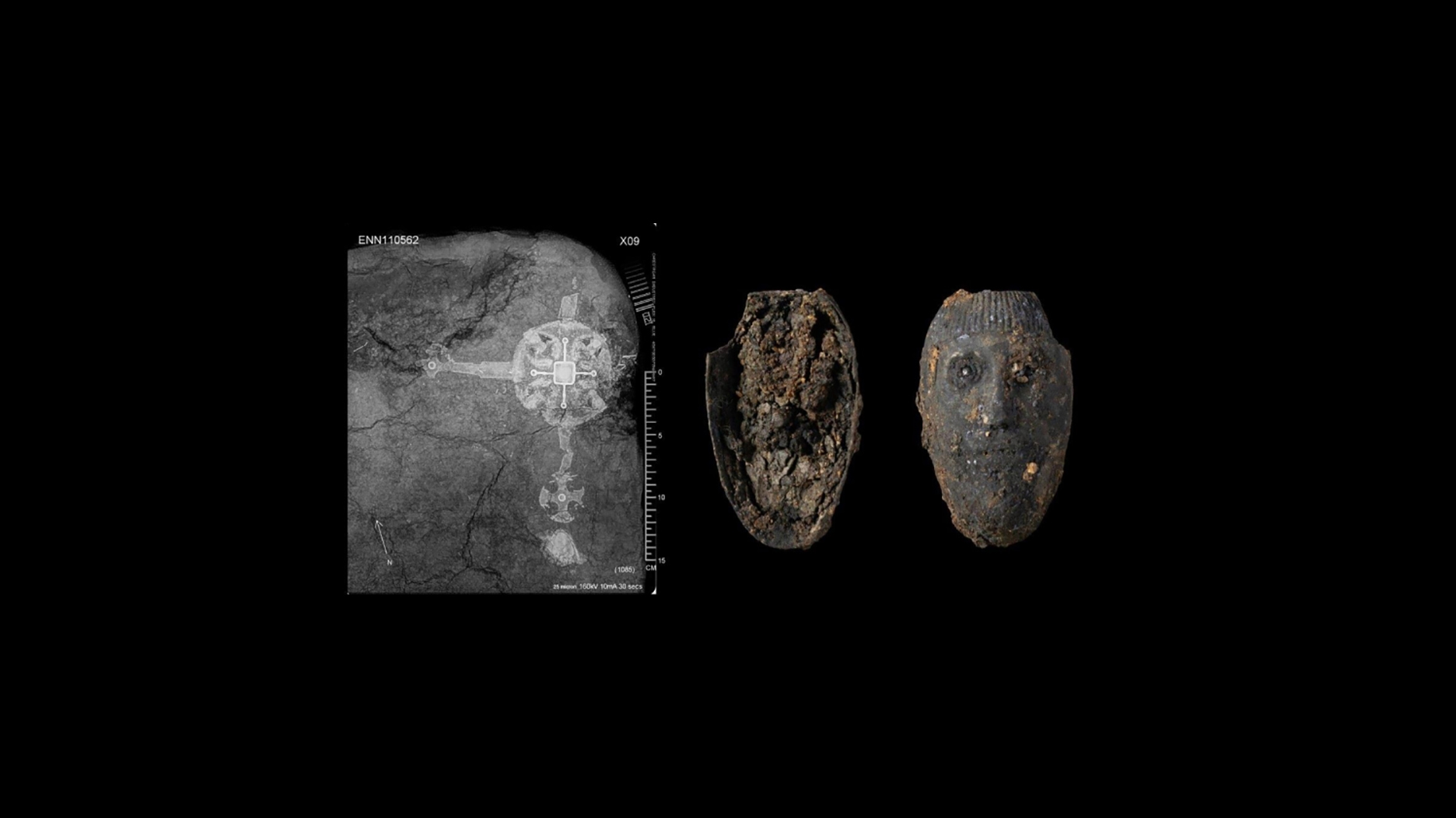
When they x-rayed soil blocks from the site, they found a large ornate cross set with garnets and smaller crosses at the end of each arm.
The piece is being micro-excavated, but an x-ray shows an incredible level of detail.
An x-ray of the area shows a large ornate cross, leading the team to believe the woman buried at the site may have been an early Christian leader. (Image courtesy of The Museum of London Archaeology)
At the end of the two arms of the cross, there are human faces cast in silver.
“The sheer size of the cross suggests the woman buried here may have been an early Christian leader,” said the museum, calling it “one of the most spectacular female Early Medieval burials ever discovered in the U.K.”
As for what’s next, the team said it is in the early stages of conservation and analysis and hopes to learn more about the cross and necklace.
As per the country’s Treasure Act, the findings were reported to the coroner and have to go through a legal process.
If declared to be a “treasure,” the goods will then be valued by the Treasure Valuation Committee.
The Vistry Group has waived its right to a portion of the reward, so the valuation process may be skipped.
For comparison, though, a contemporary gold and garnet pendant, known as the “Winfarthing pendant,” was discovered in Norfolk in 2014 and was valued at £145,000 ($178,000).