









AuctionsDec 02, 2022
Here’s How 2 Royal Jewels Performed at Auction in DenmarkAuctionsDec 06, 2022
Jewels from the Sunken ‘Ship of Gold’ Smash Auction Estimates
Holabird Western Americana Collections offered hundreds of treasures recovered from the S.S. Central America in its Dec. 3 sale.


This gold ring featuring a gold-bearing quartz sold for $14,400 (compared with a $1,000 estimate) in Holabird Americana’s recent auction of treasures from the sunken S.S. Central America.
Reno, Nevada—Bidding for the lost treasures of the “Ship of Gold” was strong in one recent auction.
The S.S. Central America sank off the coast of South Carolina during a hurricane in 1857 while traveling from Panama to New York City.
In addition to losing the lives of more than 400 of its passengers, tons of gold bars and coins from the California Gold Rush valued in the millions also went down with the ship.
Recovery from the shipwreck occurred in stages: between 1988-1991 and then again in 2014.
In a Dec. 3 sale, Holabird Western Americana Collections auctioned off gold jewelry, vintage clothing, and other historic items recovered from the site.
The top jewelry lots smashed their pre-sale estimates.
One highlight was a pair of gold watch case covers featuring customized California Gold Rush engravings—one side has a miner leading his pack burro with supplies away from Yerba Buena (the early settlement that became San Francisco) while the other shows the miner heading out of town with San Francisco in the background.
The pair sold for a total of $26,400 (including buyer’s premium), against a $5,000 estimate.
A gold ring with a 10 x 8 mm oval of gold-bearing white quartz went for $14,400, compared with its $1,000 estimate, and a rare medal/badge presented by the Order of Saint Maurice and Saint Lazarus, the world’s second oldest order of knighthood, went for $13,200, compared with a pre-sale estimate of $2,000.
See: Highlights from the S.S. Central America Auction
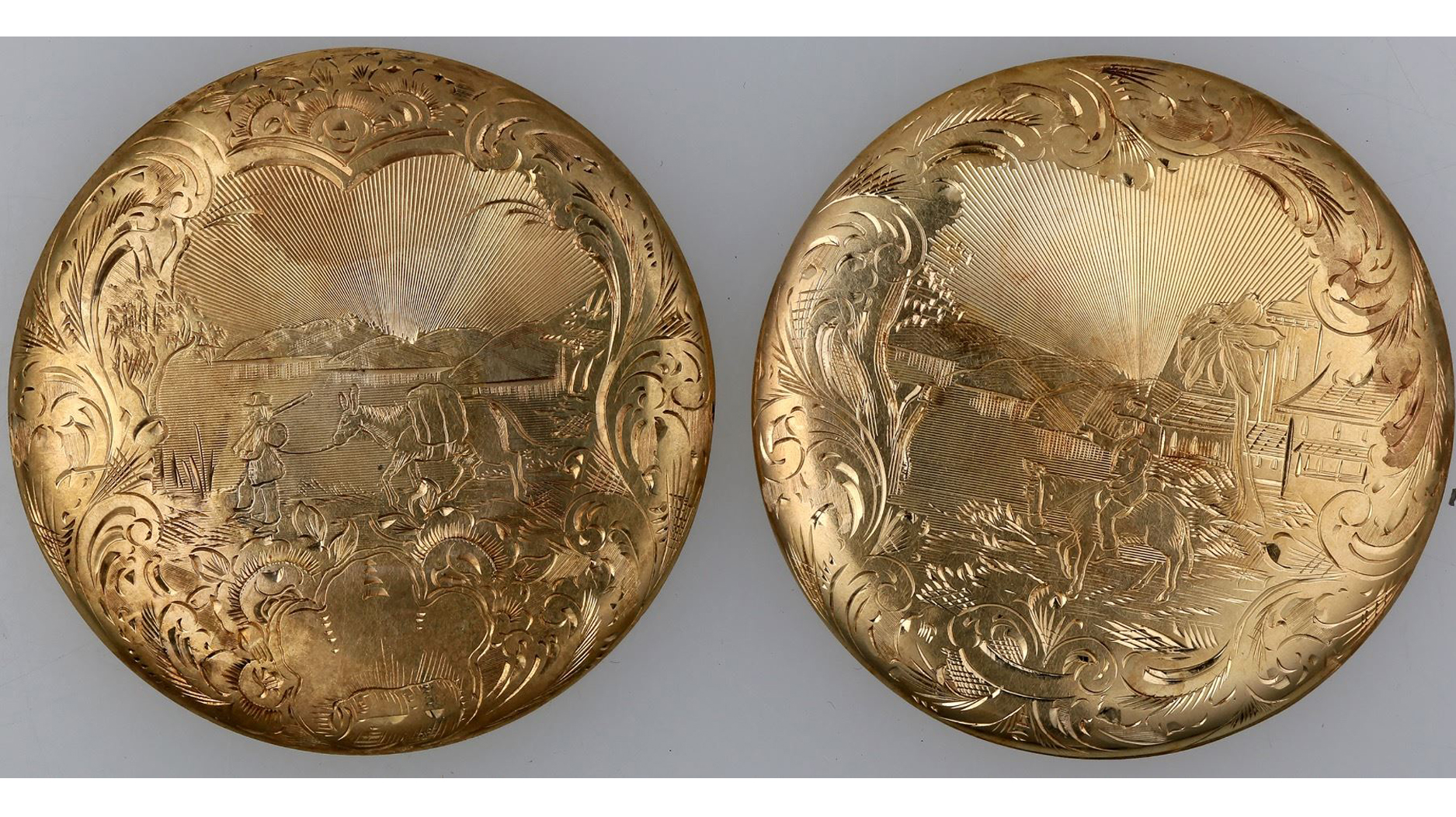
These two gold watch case covers were one of Holabird’s top lots, selling for $26,400 in the auction (compared with a pre-sale estimate of $5,000). One side has an engraving of a miner leading his pack burro with supplies away from Yerba Buena (the early settlement that became San Francisco) while the other shows the miner heading out of town with San Francisco in the background.
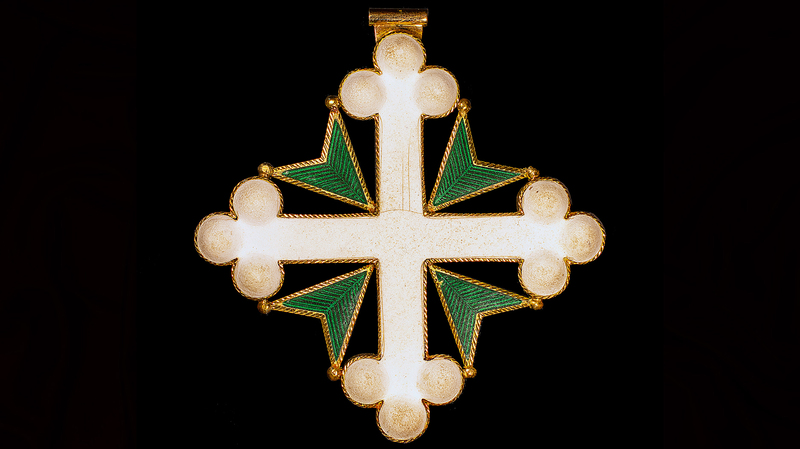
This rare medal/badge presented by the Order of Saint Maurice and Saint Lazarus, the world’s second oldest order of knighthood, went for $13,200 in the auction. It was estimated to sell for $2,000.
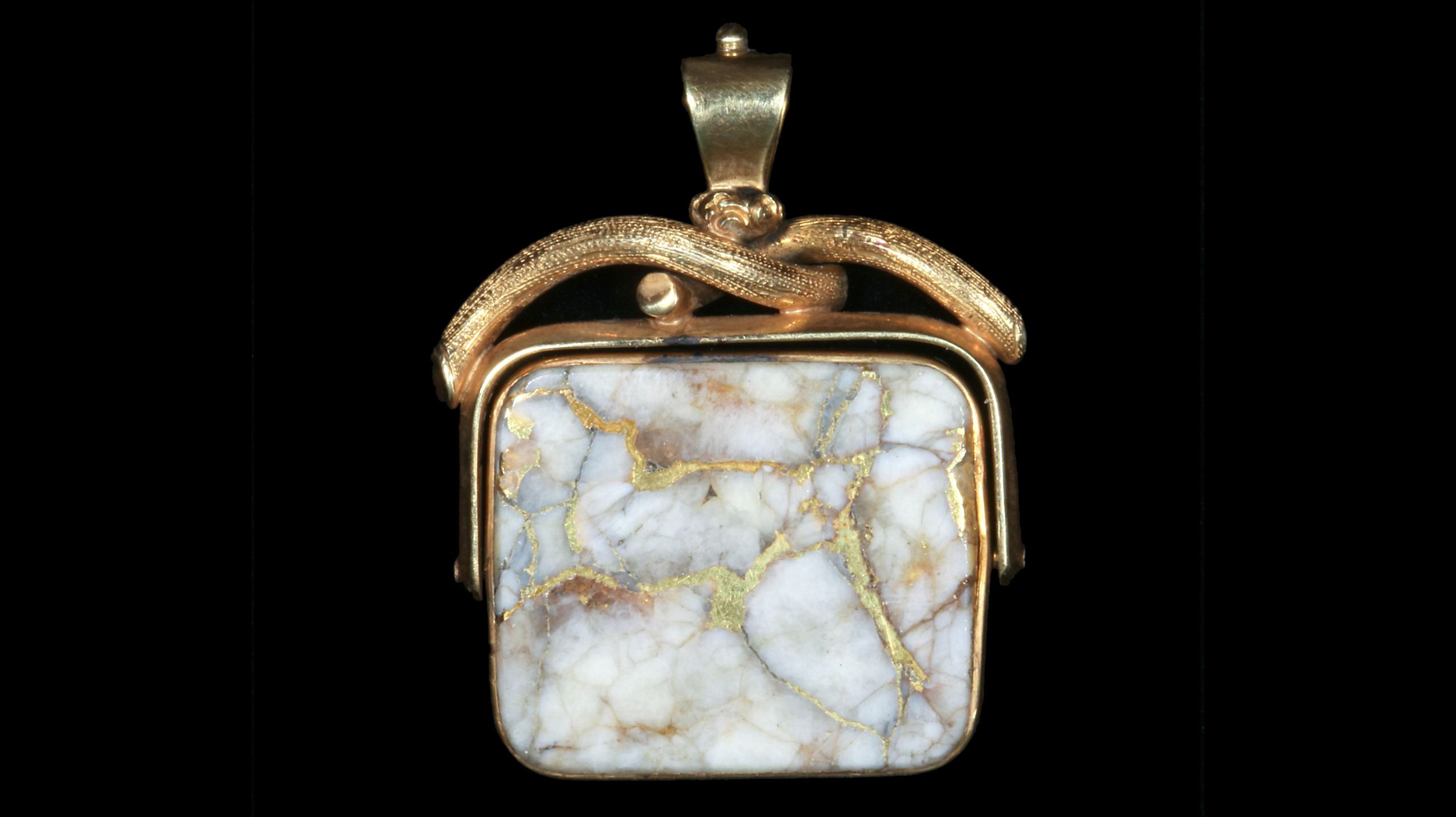
This gold pendant with a piece of gold-bearing white quartz mounted in a frame that allows the stone to spin sold for $11,100 against an initial estimate of $2,000.
There was also a double stickpin featuring two gold nuggets, each of which are soldered to a 1.5-inch stick pin, that are then joined by a four-inch gold curb chain, that sold for $12,000 against an initial estimate of $1,000.
A gold pendant made from a 25 x 22 x 4 mm piece of gold-bearing white quartz mounted in a frame that lets the stone spin on a horizontal axis and featuring an engraving reading “G.F.C. Banks” sold for $11,100 compared to a pre-sale estimate of $2,000.
A dome-shaped pinback with 15 irregularly shaped diamonds—with the largest at center, surrounded by seven slightly smaller diamonds and again by another seven smaller diamonds—in 18-karat gold garnered $8,400 at the sale.
There were also several rings with heart shapes that would’ve eventually been engraved with lovers’ initials that sold for above their estimates.
The auction also featured many other interesting items from the sunken ship.
The top lot of the sale overall was a pair of men’s work pants recovered from a trunk in the ship. According to Holabird, the five-button fly suggests they were an early manufacture of work pants sold by Levi Strauss and appear to be miner’s pants.
They went for $114,000 at the auction, more than doubling their pre-sale estimate.
A ring with three brass keys and a brass key tag engraved with “// S.S. Central America / Purser Hall / S. L. //” recovered from the purser’s safe went for $103,200; and a Wells, Fargo & Co. engraved treasure box lid—the only known piece of an original Wells Fargo gold treasure box from the California Gold Rush of the 1850s, according to Holabird—sold for $99,600.
To see the full results, visit HolabirdAmericana.com.
A second auction featuring hundreds of additional artifacts from the shipwreck will be held in February.
Editors' Picks
Sponsored by
More on Auctions



The Latest




Weekly QuizOct 03, 2024
This Week’s QuizTest your jewelry news knowledge by answering these questions.

PodcastsJan 12, 2026
Introducing My Next Question, the PodcastA monthly podcast series for jewelry professionals


Brought to you by
Navigating Cybersecurity: Essential Guidance for JewelersFrom protecting customer data to safeguarding inventory records, it's crucial to learn how to tackle cybersecurity challenges.





PodcastsNov 27, 2025
Test Podcast With VideoTest Podcast With Video. New interview with Ada Lovelace.



PodcastsNov 25, 2025
Test New Podcast PostAbstract for tests. New Podcast interview with John Lennon, Jimi Hendrix and Jim Morison.

ColumnistsOct 09, 2024
Peter Smith: 7 Things to Know When Selling LuxuryAhead of the holiday season, Smith delves into the often subconscious reasons people buy luxury products for themselves or their loved ones.


MajorsOct 09, 2024
New Simon Campaign Invites Gen Z to ‘Meet Me At The Mall’The ads celebrate the mall culture of the ‘80s and ‘90s.


MajorsOct 09, 2024
PGI Launches New Virtual Sales TrainingRetail sales associates can access the video series on mobile to refresh their selling skills.


Policies & IssuesOct 09, 2024
GJNRF: Reaching Out, Rebuilding Futures For 25 years, India’s Gem & Jewellery National Relief Foundation has provided aid in the wake of war, natural disasters, and global crises.


SourcingOct 08, 2024
Rio Tinto Begins New Phase of Production That Will Extend Diavik’s LifeCommercial production has begun underground at the Canadian diamond mine’s A21 pipe.


SurveysOct 08, 2024
What to Know About Online Shopping This Holiday SeasonDeloitte and Adobe Analytics shared their insights on the season, from the retail sales forecast to the role of generative AI.

CollectionsOct 08, 2024
Sylvie Adds New Men’s BandsThe Texas-based jeweler collaborated with luxury clothing brand Uncommon Man on men’s bands designed with European influences.


SourcingOct 08, 2024
Is Current Diamond Industry Turbulence Shaping a ‘New Normal’? Industry players have found ways to cope with market conditions while working to reshape themselves in the face of emerging realities.

SourcingOct 07, 2024
Rio Tinto to Offer 76 Diamonds in 2024 Beyond Rare Tender The sales event, in its second year, features a selection of rare diamonds from the miner’s Argyle and Diavik diamond mines.

CollectionsOct 07, 2024
Olympian Kristi Yamaguchi Partners With Heller Jewelers on New CollectionA portion of the proceeds from the “Always Dream” collection will go to Yamaguchi's foundation, supporting early childhood literacy.

SurveysOct 07, 2024
Hill & Co.’s New ‘Business of Jewelry Report’ Is OutThe first in what is slated to be a series of in-depth reports from the consulting company, it focuses on shortening supply chains.

WatchesOct 04, 2024
Watches of Switzerland Clocks Another Acquisition—HodinkeeThe company said Benjamin Clymer will return to his role as head of the watch news website, which will maintain editorial independence.