In Results of Diversity Survey, a Tale of Two Experiences
National Jeweler breaks down the results of the survey on diversity in the fine jewelry industry that it conducted in partnership with Jewelers of America.
New York—A recent survey about diversity and inclusion in fine jewelry paints a picture of an industry that thinks it’s doing better than it is but is open to improving.
Conducted by Jewelers of America and National Jeweler in fall 2020, the “Diversity in the Fine Jewelry Industry” survey was limited to U.S.-based companies and broken down into three segments: one directed at employers, one for self-employed individuals, and one for employees.
This story focuses on the results of the survey directed toward employers (defined as owners or C-suite executives) in the fine jewelry industry. An analysis of the survey geared toward employees will be published on NationalJeweler.com as well.
A total of 473 individuals took the employer-focused diversity survey, with the survey completed by more men (61 percent) than women (35 percent). (The remaining 4 percent selected “other” when asked about their gender.)
The majority of respondents identified themselves as owners of retail stores (65 percent), while 10 percent were manufacturers, 8 percent were jewelry designers and 6 percent were wholesalers.
Most of these companies (88 percent) employ between two and 25 people.
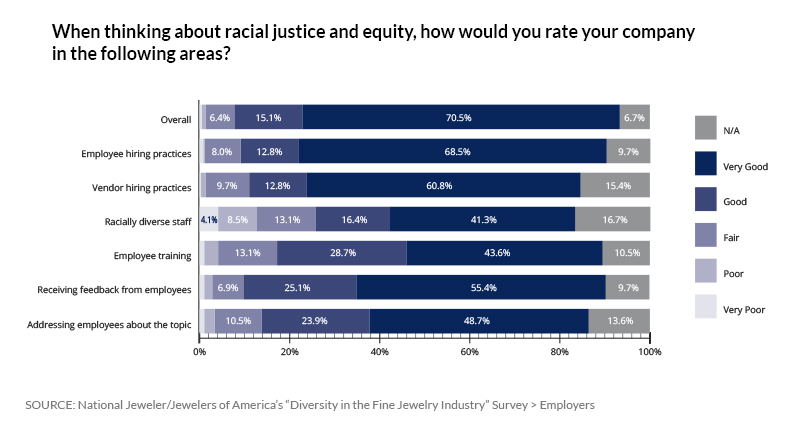
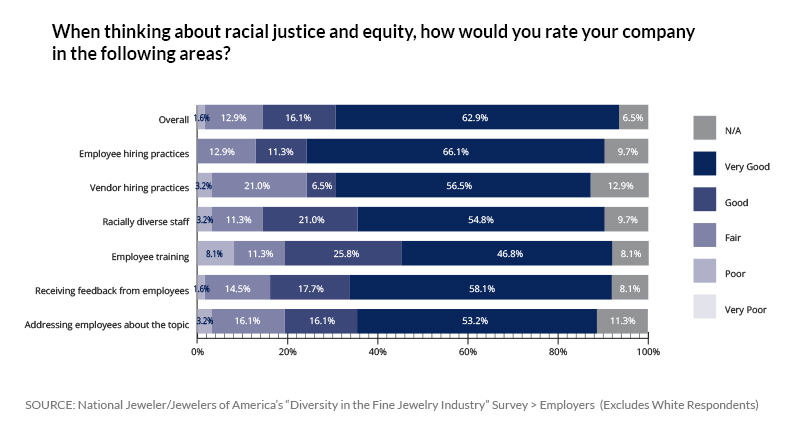
When asked to rate their company’s performance in various areas as they relate to racial justice and equity, the survey-takers gave themselves high marks across the board, with 71 percent rating themselves as “very good”—the survey’s top rating—overall.
Looking at specific categories, the majority of respondents said they are “very good” when it comes to diversity in employee hiring (69 percent) and vendor hiring (61 percent), and as it relates to processing feedback on racial justice-related issues from employees (55 percent).
They gave themselves somewhat lower marks for addressing employees about racial justice (49 percent said they were “very good” at this) and employee training in this area (44 percent).
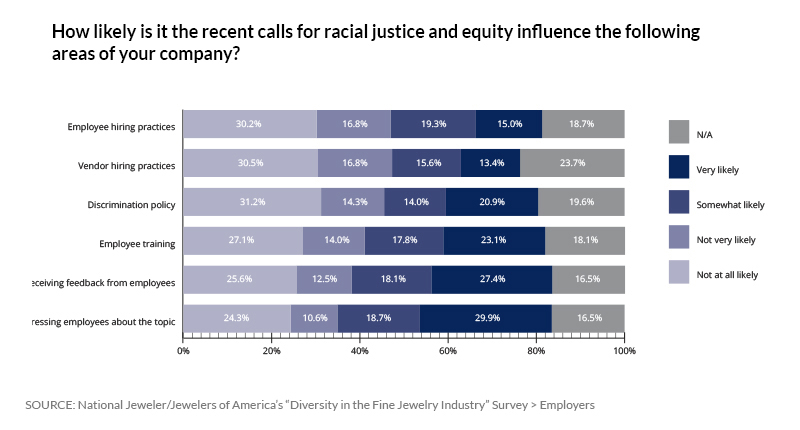
And, about half of survey-takers said the current push for racial justice and equity wasn’t going to change how their company approached the hiring of employees (47 percent) or vendors (47 percent) or their company’s racial discrimination policy (46 percent), which is non-existent at about half the companies that took the survey.
Most respondents who rated their company as having a “very good” performance overall in areas of racial justice and equity chose to elaborate on their response.
A few wrote their company has been focused on diversity and inclusion for years, some because they have experienced discrimination firsthand.
One survey-taker said: “Being a black-owned business and being
the first black manager for the [company name withheld], I understand the importance of racial justice and equity. My company practices treating all people with respect because I have personally experienced both sides.”
Others who rated their company as “very good” did so pre-emptively it seems; it’s not an issue their company has tackled yet, but they expect it will.
“Over the years, I think we have done an exceptional job at addressing gender diversity issues and hiring,” one respondent wrote.
“However, most recently we have turned our attention to areas of opportunities with respect to hiring within the BIPOC community. Recent social and racial tensions in the U.S have prompted us to take a moment of self-reflection. In so doing, it became apparent that this seem to be the one demographic where we have underachieved, at least with respect to our aspirations to be an inclusive, diverse environment.”
Others said they rated their company as “very good” because, in their view, they treat everyone equally.
A few described themselves as being “color blind” or noted they “don’t see color.”
One respondent, who identified as white, wrote: “I was raised on an Air Force base … the military does not see color; they are all our brothers. I run my business the way I was raised, to hire and promote on an individual’s ability and merit. If they deliver and continue to have a positive attitude to help the company grow and prosper, they will be rewarded accordingly.”
Expressions such as these are often used to impart the idea that an individual is not personally biased or discriminatory, but, as many experts have discussed, they can actually be harmful to diversity and inclusion efforts.
A Closer Look At first glance, the survey paints a picture of an industry that is diverse, open, and inclusive. Take into account the race of the respondents, however, and that picture starts to shift.
The vast majority of jewelry industry employers who responded to the survey—77 percent—were white.
Fewer than 100 survey-takers identified as a person of color, accounting for 13 percent of the total respondents. Four percent were Asian; 3 percent Black; 3 percent Hispanic or Latino; 2 percent multiracial or biracial; and 1 percent American Indian or Alaska Native.
Among that 13 percent, the majority were owners or executives at retail stores (48 percent) or in the field of jewelry design (22 percent), with most (76 percent) identifying as the owner of their business rather than a C-suite executive (24 percent).
Respondents of color gave their companies lower marks when it comes to racial justice and equity.
The percentage who rated their company as “very good” overall was 63, down from 71 percent when all responses are taken into account.
Nearly a quarter rated their company as “fair” or “poor” when it comes to diversity in vendor hiring—as opposed to 11 percent of all survey-takers—while 19 percent rated their company as such when it comes to addressing employees on the topic, compared with 13 percent of all survey participants.
Another 19 percent gave “fair” or “poor” marks for employee training, up from the 16 percent who said the same thing when looking at all results.
“I believe that my company viewed [racial justice] as a political issue, rather than a human rights issue,” one respondent, who identified as Black, wrote. “2020 has caused a shift in perspective, and they are now actively working toward improving our work culture. In my past experience, this was never addressed or perhaps seen as an HR concern, rather than something that needed to be addressed companywide.”
The respondent continued: “When our company did make a public statement, we received a lot of backlash from people and it really set the tone for how the jewelry industry is not quite open to these conversations, but they must be had.”
National Jeweler and Jewelers of America’s “Diversity in the Fine Jewelry Industry” survey was conducted from Sept. 23 to Oct. 14, and all responses were anonymous.
The organizations created and launched the survey in the wake of the 2020 nationwide protests for racial justice. The survey goal was to better understand the experiences of people of color—particularly Black professionals—in the fine jewelry industry.
The protests kicked off discussions about racial inequities, discrimination, and injustice in all industries, and the jewelry industry was not immune.
Conversations cropped up on social media platforms, companies and associations industrywide organized panels on diversity, and jewelry businesses brought in diversity trainers.
Also in 2020, a group of Black gem, jewelry and watch industry professionals launched the Black in Jewelry Coalition.
BIJC is the first nonprofit association dedicated to the inclusion and advancement of Black professionals in the industry, and its launch comes at a time many see as a major turning point for racial justice and equity in America.
The Work Ahead While the majority of employers ranked themselves as “very good” overall when it comes to racial justice and equity, their answers to other questions indicate there is more work to be done.
As previously mentioned, jewelry company owners and C-suite executives gave their companies high marks for diversity in employee hiring, with 82 percent ranking themselves as “good” (13 percent) or “very good” (69 percent).
No other area of company operation garnered such high marks from employers when it comes to racial justice and equity.
Yet, the area to receive the lowest percentage of “very good” rankings is one that involves putting the idea of diversity into action.
Only 41 percent of employers rated themselves as “very good” when it comes to actually having a racially diverse staff, while one-quarter of respondents rated themselves as “fair” (13 percent), “poor” (9 percent), or “very poor” (4 percent) in this area.
“We have just started to come out as a company with a statement about racial justice and equality,” one respondent wrote. “We now need to follow through. We also need to hire more diverse staff and make sure our designers reflect the equity we want to put forward.”
A number of survey-takers said their ability to have a more diverse staff was limited by available candidates—a few noted they’ve never had a person of color apply for a job at their company—or because their business is a one- or two-person operation.
“I have one employee,” one respondent wrote. “Our geographic area is predominantly white. I did not have any non-white applicants during the hiring process. I grew up in a diverse environment and would like to bring diversity into my business. It has been on my mind from the beginning.”
The survey also asked respondents to compare the jewelry industry’s treatment of its Black employees to other industries, and it inquired about their willingness to make it better.
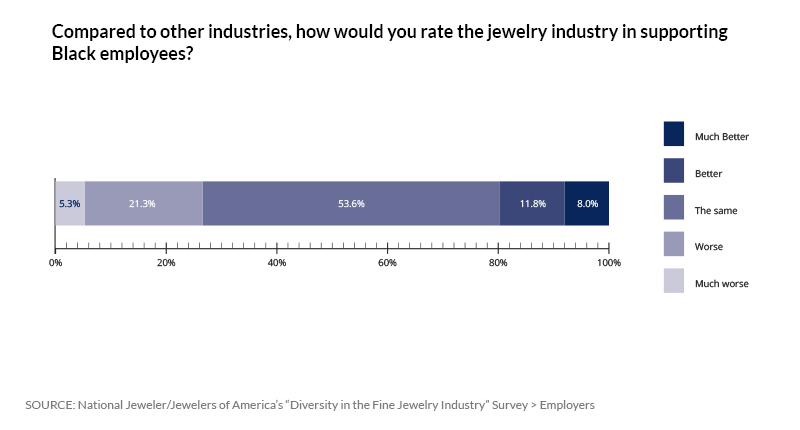
One-quarter of survey-takers said they believed the jewelry industry is worse (21 percent) or much worse (5 percent) than other industries when it comes to supporting Black employees.
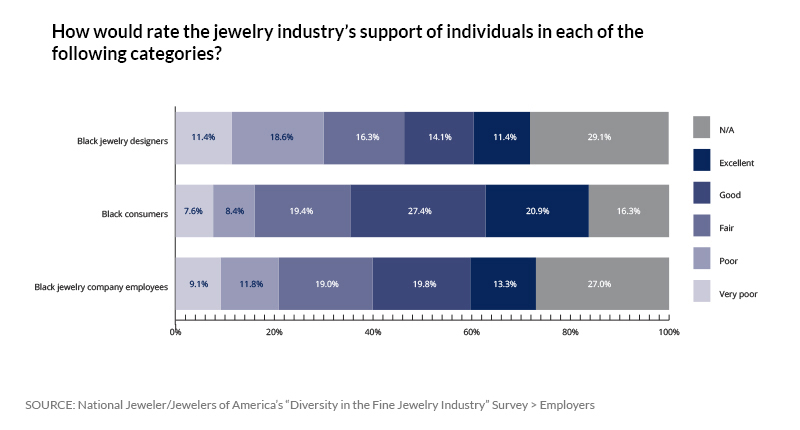
Meanwhile, 46 percent said the industry does a “fair,” “poor,” or “very poor” job of supporting Black jewelry designers. Forty percent said the same about supporting Black-owned jewelry companies, and 35 percent about Black jewelry consumers.
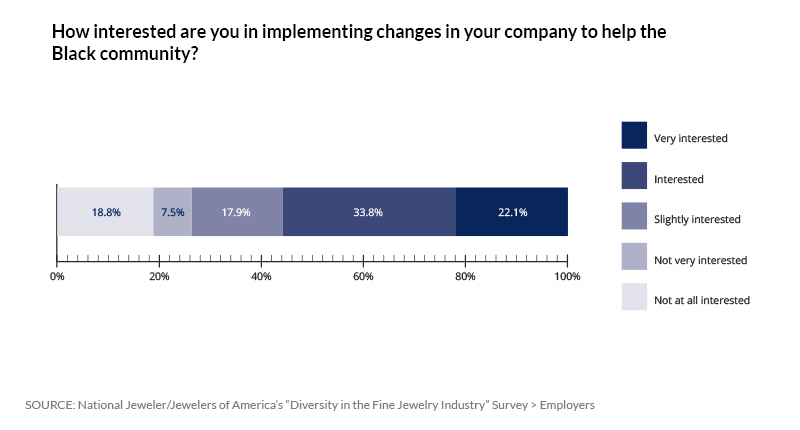
But, 74 percent of respondents expressed some level of interest in making changes to help the Black community: 18 percent are “slightly interested,” 34 percent are “interested,” and 22 percent are “very interested.”
Write-in suggestions for resources included “give GIA training for affordable prices,” and “mentoring programs, apprenticeships, networking groups, etc.”
One respondent wrote: “We are a small shop in a rural area. Diversity is hard to come by but setting up a school with transportation to and from is a start.”
For full survey results, please visit Jewelers.org.
Michelle Graffis the editor-in-chief at National Jeweler, directing the publication’s coverage both online and in print.