A custom fine jewelry designer, Vittoria d’Aste-Surcouf, has a diverse background in art history, events and public relations, jewelry fabrication, sales and fine jewelry rendering. She can be reached at info@vasbijoux.com.
“Harmony and contrast. All beauty comes from these two things … To know that is the beginning of being an artist.” — Gérard Depardieu playing the role of 17th-century French chef François Vatel in “Vatel”
Well hello there! It’s been a minute since my last column. Like the rest of the world, I too am slowly emerging into this brave new world we all occupy.
It has been a difficult time, to say the least, but out of chaos and calamity can come artistic flow and abundance.
Jewelry is an art form, and it helps to approach it in the same way a visual artist approaches a painting or a sculpture, or a chef an exotic dish.
It is not surprising I think this way since my previous life (as in pre-jewelry) was spent entrenched in the New York City contemporary art world, where I earned a master’s in art history.
My days were spent in museums, galleries and artists’ studios analyzing, dissecting and deconstructing the composition, materials and style approach used by professional painters, sculptors and photographers.
As I left the art world behind and moved into creating my own jewelry art, it was only natural that I would approach jewelry design with the same classically trained artistic eye.
So, what are these techniques and principles found in fine art, and how do we apply them to the miniature sculptures called jewelry?
Below, I’ve outlined five key ways to help you channel your inner Picasso!
1. Light It Up Drama always reigns supreme, and there is zero drama without proper lighting.
Cue the “Mona Lisa” by Leonardo da Vinci.
Although admittedly one of my least favorite paintings, I cannot argue the brilliance of the subject front and center and lit up against a darker background.
A jewelry comparison is a glorious rare diamond perfectly perched atop a ring allowing light to bounce in and out of it, creating a dazzling display.
Like the Mona Lisa, the diamond as subject matter is in the foreground, blinding you, evoking all kinds of emotions. The mounting is the background, and it becomes secondary. If this same diamond were placed too low, then the light would be diminished and the effect would not be as powerful.
Since jewelry is sculptural, the negative and positive spaces create interesting plays of light.
For example, an organic shape has smooth edges (more positive space than
negative) and reflects the light off this type of undulating surface. There is no place for the light to hide, and the surface looks smooth and unified.
When creating a more modern or edgy piece, sharp angles create starker contrasts and shadows give the piece a more angled, contrasting look.
Also, give some thought as to how the gemstone will look during different times of day or in different light—bright sunshine, the light cast by candles during a romantic dinner, everyday interior light, etc.
2. Consider Composition So, you’ve developed your concept, you’ve roughly sketched it out and now you want to bring it to life. This is the pinnacle moment where you distinguish yourself as a designer who has learned to truly use and manipulate the medium and is seen as a master of their craft.
It is at this point you use the various elements to focus the viewer, manipulate their emotional response, determine a focal point and create harmony within your design.
It is not easy to arrange elements in a two-dimensional space (initial rendering on paper) and transfer them to a three-dimensional one.
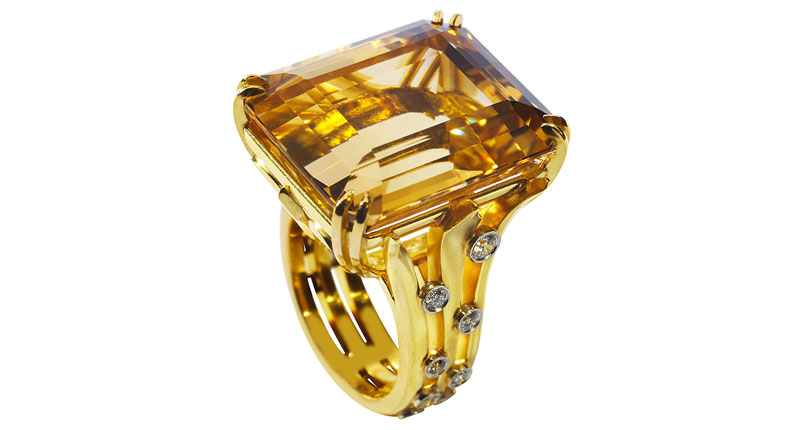
This citrine ring designed by Vittoria d’Aste-Surcouf shows how careful composition can make a top-heavy ring look graceful and sleek. Inspired by the columns in ancient Greek ruins, the design flows upwards holding the 38-carat citrine. The platinum bezel-set champagne and colorless diamonds are sporadically placed on the sides of the mounting. An “unpolished” finish was chosen to mirror the weathered, sun-bleached appearance of the columns.
Formal bench training helps tremendously with this because you now have a jeweler’s technical know-how.
Composition is the structure, the bones and the foundation behind the work of art.
You have set your stage, and there can only be one star of the show. It is your job as a designer to guide your audience to that focal point and make sure all the other elements are providing excellent supporting roles.
This is where the artist crosses from the creative into the technical realm.
3. Romancing Color Jewelry is emotional and so is color. Artists use basic color theory to experiment in their works to express an emotion or mood.
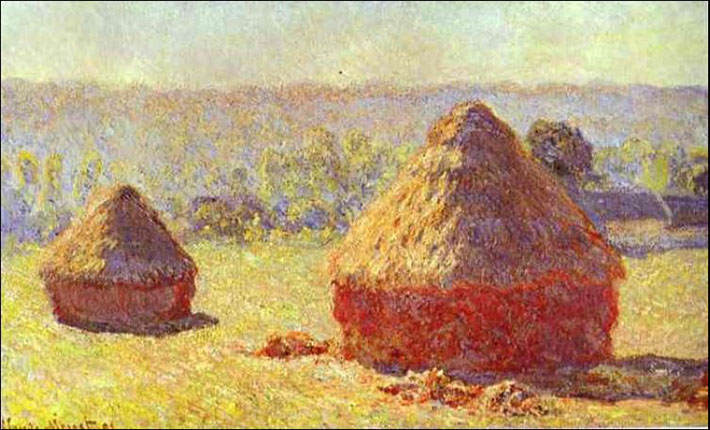
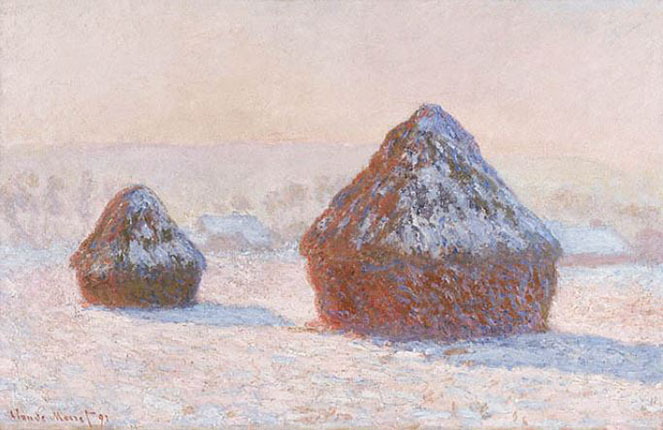
Famed Impressionist painter Claude Monet used color theory beautifully in his various “Haystacks” series.
He explored the exact same theme in different light, at different times of day and during different seasons.
This painting from Claude Monet’s “Haystacks” series shows the pastoral landscape in late summer. “Haystacks, End of Summer” (1891) hangs in the Musée d’Orsay in Paris.
Each of these paintings conveyed different emotions and told a completely different narrative through color, all while using the exact same image.
At the heart of color theory is the color wheel. I have one printed and hanging in my studio so I can easily use it as a reference when working with gemstones or different metals.
Monet used different colors to paint the same haystack scene in winter. “Wheatstacks, Snow Effect, Morning” (1891) is part of the collection of the J. Paul Getty Museum in California.
Using a color wheel has many different facets, but for the sake of keeping things simple, you can begin by referencing complementary colors (directly opposite from each other on the color wheel) or analogous colors (three colors placed side by side on the color wheel).
I use this as a starting point when deciding on my gemstone palette and then I let my creativity guide me.
The Victorians were excellent at conveying mood using color when designing their mourning jewelry.
Black, brown, gray and white were the go-to colors since these hues are associated with mourning the death of a loved one.
4. Material and Surfaces Jewelry is tactile, and we are tactile creatures. A piece can look good but if it does not “feel” good all your design efforts have been in vain.
Material choice blends the senses by appealing to our sense of touch as well as the visual. Like sculpture, jewelry has been formed by an artisan’s hand.
In fine art, there is a lot of talk about surfaces. The use of specific materials lends itself to certain manipulation that is both aesthetically pleasing and satisfies our tactile senses.
By selecting the right material, be it gold, platinum or some other kind of interesting metal, achieving the proper weight and balance is crucial. A piece that is too heavy will be uncomfortable to wear.
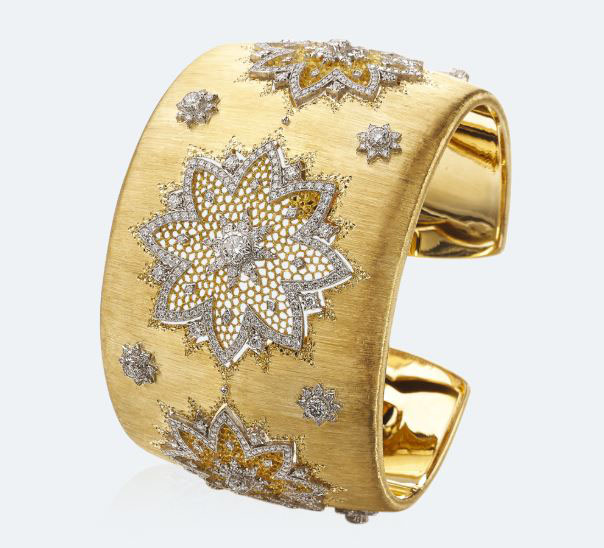
Buccellati masters the art of surface manipulation by choosing malleable yellow gold to hand-engrave with its signature finish. This finishing gives an almost aura-like appearance to the surface of this white and yellow gold cuff with diamonds. (Photograph courtesy of Buccellati)
Surface manipulation through engraving or finishing of the metal can add an interesting effect.
To really see the details of this type of surface, you can view the piece in what is called raking light. This is an art term that means illuminating the object’s surface from almost a parallel angel and revealing information about the surface topography.
By using this technique on the surface of jewelry you are ensuring the consistency of the craftsmanship as well as your aesthetic message. Surface manipulation can include different types of engraving or enameling.
“Every piece of art has a story. Jewelry is no different, and the storytelling aspects of jewelry are even stronger because it is highly personalized.”
5. Storytime Who doesn’t love a good story?
We are as fascinated with the backstory of a piece of art as we are with the finished product.
Every piece of art has a story of how the artist came up with the concept, executed the process, chose their materials, colors and composition, as well how the piece finally came to be.
Jewelry is no different, and the storytelling aspects of jewelry are even stronger because it is highly personalized.
We are natural-born storytellers, so adding a bit of backstory into a piece makes the wearer and the audience connect more with the design.
In terms of design, keeping with the initial story you want to tell as a designer helps unify the concept from start to finish.
It surrounds the piece with a certain mystique, allowing the wearer to delight in it and making it invaluable to them.
Vittoria d’Aste-Surcoufis a custom fine jewelry designer with a background in art history, events, public relations and sales.