



PodcastsJan 12, 2026
The latest poscasttest





test


The stone had been broken in half and put back together with an “unknown adhesive,” and couldn’t be graded by the Carlsbad lab.

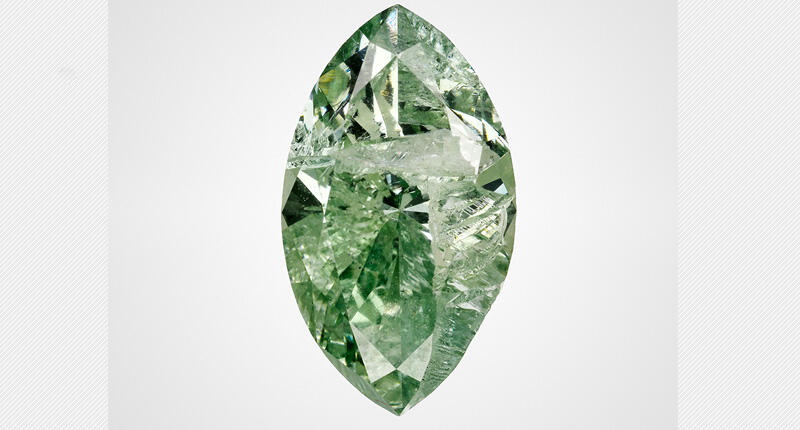
Carlsbad, Calif.—The Gemological Institute of America said its Carlsbad lab recently received a diamond that had broken in half and been repaired with an adhesive of some sort.
In the summer 2018 issue of Gems & Gemology, GIA research associate Troy Ardon wrote a lab note about a 1.38-carat marquise-cut diamond submitted to the laboratory for colored diamond grading services.
Graders initially noted large fractures and a large cavity on the table. After careful examination under a microscope, they discovered that the stone had been broken in half and then repaired with an “unknown adhesive,” a method the lab noted was unusual.
The GIA said there were a number of factors that hinted to it being broken and put back together imperfectly, the first being a large fracture from crown to pavilion showing a “sizeable gap” throughout the diamond.
The fracture indicated it was a repair, rather than two separate diamonds glued together to make a larger stone, because it had an irregular surface, according to Gems & Gemology.
From a certain angle, graders could also see large air bubbles trapped in the fracture.
Additionally, the facets that the fracture transected showed “slight to moderate” misalignment, which the GIA confirmed can’t happen during the polishing process.
The GIA said polish lines on the pavilion facets contained a pattern that would’ve lined up if it wasn’t for the fracture that separated them, demonstrating that the breakage occurred after the diamond had been at least somewhat polished. Beyond that, it’s not possible to tell when the damage happened, the lab said.
While the application of glue to diamonds to form a diamond-diamond doublet has been done before, the GIA noted that it has never seen a broken diamond repaired with adhesive in this manner.
The lab was not able to grade the diamond because the 4Cs don’t apply to “composites” like this. For example, the carat weight would actually represent the sum of the two diamond weights plus that of the adhesive.




A monthly podcast series for jewelry professionals


From protecting customer data to safeguarding inventory records, it's crucial to learn how to tackle cybersecurity challenges.


Test Podcast With Video. New interview with Ada Lovelace.



Abstract for tests. New Podcast interview with John Lennon, Jimi Hendrix and Jim Morison.

Ahead of the holiday season, Smith delves into the often subconscious reasons people buy luxury products for themselves or their loved ones.

The GMT-Master “Pepsi” belonging to astronaut Edgar Mitchell is a standout in RR Auction’s online “Space Auction,” going on now.

The ads celebrate the mall culture of the ‘80s and ‘90s.

Retail sales associates can access the video series on mobile to refresh their selling skills.

For 25 years, India’s Gem & Jewellery National Relief Foundation has provided aid in the wake of war, natural disasters, and global crises.

The November auction will feature a collection of jewels owned by Ferdinand I, the first king of modern Bulgaria, and his family.

Commercial production has begun underground at the Canadian diamond mine’s A21 pipe.

Deloitte and Adobe Analytics shared their insights on the season, from the retail sales forecast to the role of generative AI.

The Texas-based jeweler collaborated with luxury clothing brand Uncommon Man on men’s bands designed with European influences.

Industry players have found ways to cope with market conditions while working to reshape themselves in the face of emerging realities.

The sales event, in its second year, features a selection of rare diamonds from the miner’s Argyle and Diavik diamond mines.

A portion of the proceeds from the “Always Dream” collection will go to Yamaguchi's foundation, supporting early childhood literacy.





This site uses cookies to give you the best online experience. By continuing to use & browse this site, we assume you agree to our Privacy Policy