2 Years Later: An Update on the Montana Yogo Sapphire Mine
The new owners of the Vortex mine talk about the progress they’ve made, the challenges of having mining claims on Forest Service land and their future plans.
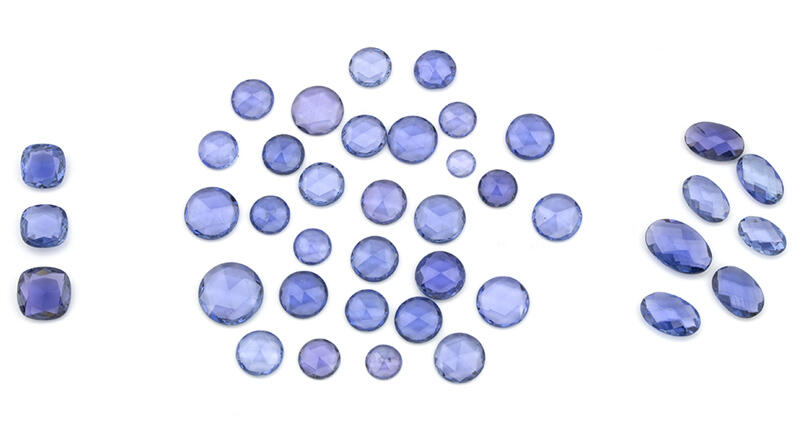
A selection of rose-cut and petal-cut Yogo sapphires from the Vortex mine
A little over two years ago, a retailer acquired the Vortex Yogo sapphire mine near Lewistown, Montana, with plans to restart production and bring more of its intense blue stones to market.
I interviewed The Gem Gallery owner Don Baide and his son Jason Baide at the time about their plans for the mine and the stones, and the article I wrote about Vortex restarting production was met with plenty of excitement.
I traveled west to Montana last summer and while I wasn’t able to get to the mining site, I did stop by The Gem Gallery in Bozeman, where Jason was kind enough to show me around, pull out some pieces and talk Yogos with me. The sapphires are gorgeous, and I totally get the hype.
In fact, both GIA and AGL are now issuing reports with Yogo Gulch source of origin, notable because these stones fetch a premium over other Montana sapphires.
After seeing a few photos on social media recently of the gemstones emerging from Vortex, I figured it was the perfect time for an update on the mine.
Here’s what Don and Jason had to say. (This interview has been edited for length and clarity.)
National Jeweler: Last time we chatted, you had just acquired the mine. Talk me through what’s had to happen since then.
Don Baide: First off, all the permitting. We had to go through all the government regulations, the Forest Service regulations, get everything approved. There were probably six months of paperwork because we are on a Forest Service claim, and because of that I have to dance with the Forest Service quite nicely. I’ve made good friends with them; I’m a really easy-going guy and I’d rather work with them. It’s about, how can we make this better? How can we improve the property and what can we do for the land?
Jason Baide: That’s a big reason why we’re a bit different and something that we’re appealing to clients for is the environmental impact—the impact we have on the land that we’re very conscientious of and that’s very important to us. We’re happy to be making road improvements to make sure the creek doesn’t flood, and we’re happy to make sure the wash plant has a pond that’s filtering as it’s straining through the soil before it goes back into the water table. That’s always been important to us.
Two years ago, we talked about the previous owner having a relationship with the Forest Service where he was providing them with road fill.
DB: Yes. The gravel that comes out of the mine belongs to the Forest Service. The sapphires belong to me. As far as using the gravel for roads, yes, the Forest Service can take that and use that. To dispose of it, they’ve told me that I can haul it like 18 miles away to a disposal facility, which is a really long way.
But there was an experiment this year about what was in the tailings (leftover gravel from the mine’s previous operation) that went through the wash plant. I am now actively reprocessing the tailings and doing extremely well with it.
Our goal is to get sapphires out of the rock and dispose of—nicely—the tailings. At this point, we’re not creating any new tailings. We’re just reprocessing at this point on the surface.
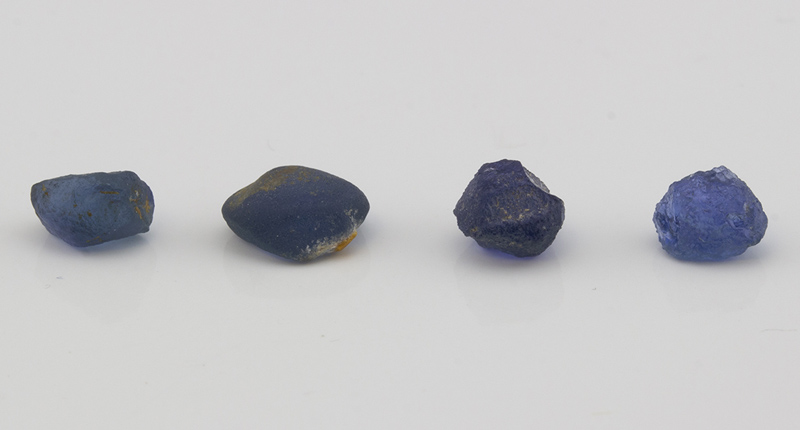
Four of the first large Yogo sapphires to come out of the Vortex mine after it reopened
NJ: How much underground mining have you done since you acquired the mine?
DB: We’ve done a little rehab work underground—scaling, knocking down the hanging rock that was in there—but we haven’t started any underground mining yet. We’ve been busy enough with tailings and profitable enough with tailings to stay aboveground.
We’re looking forward to going back underground, but we want to get all of our ducks in a row. It doesn’t do you any good to mine underground if you can’t process it once you get it up to the surface. If your plant isn’t running at 100 percent peak efficiency, you’re just wasting a lot of money and time.
Hopefully next year we’ll be back underground again. We’ll continue our tailings recovery, because that is working well, but if the tailings drop off, then we’ll be pushing more to go back underground.
JB: We needed to clean up the tailings to make sure it’s organized in terms of what was previously mined and what was our fresh mining. But it was also a nice way to test-run our improvements on the wash plant and then, when we were finding such a large quantity, it made more sense to thoroughly re-run the material since it was more than paying for itself to do that.
DB: What we lack is the really large-size stones from the tailings. That’s a drawback. But the small jewelry stones, the 2 to 3 mm in size, it produces those in abundance.
NJ: Are there any numbers you can give me in terms of carats that the tailings are turning out?
DB: It varies from day to day. Some of the tailings are really rich and some of them are not as rich. I don’t have any numbers that I want to put out right now in terms of what we’ve recovered, but it is a profitable operation to mine tailings.
NJ: Let’s go back to the improvements you had to make in the mine after acquisition.
DB: The (wash plant) basically had to be rebuilt from scratch. The Forest Service also required us to rebuild road access to the mine to make it safe and so it wouldn’t fall into the creek. The way they designed the road, it was not built properly to drain, so we had to put in a French drain system so it filters through the heavier rock and disappears. That was a six-month job, just building the road.
They also had an issue with the weeds. I told them, ‘Tell me which ones you want killed and what you want me to do it with.’ So we’ve got all the weeds under control. That’s a yearly maintenance thing, but we had to bring it back from the wild. It (the mine) had been sitting here for five years without any weed control.
NJ: How does that come into play with their concerns?
DB: It’s a forest, so I have to be a steward of the land. There are weeds throughout the whole forest, but they don’t control that. But because I’m profiting from this, they wanted me to keep my weeds looking great. We don’t mow it, but we do use specific herbicides to do that and not to pollute the water; I’m super-cautious. Anything that’s down near the creek bed, I’m down there hand pulling.
“That’s a big reason why we’re a little bit different and something that we’re appealing to clients for is the environmental impact—the impact we have on the land that we’re very conscientious of and that’s very important to us.”—Jason Baide
I have to get Forest Service permission to cut trees. If there’s a tree, it has to be evaluated—is it a habitat tree? Is there an owl living in the tree? I have to go through all sorts of little hoops.
The stream is the most important thing because we have Yogo Creek right beside us, and we want to keep that pristine.
It’s taken a lot of work. It’s going to be something that Montana can be proud of. Mining has had a black eye for environmentalists, and I want this to be a show place. I want people to walk in there and see that we use no mining chemicals whatsoever and we take care of the land.
We’re an underground mine so we just have waste that comes out from underground to deal with. Our footprint hasn’t changed a bit for years—it’s still under five acres and it will always stay under five acres.
NJ: How many people are currently on your team at the mine?
DB: Right now, I’m a one-man band at the mine, and the reason for that is MSHA (Mine Safety and Health Administration). We don’t have all our MSHA standards in place, and if you’re a single operator, MSHA can’t bother you. I run everything myself—I’m everything from the head mechanic to the heavy-equipment manager to the wash plant manager—so every day I’m busting butt up here by myself. And we’re bringing things totally into MSHA standards. We’ll be at complete compliance by next year.
NJ: Are you all cutting the sapphires yourself?
DB: All the small cutting is being done in Thailand, then all the large stones are being cut domestically. We’re hoping to build more of a Montana-based cutting operation as we go forward with bigger stones. Right now, we’re concentrated more on Thai cutting because the abundance of what we have is smaller goods, which is very suited to Asian cutting.
NJ: About what would be the cut off? When would you decide to keep it here?
DB: I’d like to say that after they’re a half-carat or above, they should be cut in America.
NJ: When we chatted two years ago, you mentioned you planned to sell sapphires through your store as well as offer them to the trade. Is that still the plan?
DB: That is still part of the plan. I won’t mention names right now, but we sent our first samples off this week to a major jewelry supply company to carry that into their American gemstone line.
NJ: Will you have a presence at jewelry trade shows?
DB: We will definitely be at the trade shows. It’s a little premature yet; we’re probably one more year before we hit those. We’ll see how far we get this year. Everything can change really quickly. But we definitely will be attending AGTA and the other gem shows. We just don’t have enough volume yet—I want to make a good presentation. We want to look like we fully have enough stones to present.
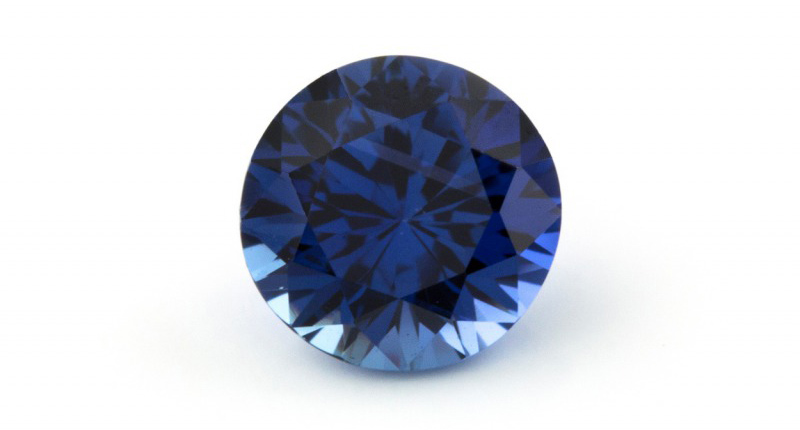
A 1.03-carat round brilliant Yogo sapphire, retailing for $13,742 at The Gem Gallery
NJ: What’s pricing like? What is the average per-carat price for a high-quality Yogo sapphire?
JB: A stone around 1 carat, AA+ grade (their average) will retail for around $13,000, assuming it’s of good, full-cut depth stone, quite clean. We get a lot of shallower stones, which are a bit less than that.
Now a 0.5-carat stone—and this is where you’ll really see the difference—is going to retail for around $1,300.
DB: When they hit the carat size, they jump up. We get top dollar for it because there aren’t very many of them. In the smaller size, the melee size, we’re really competitive on the market.
JB: Your 2 mm stones are going to be much more similar to fancy Montana sapphires or even Asian sapphires. There are so many of the smaller stones that your melees are fairly competitive. They’re still a little bit more, but to give you an idea, a 2 mm stone is probably going to retail for around $35-$40.
NJ: Tell me about the Yogos in The Gem Gallery, especially in terms of how people respond to them and how it’s helped set the store apart even more.
DB: The Gem Gallery was literally built from the ground up with Yogo sapphires. Everything I own came from Yogo sapphires so when you walk into the store, I’m going to say 70 percent to 80 percent of the total value that’s in the store is represented by Yogo sapphires.
We also carry a selection of Montana sapphires because not everybody can afford a Yogo; they’re expensive. But people walk in wanting a Yogo sapphire. We’re a destination. We have such an exclusivity with Yogos that people come to us because they know that we control the mine.
JB: We’ve become known for Yogos pretty thoroughly, so we get a lot of people coming into town to seek us out. We’ve got a whole wall in our store with information, and our staff are all very knowledgeable about them, so a lot of our days are spent informing people and showing them samples and helping them fall in love with these gemstones. We’ve had people come to Montana just to come see our Yogo collection and pick out their wedding ring, which is pretty special.
DB: Other plans I have right now is selling containers of concentrate, where people can take the gravel home and pick out their own Yogo sapphires. That’s something in the works right now and will be on the market soon. I plan to sell off a lot of the tiny stones that way; it’s something great for families to play with and pick out with tweezers, and it’s also ideal material if you’re learning how to gold pan.
NJ: Will you sell those out of The Gem Gallery?
DB: Yes. There’s going to be two arms of this: The Gem Gallery is our retail end, and Yogo Mining is going to be our wholesale end.
JB: They are two separate companies that will work closely together for sure and supply each other, but we do want to emphasize that they’re two companies with separate organization.
DB: Something else I’d like to mention is that what comes out of Yogo tends to be rather shallow. That’s just the nature of the crystal. Some of them are perfect rounds, but we have a lot of larger, flatter stones that work great for tumble polishing. That’s been one of our bestsellers and good profit maker, our tumbled Yogos, because we don’t sell them at the same high price as the cut stuff, but we sell them by weight and by size, so somebody can get a carat-plus Yogo sapphire that’s tumble- polished and mounted with diamonds and gold for a very reasonable price. I think that’s going to be a big thing.
“People walk in wanting a Yogo sapphire. We’re a destination. We have such an exclusivity with Yogos that people come to us because they know that we control the mine.”—Don Baide
NJ: It seems like there’s a trend of that in the market— setting either tumbled or rough material as is.
JB: Definitely. It’s an area we’re expending in a lot too, not just tumbled but rough as well, because it really does fit in with a lot of the reasons people buy Yogos. Almost anyone that’s wanting something that isn’t environmentally detrimental go for a Montana sapphire. The tumbled stones really fit what those people are looking for, and it’s a really beautiful finished piece that’s quite different from anything else.
NJ: Yogo sapphires come out pretty rich in color already, right? Not much needs to be done to them.
DB: There is no treating whatsoever. They’re not heated. They’re not chemically treated. They’re completely natural. These stones come out of the ground with very few inclusions. A lot of them that we cut are near-flawless in clarity. There’s a percentage of stones, of course, that are included and rejected that end up going into tumbling, but our cut gems are extremely clean.
For anyone interested in wholesale through Yogo Mining, Don said you can reach out to info@yogomining.com. A website is in development.
Brecken Branstratoris the senior editor, gemstones at National Jeweler, covering sourcing, pricing and other developments in the colored stone sector.