test
5 Things To Know About … Sphene
Discover what gives the gem a fire that can out-sparkle a diamond, its second name, geographic origins, and more.

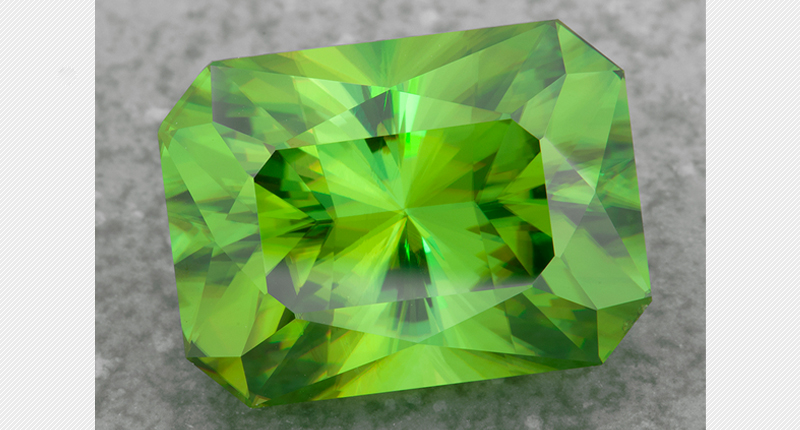
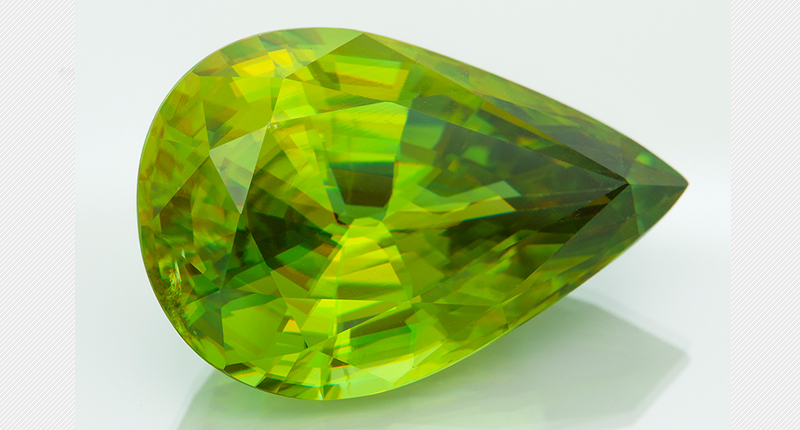
I, for one, love when the gemstone is a vibrant, almost lime green that also shows flashes of orange and yellow.
Sphene belongs to the titanite mineral group, occurring as an accessory mineral in granitic and calcium-rich metamorphic rocks, and is the only member of the group commonly used in jewelry.
Here are five things to know about this unique gemstone.
1. It has another name.
Sphene comes from the Greek word “sphenos,” meaning wedge, a reference to the mineral’s characteristic wedge-shaped crystals.
But it also goes by the name titanite, referencing its place in the mineral group.
According to many online sources, “sphene” is more commonly used in the gem and jewelry sector while geologists and mineralogists tend to use “titanite.”
2. Gem-quality examples are rare.
Sphene is a collector’s gem and is particularly rare when you start talking about a clean stone above 5 carats, the International Gem Society says.
As is the case with all gemstones, size creates a premium with this species.
3. It has more “fire” than a diamond.
Sphene has one of the highest dispersions of any mineral; the term dispersion refers to a mineral’s ability to break white light into spectral colors.
The dispersion of sphene is 0.051. A diamond’s dispersion, by comparison, is 0.044.
It’s this high number that helps to give the stone such an intense “fire,” showcasing multiple colors, especially when it’s well-cut.
Sphene has a refractive index of 1.843-2.110 and a birefringence of 0.100-0.192. Its high birefringence often results in visible doubling of facets within the stone, meaning there looks to be a “fuzziness” inside the gem.
It’s a 5 to 5.5 on the Mohs scale, making it softer than other, more well-known gems like sapphire, ruby and even garnet.
Sphene has distinct cleavage in one direction, but can still create beautiful jewelry when cut and set properly.
It’s also pleochroic, showing more than one color depending on the angle from which you view it; sphene’s transparent specimens are notable for their trichroism, showing three different colors.
The three colors depend on the base stone color, according to Gemdat.org.
4. It comes in a variety of hues, but some are preferred.
According to IGS, there’s a preference in the market for lighter tones, especially the yellows, light oranges and greens, which best show off the gemstone’s amazing dispersion.
IGS also notes that “chrome sphene”—dark green in color—is the most valuable type as its hue mimics a good emerald.
5. Here are its sources.
The primary sources of sphene are Canada, Madagascar and Mexico, IGS says.
Baja California, Mexico produces yellow-brown, brown, green and dark green (chrome) crystals up to 4 inches long, making it one of the world’s main sphene deposits.
Madagascar produces green crystals, some of which are large in size, while Canada produces brown and black crystals.
IGS added that Austria and Switzerland also have both produced sphene.
Other places where sphene has been found are: India, Sri Lanka, Afghanistan, Germany, Kenya, Myanmar, Pakistan, Russia, New York state and Minas Gerais, Brazil.
The Latest


A monthly podcast series for jewelry professionals

From protecting customer data to safeguarding inventory records, it's crucial to learn how to tackle cybersecurity challenges.

Test Podcast With Video. New interview with Ada Lovelace.

Abstract for tests. New Podcast interview with John Lennon, Jimi Hendrix and Jim Morison.

Ahead of the holiday season, Smith delves into the often subconscious reasons people buy luxury products for themselves or their loved ones.

The GMT-Master “Pepsi” belonging to astronaut Edgar Mitchell is a standout in RR Auction’s online “Space Auction,” going on now.

The ads celebrate the mall culture of the ‘80s and ‘90s.

Retail sales associates can access the video series on mobile to refresh their selling skills.

For 25 years, India’s Gem & Jewellery National Relief Foundation has provided aid in the wake of war, natural disasters, and global crises.

The November auction will feature a collection of jewels owned by Ferdinand I, the first king of modern Bulgaria, and his family.

Commercial production has begun underground at the Canadian diamond mine’s A21 pipe.

Deloitte and Adobe Analytics shared their insights on the season, from the retail sales forecast to the role of generative AI.

The Texas-based jeweler collaborated with luxury clothing brand Uncommon Man on men’s bands designed with European influences.

Industry players have found ways to cope with market conditions while working to reshape themselves in the face of emerging realities.

The sales event, in its second year, features a selection of rare diamonds from the miner’s Argyle and Diavik diamond mines.

A portion of the proceeds from the “Always Dream” collection will go to Yamaguchi's foundation, supporting early childhood literacy.