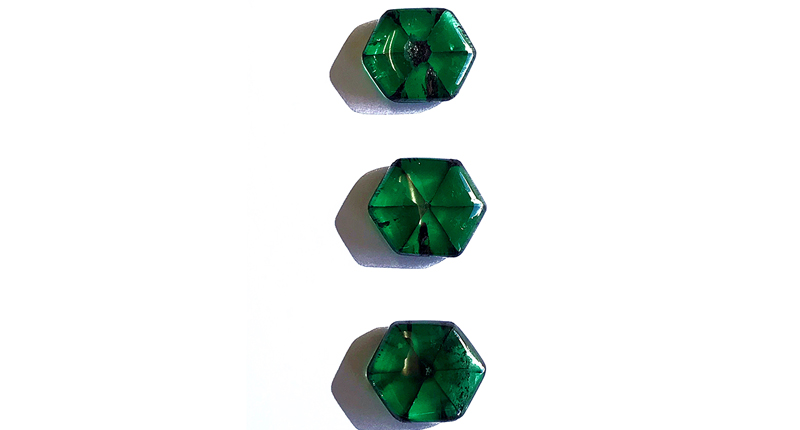
Emerald trapiche stars from gemstone dealer Mayer & Watt, weighing (from left to right) 9.97 carats, 7.37 carats and 7.75 carats
When it comes down to it, I think what’s most appreciated about a great colored gemstone is the fascination at what Mother Nature created--how the color is so vivid or saturated, how they can grow so large, how they tell the story of the Earth.
Trapiche gemstones are a great example of this. The geometry and symmetry of the stones created by their rayed patterns are truly spectacular and valued for both their beauty and uniqueness.
Trapiche emeralds were first on the scene, at least according to written records, with the name adopted because of their resemblance to “trapiche de caña de azucar,” the Spanish name for the six-spoked cogwheel used in sugar mills.
Beyond the almost-immediate fascination trapiches spark with their beauty and rarity, there’s plenty to know about these stones, starting with these five points below.
1. Trapiche gems have equivalent crystallographic growth patterns separated by boundaries of inclusions. According to the Gemological Institute of America’s “Gems & Gemology,” these boundaries intersect at a central point or extend from a central core, creating a pattern that, often, resembles a wheel.
Trapiche gems also are characterized by their high symmetry--which appears in a hexagonal manner, for example, for emeralds--and feature inclusions of organic matter.
2. There are a number of gemstones that can be found in trapiche variations. The spoke patterns that define trapiche gemstones are best known in the popular green beryl, but one can also find trapiche corundum, garnet, tourmaline and chiastolite, though chiastolite only exhibits four arms, InColor said.
3. The history of (finding and studying) trapiche is long. Or at least for emeralds, that is.
According to Gems & Gemology, Colombian trapiche emeralds were first described by French mineralogist Emile Bertrand in 1879 at a meeting for the Société Géologique de France, though they did not yet have a name.
The first known use of trapiche emeralds in jewelry is in an early-19th century gold ring by an unknown artist that was bequeathed to the Victoria & Albert Museum in London.
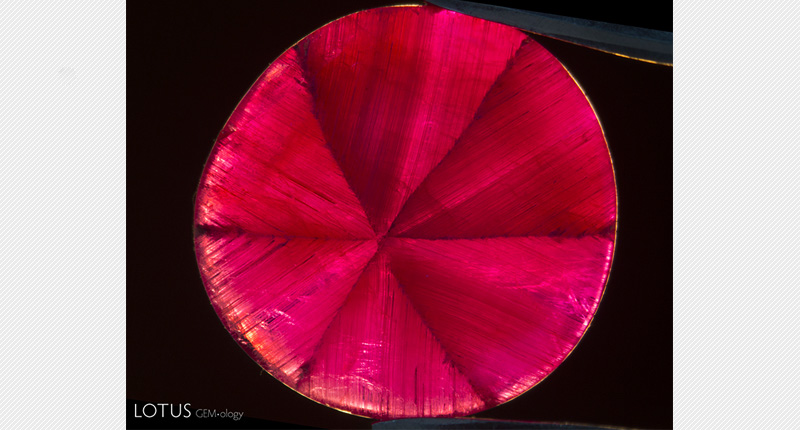
Trapiche rubies from Burma, meanwhile, were first documented by the GIA in 1995, according to InColor, but the stones also have been found in Guinea, Kashmir, Pakistan, Nepal, Sierra Leone and Tajikistan.
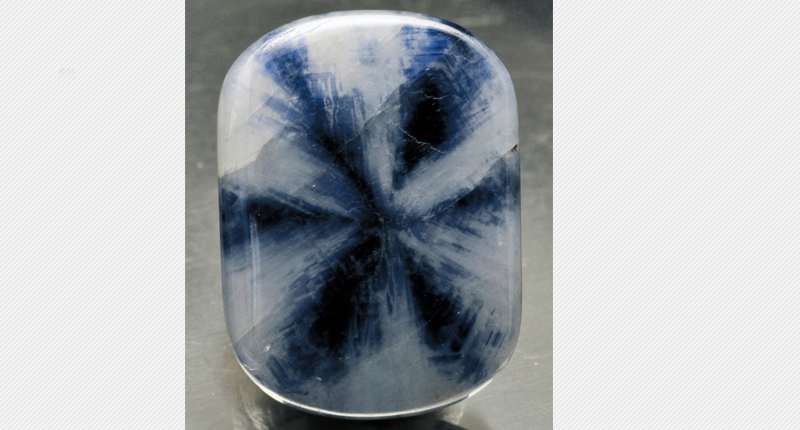
Trapiche sapphires first appeared on the gem market in early 1996, when samples were offered in Basel by a Berlin gem dealer, and have been found in Australian, Cambodia, China, France, Kenya, Madagascar, Nepal, Sri Lanka, Tanzania and more.
These three trapiche emeralds from Evan Caplan weigh 85.50 total carats.
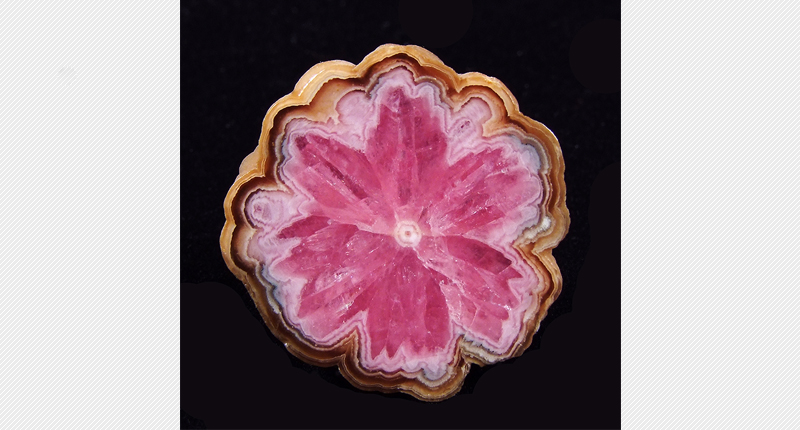
This trapiche rhodochrosite from the Capillitas Mine in Catamarca, Argentina, is 30 mm across and weighs 35 carats. It was likely mined in the 1960s, gem and mineral dealer Russ Behnke said.
A trapiche ruby from Mong Hsu, Myanmar (Photo credit: Lotus Gemology and Patharaphum Sudprasert)
A trapiche sapphire from Mayer & Watt weighing 36.16 carats
4. Supply and demand have stayed fairly consistent. As with any rare gemstone, trapiches are still pretty hard to come by, goldsmith and jeweler Paul Farmer said.
But there may be an opportunity, however big, with pieces or partial trapiche stones, he said, which can make unique pieces such as butterfly wings.
He sees some opportunity in this area as more lower-quality gems come onto the market, noting that they can “make fun, inexpensive pieces,” he said.
Jeffery Bergman of Primagem said emerald trapiche continue to be the most available and in highest demand of all trapiche gems.
Trapiche rubies from Burma, meanwhile, tend to be mostly under 1-carat in size, he added, and rather dark, requiring thin slicing to get the best color and trapiche pattern, which has had the effect of restricting their use in jewelry.
Bergman also said fine trapiche sapphires from Mogok, Burma are still in high demand with very limited supply.
“Most of the material on the market is semi-translucent to opaque, and the occasional gemmy translucent example fetches several thousand dollars per carat,” he said.
He added that Vietnam has been producing some semi-translucent-to-opaque trapiche sapphires ranging in size from 5 to more than 50 carats and reasonably priced at about $50 per carat for finer pieces.
Simon Watt of gemstone dealer Mayer & Watt also said that supply hasn’t changed much, with the fine stones still hard to come by and with the bulk of demand from gem connoisseurs.
What’s more, “There’s never enough (supply) for the demand to be so great,” he said.
In fact, he hasn’t seen a resupply of trapiche sapphires in the past year.
The difference for him, though, is that he’s been marketing the material for years, and it’s paid off with an increased buzz around the gemstones.
5. Prices have increased. The downside to the buzz he’s created, Watt said, has been a price increase; he said he’s seen prices double in the past five years for fine material.
This is not to mention the rarity of the stones keeping prices high.
Bergman also noted that prices of emerald trapiche have doubled and tripled over the past several years as well-known jewelry designers like Selim Mouzannar, Omi Prive and Erica Courtney have incorporated them into award-winning designs.
Still, Watt is hopeful prices will start leveling out, if nothing else, and notes that when he does get trapiche stones, he has rarely has trouble selling them.
“The end user is really looking for something very unique that blows their mind. Trapiches do just this because you look at them and think, ‘Nature is truly incredible, isn’t it?’”
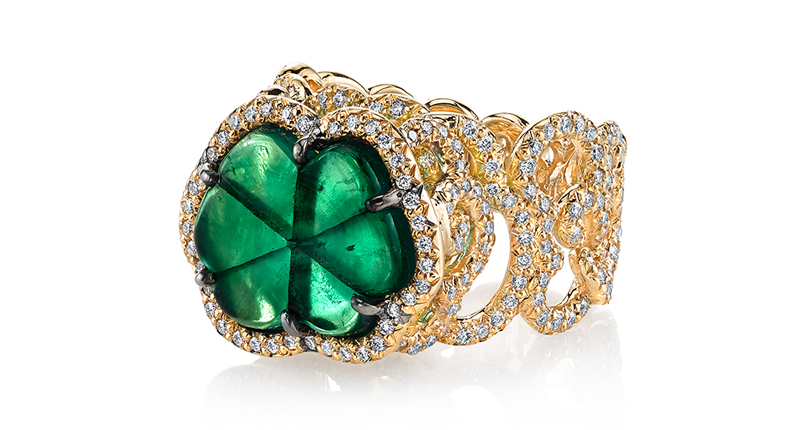
Erica Courtney’s 18-karat yellow gold “Cloud” ring, featuring a 6.24-carat trapiche emerald accented with 1.60 carats of diamonds ($45,500).
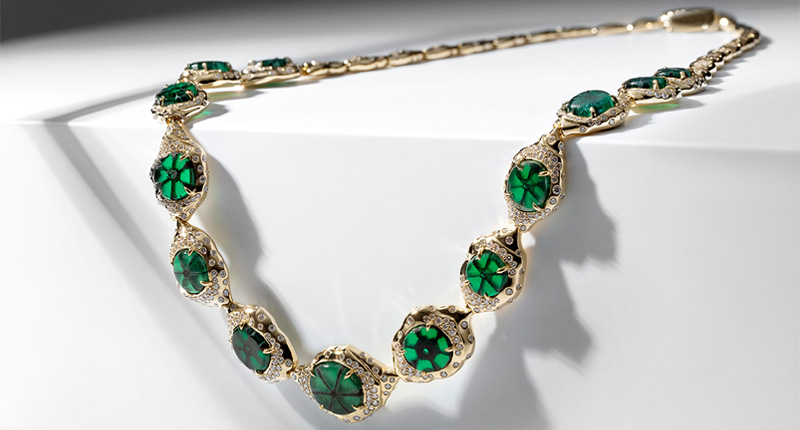
This necklace from Kat Florence features 13 cabochon trapiche emeralds from Colombia totaling 27.11 carats, along with round brilliant-cut D flawless diamonds weighing 4.78 carats set in 18-karat yellow gold (price available upon request). (Image courtesy of Kat Florence)
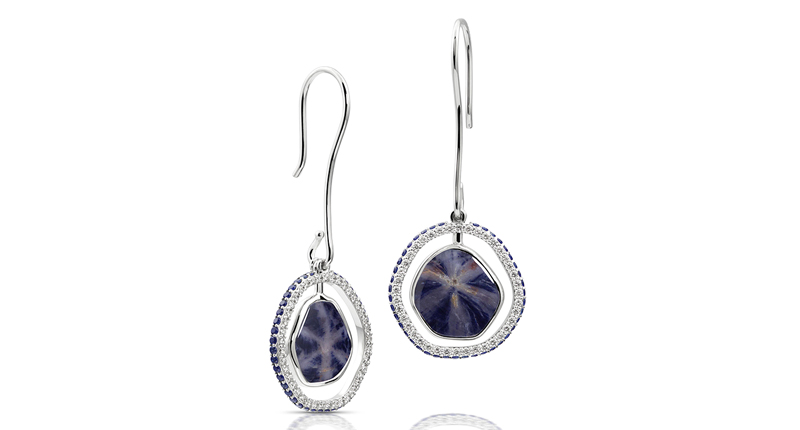
A pair of 18-karat white gold interchangeable earrings by Lindsay Jane Designs featuring trapiche sapphires and diamonds ($9,000). (Photo credit: Sara Rey Jewelry Photography)
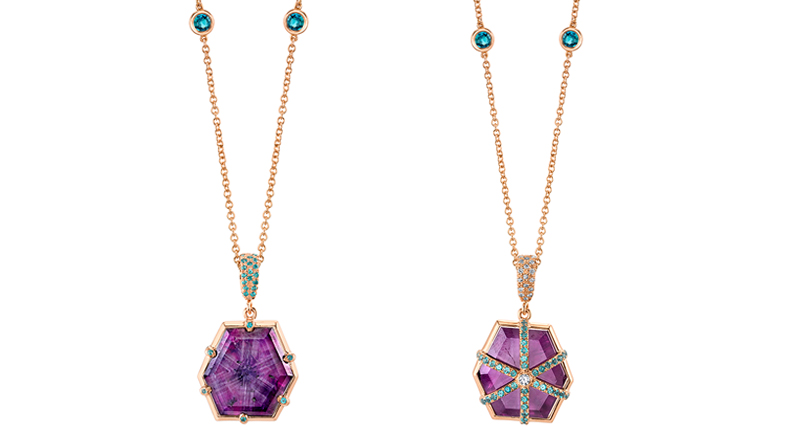
This necklace from Omi Prive, which is no longer available, features a 25.81-carat trapiche purple sapphire from Tajikistan accented on the reverse side with 1.41 total carats of Brazilian alexandrite and 0.14 carats of diamonds.
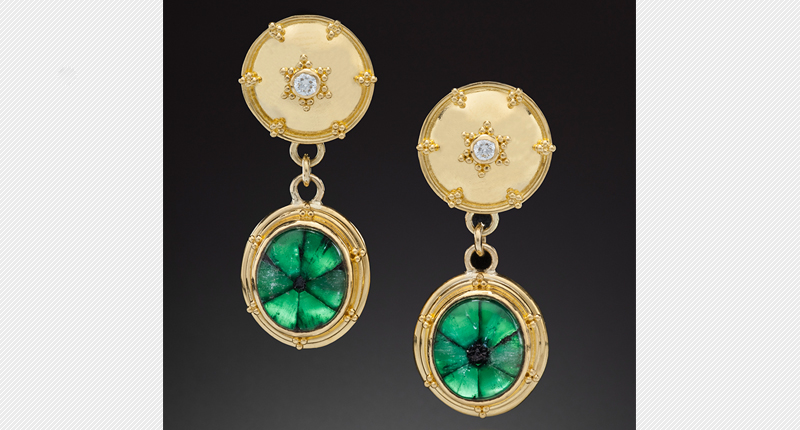
These earrings from goldsmith Paul Farmer feature 7.42 carats of emeralds which feature both the trapiche and cat’s eye phenomenon ($21,500). (Photo credit: Jeff Scovil).
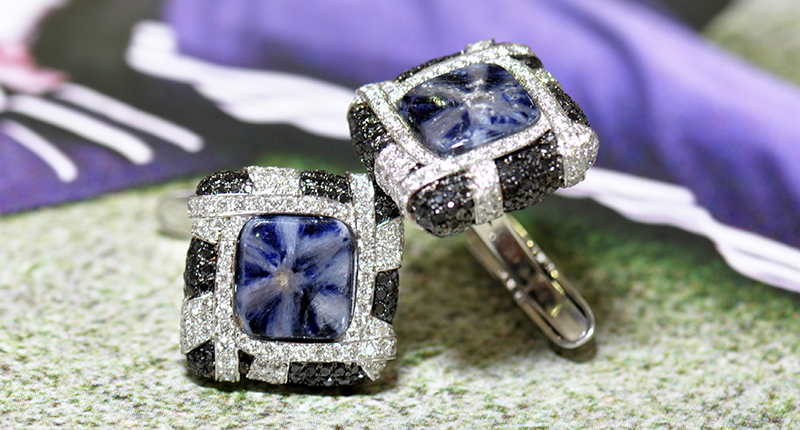
These cufflinks from Ricardo Basta Fine Jewelry feature two trapiche sapphires totaling 12.83 carats, set in 18-karat white gold and accented with 420 white diamonds and 278 black diamonds ($12,000).
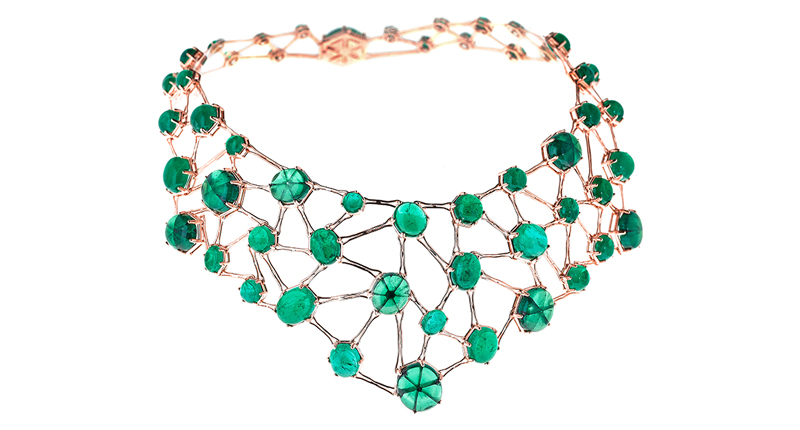
Selim Mouzannar’s necklace--which won Best in Colored Gemstones Above 20K at the Couture Design Awards in 2016--is comprised solely of natural emeralds from the Muzo mines in Colombia. Of 55 emeralds, eight are trapiche, and they total 163.26 carats. The necklace is for sale for $430,000.
Brecken Branstratoris the senior editor, gemstones at National Jeweler, covering sourcing, pricing and other developments in the colored stone sector.