test
A Hands-on Lesson in Telling Gemstones Apart
Senior Editor Brecken Branstrator recounts what she learned at an AGS Conclave education session on identifying gemstones presented by Gem-A.

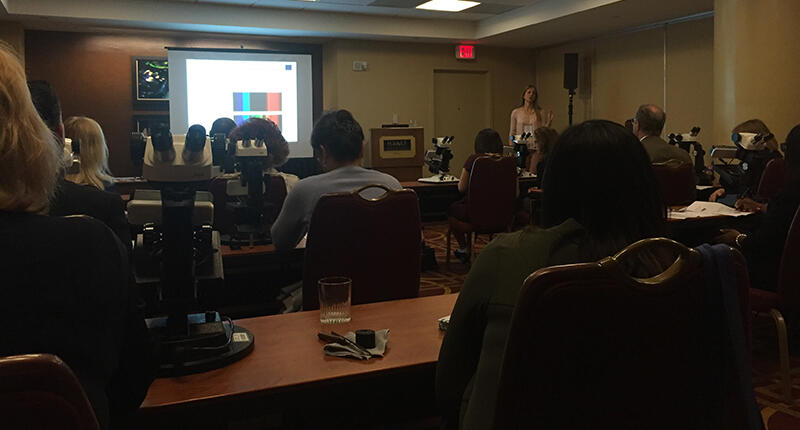
The American Gem Society knocks it out of the park every year for their Conclave event. The keynote speakers are top-notch, and the education sessions cover a wide variety of topics presented by experts in the industry.
Held in Washington, D.C. this year, Conclave again was full of great sessions, from a panel on bridal trends, to updates on diamond prices and grading reports, to a fascinating session on diamonds and their healing powers.
A particularly cool one that I got to attend was held Friday by The Gemmological Association of Great Britain (Gem-A).
In “Separating Similar-Looking Stones,” Gem-A’s Claire Mitchell began by walking session attendees through the steps used to identify a stone, starting with observation and then working through the instruments that can help jewelers tell apart similar-looking stones.
I loved this session because it was a hands-on experience--half the session was a presentation and the other half had us using the instruments ourselves. (I think a lot of people were excited about this session, as it had a waiting list and attendees were lined up before it started. I was lucky enough to just make it in and get a seat with equipment.)
First, Mitchell walked us through what kind of observations can be made before using any instruments.
For example, inclusions such bubbles and swirls or molding marks that indicate a paste glass might tell you that a gemstone is man-made.
Inclusions in natural stones can help indicate what the stone might be as well, such as “horsetail inclusions” found in demantoid garnets or “lily pads” that show up in peridot.
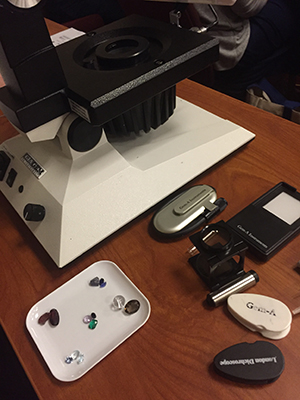
Next, Mitchell walked us through the use of instruments such as a polariscope, spectroscope and a dichroscope.
We got to use all three on gemstone samples provided so we could see for ourselves how each worked and what the stones looked like through the instruments.
The polariscope, for example, can tell you if a stone has double or single refraction, while a spectroscope is a diagnostic tool showing a spectrum of colors that is “like having a bar code for a gemstone” to help with identification.
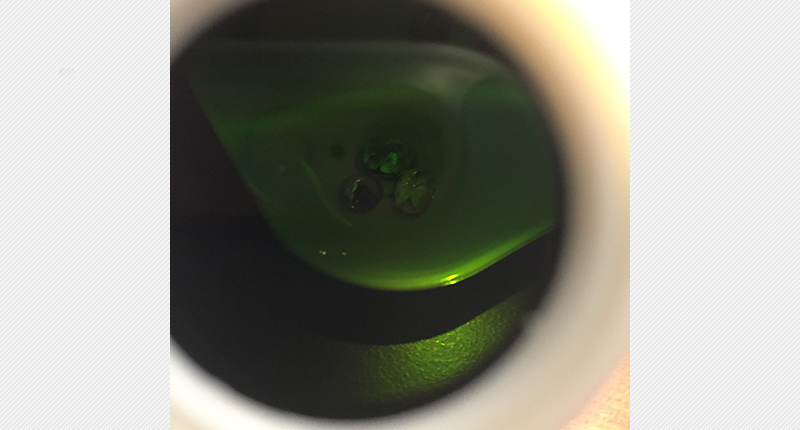
My personal favorite was the Chelsea Color Filter, which is a dichromatic filter that transmits two wavelengths only to help identify certain green, red and blue stones, as well as detecting dyes in certain gems.
Above is a picture of three different blue stones--aquamarine, topaz and spinel--under the filter.
I
While I’m always trying to see if I can guess what a gemstone is when I see it, Gem-A stressed that there should always be more tests involved to figure out a stone’s true identity. This session definitely made me want to go out and get some of these instruments for myself.
The Latest


A monthly podcast series for jewelry professionals

From protecting customer data to safeguarding inventory records, it's crucial to learn how to tackle cybersecurity challenges.

Test Podcast With Video. New interview with Ada Lovelace.

Abstract for tests. New Podcast interview with John Lennon, Jimi Hendrix and Jim Morison.

Ahead of the holiday season, Smith delves into the often subconscious reasons people buy luxury products for themselves or their loved ones.

The GMT-Master “Pepsi” belonging to astronaut Edgar Mitchell is a standout in RR Auction’s online “Space Auction,” going on now.

The ads celebrate the mall culture of the ‘80s and ‘90s.

Retail sales associates can access the video series on mobile to refresh their selling skills.

For 25 years, India’s Gem & Jewellery National Relief Foundation has provided aid in the wake of war, natural disasters, and global crises.

The November auction will feature a collection of jewels owned by Ferdinand I, the first king of modern Bulgaria, and his family.

Commercial production has begun underground at the Canadian diamond mine’s A21 pipe.

Deloitte and Adobe Analytics shared their insights on the season, from the retail sales forecast to the role of generative AI.

The Texas-based jeweler collaborated with luxury clothing brand Uncommon Man on men’s bands designed with European influences.

Industry players have found ways to cope with market conditions while working to reshape themselves in the face of emerging realities.

The sales event, in its second year, features a selection of rare diamonds from the miner’s Argyle and Diavik diamond mines.

A portion of the proceeds from the “Always Dream” collection will go to Yamaguchi's foundation, supporting early childhood literacy.