test
Ebola and the artisanal sector
Last week I had the chance to talk with Dorothée Gizenga, executive director of the Diamond Development Initiative, about how the Ebola outbreak is impacting the lives and livelihoods of the artisanal diamond diggers the organization aids.

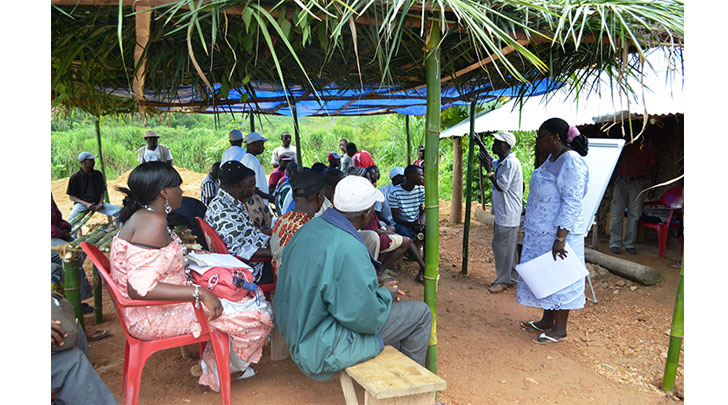
There, the DDI is working to create the Development Diamond Standards by training diggers on sound social and environmental practices and then helping them apply these practices. The sites where they work then are verified and certified by an independent third party as having produced ethical diamonds, and the DDI connects the miners with buyers in order to establish a chain of custody.
“That’s the project we have in place,” Gizenga said. “We want to make sure the artisanal miners are not marginalized in this big move for ethical sourcing.”
She said so far five sites, all in the Kono district of Sierra Leone, have been certified as ethical. The DDI wants to certify more sites in Kono, and expand the program to Côte d’Ivoire and Guinea, but those plans are on hold due to the Ebola outbreak, as are its current activities in Sierra Leone.
As noted in this thought-provoking piece on the Kono District, the country’s ban on groups of people gathering has pretty much brought the diamond mining sector there to a standstill, impacting not only those who mine diamonds but those who are involved in dealing, trading and transporting the stones.
As of Oct. 17, the World Health Organization reported that there was a total of 9,216 confirmed, probable and suspected cases of Ebola in seven countries. Of those, 3,410 are in Sierra Leone. The country is second only to Liberia in terms of the scope of the outbreak.
Gizenga said all members of her staff in Sierra Leone, which is entirely comprised of locals, are safe and well. But she worries what will happen when trade returns to the country.
[caption id="attachment_2566" align="alignright" width="593"]
With no new kimberlite pipes discovered in the last 20 years, the world’s reliance on the stones found by artisanal diggers in countries like Sierra Leone, which produces very high-quality diamonds, has increased. To wit: according to statistics compiled by the Kimberley Process, Sierra Leone exported
Gizenga said the Ebola crisis will have an impact on the enforcement issues the trade has worked so hard to implement in these countries, particularly as it relates to smuggling.
In addition to almost--but not entirely--bringing mining to a halt, the disease also has suspended trading, which means that when trading does resume there’ll be a glut of diamonds in the market, which is expected to depress prices and lead some to smuggle diamonds out of Sierra Leone, as people who have been struggling with little or no income for some time seek to liquidate them by any means necessary.
For those diamonds not taken out of the country, who will buy them? Will there be new buyers or will the old buyers return? Who will operate in this vacuum state that has been created?
Gizenga said these all are questions that remain to be answered. “I think it’s unknown at this point,” exactly just how big of an impact Ebola will have on the diamond industry, she said. “The longer it (the crisis) lasts, the bigger the impact.”
The DDI’s employees in Sierra Leone currently are gathering sanitizing supplies for distribution by local civil society partners in mining areas. Gizenga said anyone who wants to donate to DDI and their local partners to help stop the spread of Ebola in local artisanal mining communities can do so by sending an email to enquiries@ddiglobal.org, specifying that they want to donate funds for the fight against Ebola.
There is also the Humanitarian Coalition comprised of Oxfam, Care, Plan and Save the Children that is accepting donations to help the countries affected by Ebola more generally.
The Latest


A monthly podcast series for jewelry professionals

From protecting customer data to safeguarding inventory records, it's crucial to learn how to tackle cybersecurity challenges.

Test Podcast With Video. New interview with Ada Lovelace.

Abstract for tests. New Podcast interview with John Lennon, Jimi Hendrix and Jim Morison.

Ahead of the holiday season, Smith delves into the often subconscious reasons people buy luxury products for themselves or their loved ones.

The GMT-Master “Pepsi” belonging to astronaut Edgar Mitchell is a standout in RR Auction’s online “Space Auction,” going on now.

The ads celebrate the mall culture of the ‘80s and ‘90s.

Retail sales associates can access the video series on mobile to refresh their selling skills.

For 25 years, India’s Gem & Jewellery National Relief Foundation has provided aid in the wake of war, natural disasters, and global crises.

The November auction will feature a collection of jewels owned by Ferdinand I, the first king of modern Bulgaria, and his family.

Commercial production has begun underground at the Canadian diamond mine’s A21 pipe.

Deloitte and Adobe Analytics shared their insights on the season, from the retail sales forecast to the role of generative AI.

The Texas-based jeweler collaborated with luxury clothing brand Uncommon Man on men’s bands designed with European influences.

Industry players have found ways to cope with market conditions while working to reshape themselves in the face of emerging realities.

The sales event, in its second year, features a selection of rare diamonds from the miner’s Argyle and Diavik diamond mines.

A portion of the proceeds from the “Always Dream” collection will go to Yamaguchi's foundation, supporting early childhood literacy.