test
The ethics behind being recycled
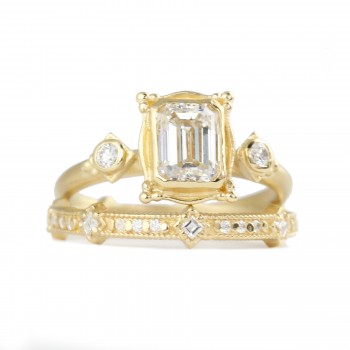
In early February, we ran a story about a new program called Sustainable in Style. Created by Scottsdale, Ariz.-based diamond company Avilan, the program pairs independents designers--Sofia Kaman, Toby Pomeroy and Megan Thorne among them--with Avilan’s “eco ethical” Storied Diamonds, which are recycled, or previously owned, stones.

Marianne Riou writes on the website for French diamond company Rubel & Ménashé that recycled diamonds are “increasingly on the agenda” in the U.S. market. National Jeweler’s own Brecken Branstrator reports on a new website that focuses on pre-owned engagement rings while IDEX Online’s Edahn Golan thinks the recycled diamond “party” is winding down at least “until the next major economic crash” (so ominous, Mr. Golan).
In the midst of all this, I received a call from a reporter for a major newspaper who informed me she was working on an article on the “trend” of more young people proposing with their great-aunts’ and grandparents’ engagement rings. The reasoning, she informed me, was because, basically, they were concerned about conflict diamonds and the “marketing tricks” associated with the stones.
Now, this is not a blog about all the misconceptions about diamonds, how the industry should be doing more to promote its positive aspects, or how ridiculous the insinuation is that diamonds are the only products on earth sold via marketing. My colleagues have done a fine job of that lately, as pointed out by JCK’s Rob Bates in this recent blog. All the stories he links to are worthy of a read as well.
But I am going to go ahead and make one point about recycled diamonds, and this is something that has always bothered me when people try to tout them as being more socially responsible than newly mined diamonds: The diamond industry has a long history that was ugly at points. Just because your stone came out of the ground before the rise of so-called blood diamonds doesn’t mean it’s completely without issue. Lack of proper housing, mistreatment of workers and health and safety issues--just to name a few of a myriad of problems--existed for decades following the time diamonds were first discovered in Africa in the late 19th century. Honestly, who do you think is better off: the miners of today in a nation such Botswana or those who were mining under colonial rule in the early 20th century?
I brought up this point in a recent interview with Jana Hadany, the vice president of operations
Hadany fully admits that there is indeed no way to guarantee an ethical origin for recycled stones. The company, she says, is not making any claims about their stones’ origin in selling their “Storied Diamonds.”
“We don’t know how it originally came into the market. It could have come from unethical sources,” she says.
What are they doing, however, is getting SCS Global Services to certify that all their diamonds are-post consumer, meaning pre-owned.
Hadany likens it to recycled paper. Just as all recycled paper originally came from a tree that had to be felled, all recycled diamonds originally came from the earth, which had to be mined. By buying recycled, though, consumers who are eco-conscious are not contributing to new diamond mining, just as those who buy recycled paper are not partaking in further deforestation.
“It’s a like a carbon-neutral kind of mentality,” Hadan says. “That’s why you buy it. There’s less impact on the environment.”
There’s definitely nothing wrong with that, just as long as consumers understand what exactly it means--and what it doesn't mean--when they choose a recycled diamond over a newer stone. Based on my conversation with the reporter and the negative reports that constantly pop up in the media about diamonds, I am not so sure many of them do.
The Latest


A monthly podcast series for jewelry professionals

From protecting customer data to safeguarding inventory records, it's crucial to learn how to tackle cybersecurity challenges.

Test Podcast With Video. New interview with Ada Lovelace.

Abstract for tests. New Podcast interview with John Lennon, Jimi Hendrix and Jim Morison.

Ahead of the holiday season, Smith delves into the often subconscious reasons people buy luxury products for themselves or their loved ones.

The GMT-Master “Pepsi” belonging to astronaut Edgar Mitchell is a standout in RR Auction’s online “Space Auction,” going on now.

The ads celebrate the mall culture of the ‘80s and ‘90s.

Retail sales associates can access the video series on mobile to refresh their selling skills.

For 25 years, India’s Gem & Jewellery National Relief Foundation has provided aid in the wake of war, natural disasters, and global crises.

The November auction will feature a collection of jewels owned by Ferdinand I, the first king of modern Bulgaria, and his family.

Commercial production has begun underground at the Canadian diamond mine’s A21 pipe.

Deloitte and Adobe Analytics shared their insights on the season, from the retail sales forecast to the role of generative AI.

The Texas-based jeweler collaborated with luxury clothing brand Uncommon Man on men’s bands designed with European influences.

Industry players have found ways to cope with market conditions while working to reshape themselves in the face of emerging realities.

The sales event, in its second year, features a selection of rare diamonds from the miner’s Argyle and Diavik diamond mines.

A portion of the proceeds from the “Always Dream” collection will go to Yamaguchi's foundation, supporting early childhood literacy.