test
Building a Better Customer Experience through Technology
Today’s consumers want to be engaged, entertained and educated, online and in store. Here are four tools to help jewelers do it.

New York--At the recent JCK Las Vegas show, technology to assist jewelers in improving the customer experience was on display at many booths. It was a hot topic of conversation during seminars, too.
Why? Technology feeds consumers’ desire to be engaged, entertained and educated, according to the 2017 Customer Experience/Unified Commerce Benchmark Survey, by Boston Retail Partners (BRP), a retail management consulting firm.
“Retailers need to fully maximize every experience with the customer using the abundance of physical and social outlets available to them,” the survey found.
That means educating and engaging consumers via social media, where many people now turn to learn about brands and products. But it also includes having technologies in store to provide product information and create unique shopping experiences that are fun and entertaining.
The BRP survey reports that 55 percent of retailers are now using digital signage and kiosks in store, up from only 20 percent last year. So it’s time to perhaps consider some additional online and in-store flair.
Luckily, companies and consultants at the show offered a variety of solutions from which to choose. This article details a few of them.
Engage and Educate Online
While many retailers are using Facebook and Instagram to interact with consumers, fewer are using LinkedIn and Twitter. But there are singular advantages to these networks, says marketing expert and jewelry industry consultant Ben Smithee, CEO of the Smithee Group, who presented a seminar at JCK Las Vegas specifically on LinkedIn and Twitter.
While Facebook and Instagram are great for image-driven excitement, LinkedIn and Twitter are where relationships can develop, words matter, and customers can learn from more in-depth content.
“LinkedIn is great for sharing blog posts and thought leadership--possibly the best right now,” Smithee said. “It’s also excellent for improving a company’s SEO.”
He advises that, along with making one’s personal profile prominent and creating a company page, there are also showcase pages retailers can create within their company profile. There, jewelers can highlight each of their product categories and add more content.
Another benefit of LinkedIn is that it doesn’t have as powerful an algorithm as Facebook and Instagram. The algorithms on those popular networks can prevent your posts from showing up on your friends’ feeds. But viewers who follow you on LinkedIn are more likely to see what you’ve shared.
You can also use LinkedIn’s Slideshare program to upload more detailed expert content,

And the final bonus: “You don’t need to pay for any of these features. Save your marketing dollars for Facebook and Instagram [where you may need to use paid ads in order to be seen by your followers].”
In terms of Twitter, Smithee says its core value now is in creating one-on-one relationships with like-minded people.
“When people ask me, ‘How do you find the time for social?’ I respond: ‘How do you not find the time?’ You have to be in the conversational flow online in order to be a part of the game today.” --Ben Smithee, CEO, The Smithee GroupYou can tweet about your business, but you should also post about non-jewelry topics to create affinities with others. The people you engage with will know you’re a jeweler, and you’ll be there for them when there’s a need.
Here are some examples of how to go about this task:
* Have an interest in local issues in your town, city, region or state? You can find others who do, too, by searching via hashtags for regional names. Liking and occasionally sharing these folks’ content can help you “win friends and influence people.” And they’re all potential customers.
* Have a hobby or other interest? If so look for others that share it, and share yourself.
* Love following the latest film or TV program, episode by episode? Find others who share your passions and interact with them.
When your connections do have jewelry questions, Smithee says Twitter’s ability to share video will allow you to give answers longer than 140 characters. You can also link to videos or other presentations you’ve already made on basic jewelry issues. And the bonus is that your followers already trust you because of the relationships you’ve built.
Though engaging in more than one or two social networks may feel overwhelming, it’s vital to building a great online reputation with prospective (and existing) customers in today’s wired and connected world.
Smithee observed that consumers have moved from simply searching for things online to discovering them, often by chance. You and your brand have to be present and communicating on a variety of social networks so that customers can discover you because that’s where they are.
“When people ask me, ‘How do you find the time for social?’ I respond: ‘How do you not find the time?’” says Smithee. “You have to be in the conversational flow online in order to be a part of the game today.”
And, if you truly don’t have time, consider a social networking ghostwriter who can learn your interests, become acquainted with your local issues, interact with your connections and post about your jewelry expertise.
The right person can learn your style--with approvals from you when necessary--and pass on private messages to see how you’d like to respond.
Entertain In-Store
Better customer experiences don’t just occur online, however.
As several companies at JCK Las Vegas demonstrated, you can bring the excitement and entertainment value of technology in store to share live with customers, and there are benefits to doing so.
This year’s winner of the JCK Think Tank, an annual competition that allows five technology vendors to present innovative ideas, was one example.
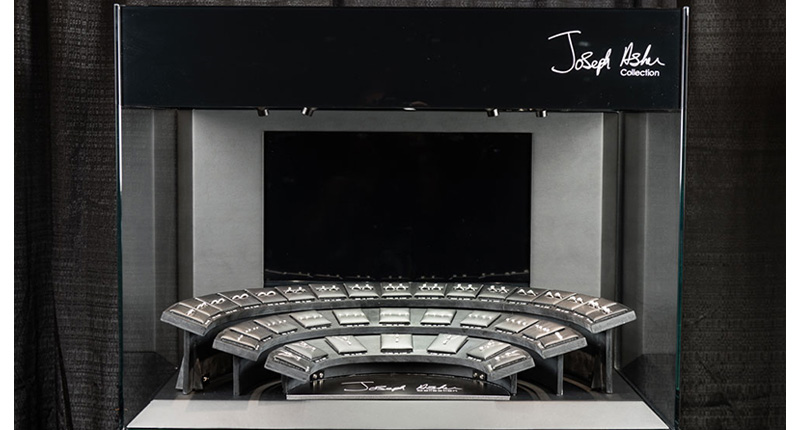
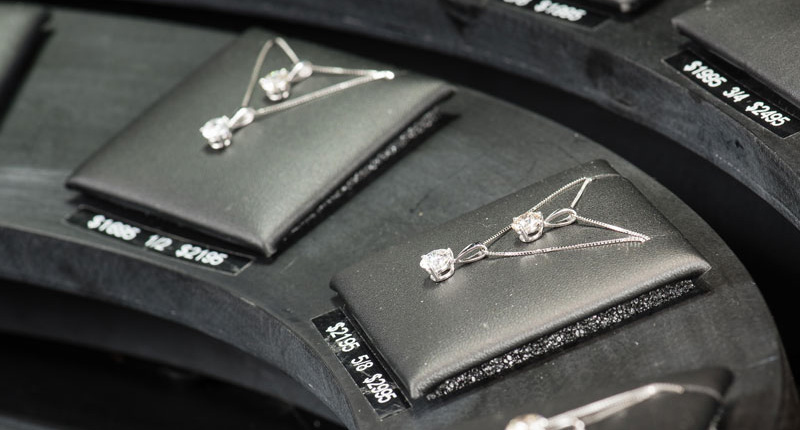
The Joseph Asher Side-by-Side Selling Solution kiosk contains an encased selection of five jewelry essentials that often form the foundation of a woman’s diamond jewelry wardrobe: solitaire diamond rings, diamond fashion rings, seven- and nine-stone anniversary bands, diamond ear studs and solitaire pendants. Everything is openly priced, and all selections feature a “better” and “best” version. The kiosk was pitched as a way to relieve the stress that men feel when shopping for diamond jewelry for women.
A computer screen within the kiosk guides men through incremental steps that help them identify their budgets and compare what different prices will get them in terms of diamond size and style.
As presenter David Rakower, of Rakower Corp., the New York-based diamond company selling the in-store system, explained, the kiosk acts as a silent salesperson to overcome three worries he says most guys have:
--They don’t want to make a mistake--hence the classics;
--They don’t want to be confused by an overly complicated selection--thus the two-choice idea; and
--They don’t like hidden prices--thus the pricing transparency.
Though the concept of making things simple for male buyers might not be new, the presentation and total package is, creating excitement in store, said Rakower.
To learn more about the Side-by-Side Selling Solution, visit DiamondSupport.com. http://www.diamondsupport.com/.
The winner of last year’s JCK Think Tank, Holojem, also went from being a concept to a product for sale at the show this year. It’s being sold by JM Facets LLC, a member company within the Jewelers Mutual Group of brands.
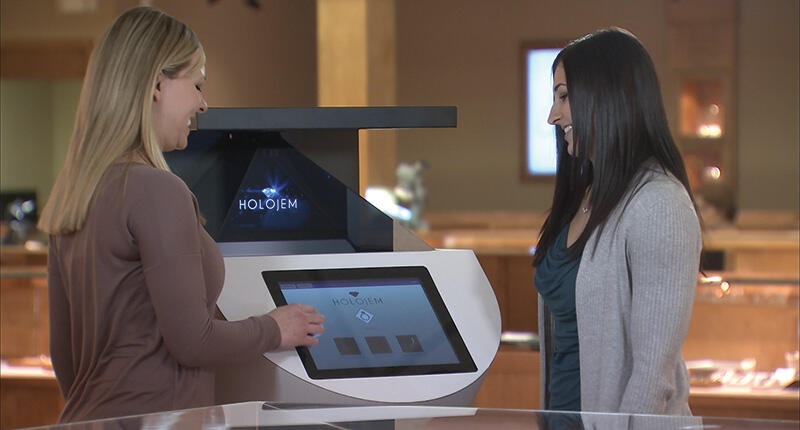
Holojem is an augmented reality platform in a self-contained kiosk that displays and shares both finished jewelry and custom designs via a patented 3-D rendering system.
Using the unit, customers can play with a variety of looks and styles and see them from every angle. During a custom design consultation, jewelers can use Holojem to help customers envision the designs they’ve just created, rendered in 3-D.
Then, when a customer is ready to leave the store, Holojem provides her or him with visuals of the creations plus a portable mobile pyramid she or he can perch on a smart phone to recreate the 3-D experience for friends and family. She or he can also share her designs via social media.
Holojem is $6,000 for Jewelers Mutual customers and $8,000 for non-customers. There is also a $249 monthly subscription fee that’s the same for both customers and non-customers; the fee covers the pyramids, unlimited cloud storage, the video content Jewelers Mutual provides for the kiosk (it can play videos continually when not in use), the warranty and service.
To learn more about Holojem, visit Holojem.com.
For jewelers who want to learn more about the intersection of technology and the customer experience, the BRP 2017 Customer Experience/Unified Commerce Benchmark Survey is a worthwhile read, allowing retailers to measure their efforts against those of other retailers.
The survey is available as a free download on the BRP website.
The Latest


A monthly podcast series for jewelry professionals

From protecting customer data to safeguarding inventory records, it's crucial to learn how to tackle cybersecurity challenges.

Test Podcast With Video. New interview with Ada Lovelace.

Abstract for tests. New Podcast interview with John Lennon, Jimi Hendrix and Jim Morison.

Ahead of the holiday season, Smith delves into the often subconscious reasons people buy luxury products for themselves or their loved ones.

The GMT-Master “Pepsi” belonging to astronaut Edgar Mitchell is a standout in RR Auction’s online “Space Auction,” going on now.

The ads celebrate the mall culture of the ‘80s and ‘90s.

Retail sales associates can access the video series on mobile to refresh their selling skills.

For 25 years, India’s Gem & Jewellery National Relief Foundation has provided aid in the wake of war, natural disasters, and global crises.

The November auction will feature a collection of jewels owned by Ferdinand I, the first king of modern Bulgaria, and his family.

Commercial production has begun underground at the Canadian diamond mine’s A21 pipe.

Deloitte and Adobe Analytics shared their insights on the season, from the retail sales forecast to the role of generative AI.

The Texas-based jeweler collaborated with luxury clothing brand Uncommon Man on men’s bands designed with European influences.

Industry players have found ways to cope with market conditions while working to reshape themselves in the face of emerging realities.

The sales event, in its second year, features a selection of rare diamonds from the miner’s Argyle and Diavik diamond mines.

A portion of the proceeds from the “Always Dream” collection will go to Yamaguchi's foundation, supporting early childhood literacy.