










SourcingDec 19, 2018
Take a Peek at the Largest Diamond Found in North AmericaEditorsApr 10, 2020
5 Interesting Facts You Might Not Know About Diamonds
Editor-in-Chief Michelle Graff recaps a webinar in which she learned more about the stones’ formation, inclusions and the oldest diamonds on Earth.


This 552-carat diamond was recovered from the Diavik Mine in Canada’s Northwest Territories in 2018, and holds the title of largest diamond ever found in North America. Canada is home to the oldest diamonds on Earth.
Last week, I wrote a blog post containing a list of 10 jewelry-related movies to watch while you’re safe at home to give both myself and our readers a break from coronavirus-related news.
I had a great deal of fun doing it, and it served as a much-needed reminder of how much I like to just write, not necessarily about a controversy or a lawsuit, or with clicks in mind, but just for the sheer pleasure of finding an expressive way of sharing something I enjoy.
With that in mind, I’m having fun again this week, this time by sharing five facts about diamonds gleaned from a webinar.
On Thursday, geologist Evan Smith, a research scientist at the Gemological Institute of America, held the first in what is going to be a series of online “Knowledge Sessions” presented by GIA.
The webinars will feature presentations on gemology from scientists, field gemologists and educators, continuing next Thursday with Mike Breeding, GIA senior research scientist, talking about identification methods for lab-grown diamonds.
(GIA is currently building a web page for its Knowledge Sessions; we will share it as soon as it is available.)
Smith’s talk, “The Unique Story of Natural Diamond,” focused on what makes the hardest substance on Earth—and one of the world’s most popular gemstones—so interesting to geologists.
I’ve interviewed and written about Smith’s research here and there over the years; he was the lead author of an article on blue diamonds that landed on the cover of Nature, a scientific journal, in 2018, and his diamond research made the cover of Science in 2016.
He alluded to both these studies in his presentation and taught me a few new things about diamonds as well.
Please feel free to comment below if you’ve learned anything, or if you just feel like saying hello. You also can view the presentation in its entirety on YouTube.
1. Diamonds form deeper in the earth than other minerals.
Most minerals including corundum (ruby and sapphire) and beryl (emerald, aquamarine and morganite) form in the Earth’s crust, which is the layer upon which we all live.
But not diamond, which Smith said is “completely exotic … because it is formed much deeper in the Earth,” beneath the crust at depths of 150-200 kilometers (93-124 miles) in the base of old, thick continents.
Some go even deeper than that, forming at the boundary between the Earth’s mantle and its outer core. These are known as superdeep diamonds.
(For those needing a visual refresher on the layers of the Earth, I found this diagram to be helpful.)
I had a great deal of fun doing it, and it served as a much-needed reminder of how much I like to just write, not necessarily about a controversy or a lawsuit, or with clicks in mind, but just for the sheer pleasure of finding an expressive way of sharing something I enjoy.
With that in mind, I’m having fun again this week, this time by sharing five facts about diamonds gleaned from a webinar.
On Thursday, geologist Evan Smith, a research scientist at the Gemological Institute of America, held the first in what is going to be a series of online “Knowledge Sessions” presented by GIA.
The webinars will feature presentations on gemology from scientists, field gemologists and educators, continuing next Thursday with Mike Breeding, GIA senior research scientist, talking about identification methods for lab-grown diamonds.
(GIA is currently building a web page for its Knowledge Sessions; we will share it as soon as it is available.)
Smith’s talk, “The Unique Story of Natural Diamond,” focused on what makes the hardest substance on Earth—and one of the world’s most popular gemstones—so interesting to geologists.
I’ve interviewed and written about Smith’s research here and there over the years; he was the lead author of an article on blue diamonds that landed on the cover of Nature, a scientific journal, in 2018, and his diamond research made the cover of Science in 2016.
He alluded to both these studies in his presentation and taught me a few new things about diamonds as well.
Please feel free to comment below if you’ve learned anything, or if you just feel like saying hello. You also can view the presentation in its entirety on YouTube.
1. Diamonds form deeper in the earth than other minerals.
Most minerals including corundum (ruby and sapphire) and beryl (emerald, aquamarine and morganite) form in the Earth’s crust, which is the layer upon which we all live.
But not diamond, which Smith said is “completely exotic … because it is formed much deeper in the Earth,” beneath the crust at depths of 150-200 kilometers (93-124 miles) in the base of old, thick continents.
Some go even deeper than that, forming at the boundary between the Earth’s mantle and its outer core. These are known as superdeep diamonds.
(For those needing a visual refresher on the layers of the Earth, I found this diagram to be helpful.)
Editors' Picks
Sponsored by
Smith said “very energetic” volcanic eruptions that come from below 200 kilometers bring diamonds to the surface. They are a sort of “accidental passenger” in these explosions.
With them, they carry valuable information in their mineral inclusions, which most commonly include kyanite, garnet and olivine.
Diamond inclusions can help researchers understand the distribution of elements in the Earth’s layers, for example, or when plate tectonics started.
“The diamond is surprisingly good at preserving these materials,” Smith said. “It’s very hard and durable, and good at keeping things from diffusing, or leaking, out of it, and diffusing, or leaking, into it.
“There’s a tremendous of information trapped in these diamonds.”
2. Superdeep diamonds were completely misunderstood until a few years ago.
For many years, diamonds that form at depths greater than 200 kilometers were believed to be small and never gem quality.
But in the past four years, Smith said, researchers have found that many large, high-quality diamonds—Type IIa diamonds (stones with top color and clarity) and Type IIb diamonds, which are gray or blue because of the presence of boron—are actually superdeep stones.
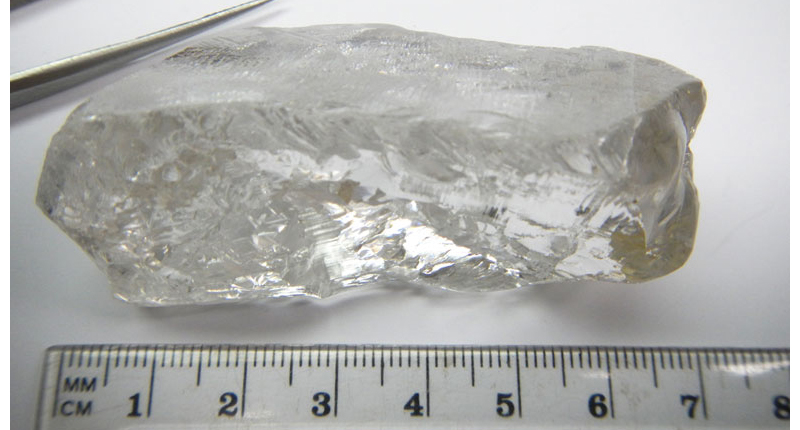
Evan Smith and a team of researchers studied offcuts from Type IIa diamonds, like this 404-carater, to gain a better understanding of the elements in Earth’s deep mantle. Their research landed them, and this diamond, on the cover of Science magazine in 2016.
One example of a superdeep diamond is the 404-carat rough diamond recovered from the Lulo Mine in Angola in 2016 (pictured above). Immediately found to be Type IIa and D color, it was the biggest diamond ever known to come from Angola.
The 813-carat Constellation diamond from the Karowe mine in Botswana also is a superdeep diamond, as is the famous Hope diamond and, of course, the largest diamond ever found, the 3,106-carat Cullinan.
Smith said superdeep diamonds are identifiable by the presence of high-pressure mineral inclusions like Ca-pv, calcium perovskite.
3. There are more diamond types than you might think.
Generally, when we talk about diamond types in the trade, we think of Type IIa or Type IIb, terms that speak to a diamond’s physical appearance, its color and clarity and, thereby, its value.
But to geologists like Smith, there are also eclogitic and peridotitic diamonds, two terms I had never heard prior to Thursday’s lecture.
Peridotite and eclogite are two types of rock found in the Earth’s mantle, and diamonds can form in both. These are not superdeep diamonds but the ones found closer, relatively speaking, to the surface of the Earth, also known as lithospheric diamonds.
Peridotite is an igneous rock and is the predominant rock type found in the mantle. If researchers find olivine inclusions in a diamond, then it tells them the host rock was peridotite.
A metamorphic rock, eclogite is much less common. The presence of kyanite inclusions in a diamond indicates it formed in eclogite rock.
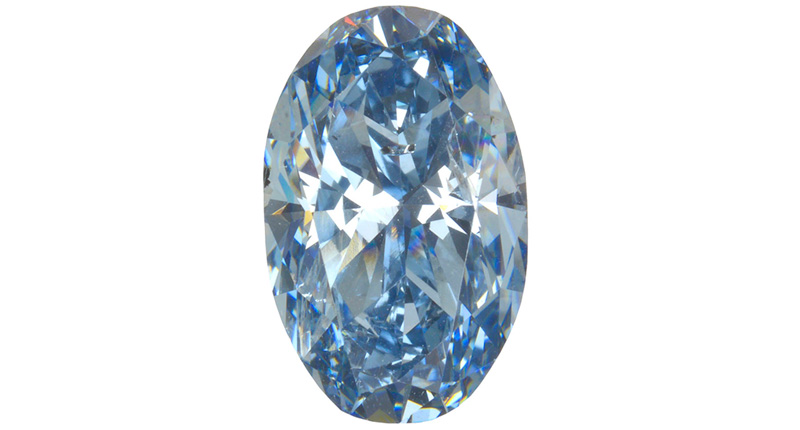
In 2018, Smith and a group of researchers completed a two-year study on included blue diamonds, like this 3.81-carat stone, that shed lights on how and where blue diamonds form. It was featured on the cover of Nature. (Photo credit: Robison McMurtry © GIA)
4. The oldest diamonds in the world are found in Canada.
Smith’s presentation included a timeline (who doesn’t love a timeline?) that illustrated just how old diamonds are relative to the history of, well, everything.
The Earth dates back 4.5 billion years while the planet’s oldest rocks, found in Northern Quebec, are 4.3 billion years old.
The oldest diamonds follow at 3.5 billion years old and, like the Earth’s oldest rocks, come from Canada, a fact I already was aware of after hearing Karen Smit, another GIA research scientist, speak about the GIA’s Diamond Origin Program back in the fall.
Smit said the oldest diamonds studied by geologists so far have come from the Diavik mine, which Rio Tinto owns and operates in partnership with Dominion Diamond Corp.
Some of Earth’s “younger” diamonds can be found at the Argyle (1.6 billion years old) and Ellendale mines (1.4 billion years old) in Australia, and in Sierra Leone, where the Zimmi diamonds are a spry 650 million years old.
To put this in perspective: All these diamonds are older than the Atlantic Ocean, which opened up when supercontinent Pangaea began to break apart about 200 million years ago, and the dinosaurs, which died off 65 million years old.
5. Pliny the Elder had something to say about diamonds.
Smith opened up his talk with a quote from Pliny the Elder, a Roman philosopher and naturalist who lived about 2,000 years ago: “Diamond is the most valuable, not only of the precious stones, but of all things in this world.”
And he concluded it with a quote from himself that I liked: “Every diamond tells a story from a place we can’t go and from a time long since passed.”
I’ve now shared a Pliny the Elder quote; my week is complete.
Have a great weekend everyone, and stay safe.
To put this in perspective: All these diamonds are older than the Atlantic Ocean, which opened up when supercontinent Pangaea began to break apart about 200 million years ago, and the dinosaurs, which died off 65 million years old.
5. Pliny the Elder had something to say about diamonds.
Smith opened up his talk with a quote from Pliny the Elder, a Roman philosopher and naturalist who lived about 2,000 years ago: “Diamond is the most valuable, not only of the precious stones, but of all things in this world.”
And he concluded it with a quote from himself that I liked: “Every diamond tells a story from a place we can’t go and from a time long since passed.”
I’ve now shared a Pliny the Elder quote; my week is complete.
Have a great weekend everyone, and stay safe.

More on Editors




The Latest




Weekly QuizOct 03, 2024
This Week’s QuizTest your jewelry news knowledge by answering these questions.


PodcastsJan 12, 2026
Introducing My Next Question, the PodcastA monthly podcast series for jewelry professionals


Brought to you by
Navigating Cybersecurity: Essential Guidance for JewelersFrom protecting customer data to safeguarding inventory records, it's crucial to learn how to tackle cybersecurity challenges.





PodcastsNov 27, 2025
Test Podcast With VideoTest Podcast With Video. New interview with Ada Lovelace.



PodcastsNov 25, 2025
Test New Podcast PostAbstract for tests. New Podcast interview with John Lennon, Jimi Hendrix and Jim Morison.

ColumnistsOct 09, 2024
Peter Smith: 7 Things to Know When Selling LuxuryAhead of the holiday season, Smith delves into the often subconscious reasons people buy luxury products for themselves or their loved ones.


AuctionsOct 09, 2024
Rolex Worn on Apollo 14 Mission Up for SaleThe GMT-Master “Pepsi” belonging to astronaut Edgar Mitchell is a standout in RR Auction’s online “Space Auction,” going on now.


MajorsOct 09, 2024
New Simon Campaign Invites Gen Z to ‘Meet Me At The Mall’The ads celebrate the mall culture of the ‘80s and ‘90s.


MajorsOct 09, 2024
PGI Launches New Virtual Sales TrainingRetail sales associates can access the video series on mobile to refresh their selling skills.


Policies & IssuesOct 09, 2024
GJNRF: Reaching Out, Rebuilding Futures For 25 years, India’s Gem & Jewellery National Relief Foundation has provided aid in the wake of war, natural disasters, and global crises.


AuctionsOct 08, 2024
Sotheby’s Selling Jewelry That Belonged to a Bulgarian TsarThe November auction will feature a collection of jewels owned by Ferdinand I, the first king of modern Bulgaria, and his family.

SourcingOct 08, 2024
Rio Tinto Begins New Phase of Production That Will Extend Diavik’s LifeCommercial production has begun underground at the Canadian diamond mine’s A21 pipe.

SurveysOct 08, 2024
What to Know About Online Shopping This Holiday SeasonDeloitte and Adobe Analytics shared their insights on the season, from the retail sales forecast to the role of generative AI.

CollectionsOct 08, 2024
Sylvie Adds New Men’s BandsThe Texas-based jeweler collaborated with luxury clothing brand Uncommon Man on men’s bands designed with European influences.

SourcingOct 08, 2024
Is Current Diamond Industry Turbulence Shaping a ‘New Normal’? Industry players have found ways to cope with market conditions while working to reshape themselves in the face of emerging realities.

SourcingOct 07, 2024
Rio Tinto to Offer 76 Diamonds in 2024 Beyond Rare Tender The sales event, in its second year, features a selection of rare diamonds from the miner’s Argyle and Diavik diamond mines.

CollectionsOct 07, 2024
Olympian Kristi Yamaguchi Partners With Heller Jewelers on New CollectionA portion of the proceeds from the “Always Dream” collection will go to Yamaguchi's foundation, supporting early childhood literacy.