test
The Smart Lab: Remove Friction and Don’t Make Me Think
Today, consumers expect a website that almost thinks for them. Here are tips on building one from Emmanuel Raheb.

When running your own business, establishing a solid online presence is vital and building an effective website is the foundation of that success.
Business owners have to make sure their brand is being found by their ever-growing online audience and consider how that will directly affect their sales performance.

When customers come to your website, you have only a matter of seconds to influence them and get them to what they’re looking for.
The good news is that you can make your website friendly while building or redesigning it just by paying attention to some simple concepts and better industry practices.
Treat It Like Your Store
It always amazes me when I look at the websites for some of the most well-run retail stores.
When I walk in the store, I’m immediately greeted by someone asking if I’d like something to drink. That someone is standing in front of the most beautifully laid out cases of jewelry, perfectly placed in categorical order, with just the right amount of lighting hitting at just the right spots.
When I ask to see an engagement ring, I’m immediately taken to that section, where they have elegantly displayed rings, in perfect order of style and price, making my shopping experience easy and thoughtful.
So I ask: Why in the world don’t you carry that same experience to your site?
UX and Usability
The hot topic on all website-related discussions is UX. UX stands for User Experience, and it’s the kind of thing that draws attention when something goes wrong.
UX defines how your customer will feel when navigating on your website and connecting with your brand, while usability will tell you how easy-to-use your website is.
Are they finding everything they need with few clicks? Is it intuitive? Are the buttons highlighted? Is the entire website user-friendly enough to make them feel comfortable?
The answers to all these questions have to be taken into consideration if you want your website to retain and sell to your customers.
Your user experience is as important as your design, and even more important when considering e-commerce-enabled websites. They have to be well organized, clever and have
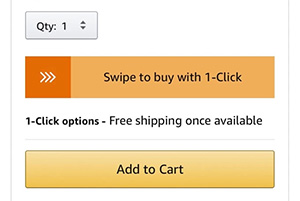
A great example of friction reduction proven to be a major success is Amazon and their one-click purchase feature (pictured here); it’s believed to have contributed $2.4 billion in additional revenue.
Experts believe this is one of the company’s biggest advantages in the online retail space, decreasing cart abandonment and improving sales.
A Friction-Less Experience (Don’t Make Me Think)
When talking about web pages, friction refers to anything that prevents a user from accomplishing a goal and every micro-moment that slows down your user.
Consumers expect to go to a site that almost thinks for them.
The less friction your website has, the easier it will be for your customer to purchase one or more products. In the digital age, people have little time to focus on only one website.
On your website, you have to make sure that your customers’ interests are displayed clearly for them, leaving no room for doubts. Your audience expects you to do all the hard work and offer a user-centered website that they’ll understand immediately.
Having a poorly designed website that your customers don’t understand will repel them, reduce your sales and weaken your brand’s credibility.
It’s not about staying where you are and not affecting your store sales. It’s about losing business to your competitors, and drastically losing the trust of your once-loyal audience.
As we say at Smart Age, “The more friction you remove, the less friction that’s tolerated.”
Emmanuel Raheb is the CEO of Smart Age Solutions, a digital ad agency and coveted Premier Google Partner. With nearly 18 years’ digital marketing and e-commerce experience, Raheb is passionate about helping and strategically growing national jewelry brands and local retailers alike. Contact him at eraheb@smartagesolutions.com.
The Latest


A monthly podcast series for jewelry professionals

From protecting customer data to safeguarding inventory records, it's crucial to learn how to tackle cybersecurity challenges.

Test Podcast With Video. New interview with Ada Lovelace.

Abstract for tests. New Podcast interview with John Lennon, Jimi Hendrix and Jim Morison.

Ahead of the holiday season, Smith delves into the often subconscious reasons people buy luxury products for themselves or their loved ones.

The GMT-Master “Pepsi” belonging to astronaut Edgar Mitchell is a standout in RR Auction’s online “Space Auction,” going on now.

The ads celebrate the mall culture of the ‘80s and ‘90s.

Retail sales associates can access the video series on mobile to refresh their selling skills.

For 25 years, India’s Gem & Jewellery National Relief Foundation has provided aid in the wake of war, natural disasters, and global crises.

The November auction will feature a collection of jewels owned by Ferdinand I, the first king of modern Bulgaria, and his family.

Commercial production has begun underground at the Canadian diamond mine’s A21 pipe.

Deloitte and Adobe Analytics shared their insights on the season, from the retail sales forecast to the role of generative AI.

The Texas-based jeweler collaborated with luxury clothing brand Uncommon Man on men’s bands designed with European influences.

Industry players have found ways to cope with market conditions while working to reshape themselves in the face of emerging realities.

The sales event, in its second year, features a selection of rare diamonds from the miner’s Argyle and Diavik diamond mines.

A portion of the proceeds from the “Always Dream” collection will go to Yamaguchi's foundation, supporting early childhood literacy.