A marketing image used around the launch of Lightbox, the lab-grown diamond brand De Beers brought to market in 2018.
I didn’t think about the fact that we are ending a decade until I saw the lists start popping up online—the best albums of the 2010s, the best movies, the worst fashion trends, the most unexpected celebrity breakups.
So, I decided to play along. Instead of doing my usual end-of-year article on the biggest stories of the past year, I expanded my scope.
With the help of a handful of retailers and others, I compiled a list of the developments that had the biggest impact on the fine jewelry industry between 2010 and 2019.
Here they are, presented in chronological order.
1. Instagram Launched It’s strange to think about now but, back in 2010, Facebook (the open-to-everyone version) and Twitter were only 4 years old, the iPad was brand-new and there was no Snapchat, Uber, Alexa or Apple Watch.
And, until October of that year, there was no Instagram.
It did not take the photo-sharing app long to state its case as a social media platform with potential, and people took notice.
Less than two years after its launch, Facebook Inc. forked over $1 billion to own Instagram.
Today the photo-sharing app is, arguably, the most important social media platform for jewelry designers and retailers.
Because they know what I do for a living, my friends constantly ask for my opinion on different pieces of jewelry or jewelry designers (yes, they like and wear jewelry, but they won’t find you if you’re not in the right places.)
When I ask where they saw a certain piece or became familiar with a designer, the answer is always Instagram.
Instagram is easy and fun, and has avoided becoming the cesspool of negativity, partisan political discourse and fake news that have turned people off sister site Facebook.
Its importance to brands and retailers will only continue to increase as it creeps closer to letting users shop directly on the platform.
Being able to shop on one’s smartphone from Instagram or other apps, known as mobile commerce or m-commerce, will play an even bigger role in the coming decade.
2. De Beers Shut Down the Diamond Promotion Service It’s hard to believe this happened in the past decade, as the Diamond Promotion Service, or DPS, seems like a stone that’s been buried for a billion years.
I couldn’t find National Jeweler’s story on the closure, but I did find this mention of my story
shared on PriceScope in December 2010 and confirmed with De Beers that it was indeed in 2010 that it pulled the plug on the DPS.
The shuttering of De Beers’ U.S.-based marketing arm, which stoked diamond jewelry demand for generations with ad campaigns like “Shadows” and beacon programs like “Journey,” heralded the start of a dilemma that plagued the jewelry industry throughout the 2010s.
There wasn’t enough advertising for diamond jewelry, or any jewelry really. This, coupled with changing consumer style and desires, caused the industry to lose ground to electronics, handbags, cosmetics and experiences.
In 2015, the world’s biggest diamond miners finally got it together and formed the Diamond Producers Association, which has been developing marketing campaigns for natural diamonds.
And Jewelers of America is spearheading a consumer-facing marketing campaign designed to get consumers, particularly women who buy jewelry for themselves (more on that below), engaged with all types of jewelry.
It will be interesting to see what impact these campaigns have in 2020 and beyond.
3. Signet Bought Zale, LVMH Bought Tiffany I started working on this blog post in early November and had a clear, single-story entry for No. 3—Signet Jeweler’s Ltd. 2014 purchase of Zale Corp.
Then a few weeks pass and, suddenly, Signet is forced to share.
Luxury Paris-based behemoth LVMH announced Nov. 25 it was acquiring iconic New York retailer Tiffany & Co. in a deal valued at $16.5 billion, for various reasons.
These two billion-dollar deals are the standout headlines in a decade during which consolidation and shrinkage were continual storylines for the U.S. jewelry industry.
Consider this: At the end of 2010, the Jewelers Board of Trade had the size of the North American jewelry industry pegged at 31,623—23,680 retailers, 4,543 wholesalers and 3,400 manufacturers.
Fast-forward to the third quarter 2019, and the JBT’s count has shrunk nearly 18 percent to 26,092—19,738 retailers, 3,777 wholesalers and 2,577 manufacturers.
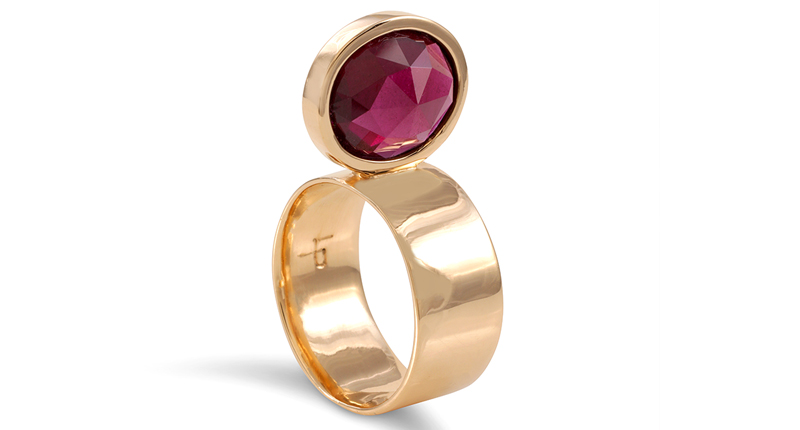
Leslie Page designed this 14-karat yellow gold ring set with a garnet from Mozambique ($4,000) for the “Lift Collection.” The collection features responsibly sourced gemstones from Anza Gems and is being sold at Greenwich St. Jewelers to benefit mining communities in East Africa.
4. There Was a Pitch to Ditch ‘Semi-Precious’ There have been a couple columns that have caused me to change how I approach my job at National Jeweler, and Monica Stephenson’s February 2015 InStore article advocating for elimination of the term semi-precious is one of them.
In it, the Anza Gems owner wrote there are many beautiful gemstones that could be considered both precious and rare that aren’t one of the “big four”—diamond, sapphire, ruby and emerald.
After I read her column, I instructed National Jeweler’s editors to stop using the term (which is not to say one or two mentions didn’t slip through the cracks over the years).
Monica is right, and her ahead-of-the-times column was the forerunner to a couple trends that will continue to impact the industry in the next decade—the rising popularity of color and the evolving conversation about the value of gemstones, both diamonds and colored.
5. The Casual Revolution Continued There’s no specific date for this development, but I’ve decided to place it between Monica’s column (2015) and the industry’s marketing revelation because of the year in which the term “athleisure” was officially added to the dictionary—2016.
Athleisure refers specifically to clothing that, years ago, you would you have worn only to the gym.
It’s rise in popularity in recent years is the culmination of a larger, long-term cultural shift in the United States—people don’t “dress up” as much as they used to, whether they’re in the office, at the theater or out to dinner.
Retired Ohio jeweler Jim Alperin, who now resides in Florida, listed the casual revolution as one of the three main factors that’s going to impact the industry going forward.
“I get a television station that shows old shows, ‘Charlie’s Angels,’ ‘The Andy Griffith Show,’ ‘Gomer Pyle, U.S.M.C.’ etc. It’s amazing to see how styles have changed. Men were wearing three-piece suits to go to a ball game!” he wrote.
“The trend seems to be continuing and once the styles of old are lost, they will never return. I think that holds true for classic fine jewelry as well. Very few people go to a grand ball today or have reason to wear a diamond collar … it sits in the drawer or the bank.”
It’s an evolution that has jewelry companies and designers rethinking what kind of jewelry they make and considering what people are going to be doing when they wear it.
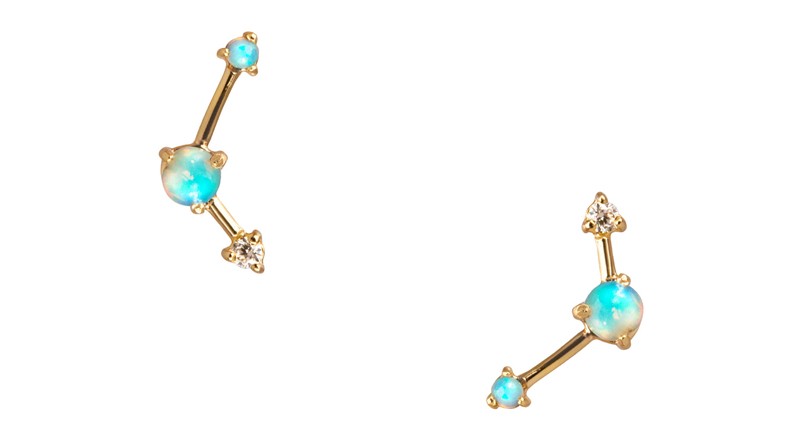
These 14-karat yellow gold opal and diamond earrings from Wwake were one of the pieces featured in a 2017 National Jeweler story on jewelry to stock for women looking to buy something for themselves.
6. The Industry Had a Marketing Revelation Former JCK Editor-in-Chief Hedda Schupak was writing about the importance of marketing fashion pieces to women buying jewelry for themselves in the early aughts, so it was no surprise the current editor of the Centurion newsletter listed the following among her top five most important developments of the decade.
At No. 4, she put: “The industry finally, FINALLY starting to acknowledge how important it is to sell jewelry as fashion to a female self-purchase audience.”
Like the casual-dressing revolution, it’s tough to pin an exact date on this one, though it’s worth noting De Beers made women buying their own jewelry the focus of its Forevermark marketing blitz in 2018.
Women also were the stars of the Diamond Producers Association’s “For Me, From Me” campaign that launched in early 2019, and they are the focal point of “Another Piece of Your Story,” the industry-led marketing campaign that just concluded its trial run.
7. ‘Where Was This Made’ Became a Big Conversation At some point in the past decade, I was at a trade show somewhere (it all blends together after a while, no?) and I heard a De Beers executive say how at one point in time, the company never would have considered talking about its mines in marketing diamond jewelry.
The imagery surrounding mines—piles of dirt and clunky metal machinery—was not what De Beers wanted consumers calling to mind when they thought of luxurious, beautiful diamonds.
Fast-forward to the 2010s, and origin is all anyone wants to talk about it seems.
Consumers want to know where the gold, diamonds and colored gemstones in their jewelry come from, and the industry—including big players like De Beers, Tiffany and even the Gemological Institute of America—is telling them and utilizing new technologies, like blockchain, to help do so.
The issue of ethical sourcing and social responsibility are so big, in fact, they spawned a couple new events in an industry already over-scheduled with trade shows and conferences.
The Jewelry Industry Summit, an interactive forum on responsible sourcing, held its first event in New York City in March 2016 and has had several iterations since then, with its next planned for L.A. in March.
Meanwhile, the first Chicago Responsible Jewelry Conference took place in 2017 and, according to the organization’s website, plans for its fourth edition in 2020 are already underway.
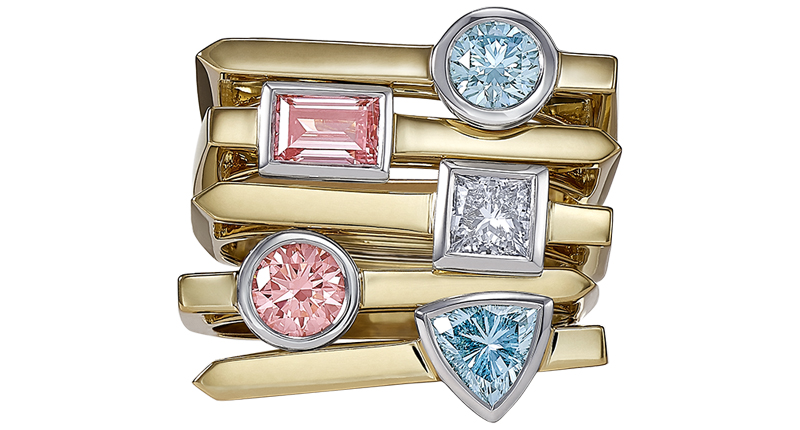
A stack of 10-karat yellow gold rings set with lab-grown blue, pink and white diamonds from De Beers’ brand, Lightbox. The rings retail for $600.
8. De Beers Started Selling Lab-Grown Diamond Jewelry Almost every single individual I reached out to for this story listed lab-grown diamonds—specifically, the ability to produce colorless or near-colorless diamonds in commercially viable quantities—as one of, if not the, biggest development of the past 10 years.
The decade’s tipping point with man-made diamonds came in May 2018, when De Beers announced it would begin selling inexpensive fashion jewelry set with blue, white and pink diamonds grown in its factory in the U.K.
Following De Beers’ announcement, more and more retailers picked up lab-grown diamond lines—most significantly Signet—which now sells them at all its major U.S. jewelry banners, JCK’s Rob Bates reported.
Lab-grown diamonds aren’t going away, and they will be an integral part of the coming decade too as their place in the industry solidifies.
What will be their market share?
What will consumers buy them for, exactly? (Hedda wrote lab-grown diamonds “will probably replace the ‘frozen-spit’ category of mined diamonds in lower-end or discount jewelry.”)
How are they going to impact the value of natural diamonds?
And, how are they going to affect consumer perception of natural diamonds?
As my retired retailer friend Jim put it: “You may not like man-made diamonds … but they are a part of today and tomorrow’s jewelry industry.”
Normally, I would end a blog post like this with something along the lines of, “I’m sorry if I’ve missed something.” But I won’t because eliminating unnecessary apologizing is one of my resolutions for 2020.
Happy holidays to all! See you next year.
Michelle Graffis the editor-in-chief at National Jeweler, directing the publication’s coverage both online and in print.