test
Why there are diamonds in Arkansas
Editor-in-Chief Michelle Graff explores the geologic origins of the diamonds found in The Natural State.

An amateur prospector from Colorado uncovered a beautiful 8.52-carat white rough diamond and the story, as Crater stories usually do, ranked among National Jeweler’s most-read articles for the week.
Whenever we cover discoveries like these at the Crater of Diamonds, two questions always come to mind for me.
Number one, why are there diamonds in Arkansas, and are there diamonds in any other part of the United States? And, number two, are people finding more diamonds in Arkansas recently or are diamond finds just getting more coverage?
To understand why there are diamonds in The Natural State, you have to go back about 300 million years, when the two tectonic plates we now call North and South America collided with each other.
The collision formed the Ouachita (pronounced wash-a-taw) mountain range, which is located just eight miles north of the park.
Now fast-forward about 200 million years, to 100 million years ago, and the site where the park is today blows a gasket, literally (as is common where the Earth’s tectonic plates have converged.)
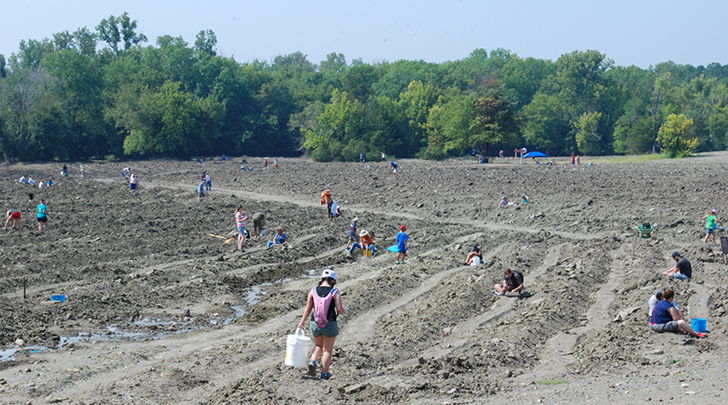
Instability within the Earth’s mantle forced gas and rock to move toward the surface, and there was a volcanic eruption that blew an 83-acre, funnel-shaped hole into the Earth, Crater Park Interpreter Waymon Cox explained to me via a phone interview recently.
(In case anyone is wondering, he’s called an interpreter because it’s his job to relay, i.e., interpret, information about the park’s geology, history and on how to search for diamonds to visitors.)
Cox said many diamonds, which had been forming underground due to the heat and pressure, came up with eruption.
While many were destroyed in the blast, a fair number also survived, and that’s what visitors find today at the Crater.
So, have the last couple of years, which have their share of good-sized rough finds, been an unusually active time for the park?
Cox doesn’t answer with an overwhelming yes, saying only that diamond discoveries at the park come and go in waves, influenced by a couple different factors.
First, there is the weather. More rain brings more diamond finds, as it washes away dirt and makes stones easier to find.
Secondly, there are the crowds. One big diamond find seems to begat another, not because people have hit on a particularly rich vein at the site but because big finds get a lot of publicity, bringing more people out to search.
More people searching equals more people turning up diamonds.
The GIA’s Russ Shor, who visited the Crater of Diamonds back in the 1990s when he was a writer for JCK (current JCK Editor-in-Chief Victoria Gomelsky did so as well, much more recently), said diamonds also were found near Rocky Mountain National Park in Colorado in the ‘90s and, going back even farther, JCK reported on diamonds being discovered in Georgia in the 1890s (before National Jeweler even existed).
But, overall, there has never been a huge diamond discovery in the U.S.
Shor notes that kimberlite and lamproite pipes, the two types of pipes that carry diamonds, don’t have an equal distribution of the stones and, of those that do contain diamonds, a smaller percentage still contain an amount of diamonds that make mining worth it.
(Interesting side note: the pipe at the Crater of Diamonds is a lamproite pipe. Shor says the only other known lamproite deposit in the world is the Argyle mine in Australia.)
He also notes that kimberlite pipes often come in clusters, like with the Kimberley Mines in South Africa.
At the Crater of Diamonds, Cox says they did try to mine the site commercially from 1906, when diamonds were first found there, to the 1950s.
In the 1990s, when a man named Bill Clinton was governor, the state decided it was once and for all going to determine if it was a sitting on diamond deposit that was worth mining or not.
As you might have guessed, what the state found was that the site “wasn’t commercially viable,” Cox says.
And so a park it remains. Happy hunting.
The Latest


A monthly podcast series for jewelry professionals

From protecting customer data to safeguarding inventory records, it's crucial to learn how to tackle cybersecurity challenges.

Test Podcast With Video. New interview with Ada Lovelace.

Abstract for tests. New Podcast interview with John Lennon, Jimi Hendrix and Jim Morison.

Ahead of the holiday season, Smith delves into the often subconscious reasons people buy luxury products for themselves or their loved ones.

The GMT-Master “Pepsi” belonging to astronaut Edgar Mitchell is a standout in RR Auction’s online “Space Auction,” going on now.

The ads celebrate the mall culture of the ‘80s and ‘90s.

Retail sales associates can access the video series on mobile to refresh their selling skills.

For 25 years, India’s Gem & Jewellery National Relief Foundation has provided aid in the wake of war, natural disasters, and global crises.

The November auction will feature a collection of jewels owned by Ferdinand I, the first king of modern Bulgaria, and his family.

Commercial production has begun underground at the Canadian diamond mine’s A21 pipe.

Deloitte and Adobe Analytics shared their insights on the season, from the retail sales forecast to the role of generative AI.

The Texas-based jeweler collaborated with luxury clothing brand Uncommon Man on men’s bands designed with European influences.

Industry players have found ways to cope with market conditions while working to reshape themselves in the face of emerging realities.

The sales event, in its second year, features a selection of rare diamonds from the miner’s Argyle and Diavik diamond mines.

A portion of the proceeds from the “Always Dream” collection will go to Yamaguchi's foundation, supporting early childhood literacy.