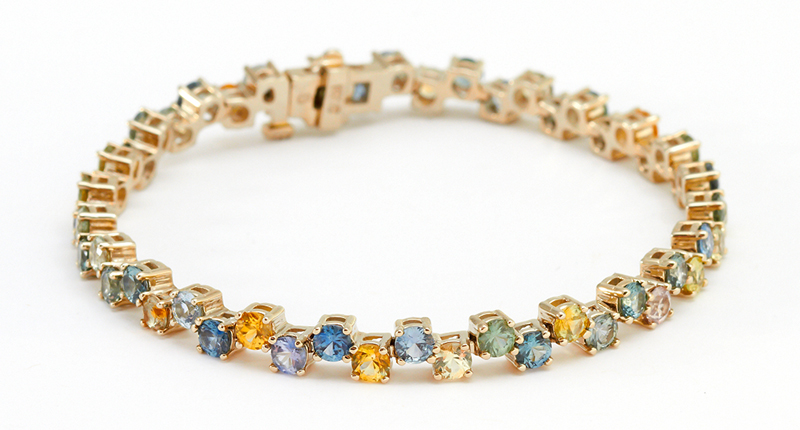
Yogo sapphires from Montana (Image courtesy The Gem Gallery)
There’s been a movement toward Americana products and American-made goods over the past few years.
The trend has, not surprisingly, also trickled into demand for colored gems. I’ve been hearing more and more about how consumers are showing interest in the stones that are mined in the United States, including several mentions of it during the Tucson gem shows earlier this year.
Eric Braunwart of Columbia Gem House told me in a recent interview that he believes the increase in demand might have to do with the desire for mine-to-market tracing and knowing where products come from, as well as an increased awareness in American-made products.
Luckily for those looking for gemstones mined domestically, the United States has got a variety of options--agate, beryl, garnet, jasper, opal, sapphire, tourmaline and much more.
In the meantime, here are some quick hits of information about American gems, including what’s available and the size of the domestic market.
1. Tourmaline started it all. According to the USGS, tourmaline was the first gemstone mined in the United States by miners other than prehistoric man or Native Americans.
Mining of the stone began at Mount Mica, Maine, in 1822, and has continued to the present, with some starts and stops.
A new phase of tourmaline mining began when Gary and Mary Freeman of Coromoto Minerals acquired the property at Mount Mica in 2003. In the first eight years of mining, more than two hundred pockets of the gemstone were discovered, according to the Maine State Museum.
Tourmaline also was the single largest contributor to the value of gemstones produced by California for a long time, according to USGS.
Since their discoveries, the tourmaline deposits in Riverside and San Diego counties have not only produced more tourmaline by volume but also produced tourmaline worth a greater value than any other deposit in the Northern Hemisphere, the USGS said.
It’s believed that, in fact, only the deposits in Brazil have been more productive than those in California, due in large part to the longevity of the individual mines in California, with many of them operating intermittently from the 1890s onward.
For example, the Himalaya mine was the world’s largest producer of tourmaline from 1898 until 1914. It’s currently owned and mined by Pala International and is still the state’s biggest producer.
(The USGS used to make available breakdowns of the production of each gemstone in the U.S. by year but stopped posting it online a few years ago. Inquiries regarding this information were not answered by press time).
A bracelet featuring Montana sapphires from Columbia Gem House
2. The reign of sapphires carries over. Mirroring the story in the international colored gemstone sector, sapphires seem to be taking the top spot in the domestic gem market, as interest increases in Montana and the corundum its mines are producing.
Montana sapphires are found in four widely separated areas across the state, with each locality producing material with its own unique characteristics.
The first were extracted from the Missouri River as early as 1865, according to Columbia Gem House’s website, and still are being found along the river. Sapphire also is found in Dry Cottonwood Creek, though production has been sporadic over the past few years.
Yogo sapphires from the Yogo Gulch area are considered some of the finest from the state, though they generally come in smaller sizes.
Yogo sapphires are known for their uniform, well-saturated blue color, relative absence of inclusions and zonation, and high luster and brilliance in both artificial and natural light, the GIA said. They also have the added advantage of not requiring any heat treatment.
Rock Creek sapphire, meanwhile, occurs in more than 50 distinct hues, including shades of teal, which the younger consumer has shown interest in, Braunwart said.
As demand for stones from this state increases, supply has trended toward becoming more consistent, he added, as more miners move to make it a regular business, rather than just a hobby.
3. A quarter of the states produce the majority of the gemstones in the country. In decreasing order of production value, Idaho, Arizona, Oregon, California, Montana, Arkansas, Maine, Colorado, North Carolina, Nevada, Texas and Utah produced 90 percent of the U.S.’s natural gemstones last year, the USGS said.
In the U.S., in addition to tourmaline and sapphire, domestic production includes beryl, coral, garnet, jasper, opal, pearl, topaz and turquoise.
Interestingly, one miner in California who’s been doing it for the past three decades said he has mined some quartz that displays multiple stars. (The Gemological Institute of America wrote about them in an issue of “Gems & Gemology” in 1990.)
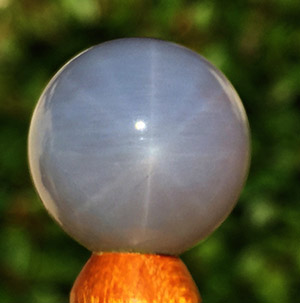
Multiple-star quartz mined by David Muster of Muster Gems in California
At the Diamond Mountain Mine in Plumas County, David Muster of Muster Gems finds quartz that display six- to 12-rayed stars of various intensities. Additional stars also can be seen at times on the sides of a cabochon.
They come in a variety of pastel colors, from white to blue to rose and even sometimes a deep orchid.
“You never get the same color twice with these stones,” Muster said. “Whatever you dig up is what you’ve got.”
The star phenomenon doesn’t show up in all gemstones, and the very high-quality, geometrically perfect stars are very rare, Muster said. Alternatively, it can sometimes show as cat’s eye.
His mining site doesn’t produce a lot of material. He estimates that for every ton mined, it produces about a pound of gemstone material.
California also is the only source of its state gemstone, benitoite, a beautiful blue gem found only in San Benito County.
4. Demand might be up, but production is a different issue. While interest in American gems might be growing, it remains to be seen if supply will be able to keep up, if the numbers from the USGS are any indication.
After a slight decline between 2008 and 2009, from $11.5 million to $9.3 million, the value of U.S. natural gemstone output has gradually increased for a few years-- $10 million in 2010, and then around $11 million in 2011 and $11.3 million in 2012.
Then in 2013, it dropped again to $9.6 million, where it hovered through 2014 before dropping again to $8.5 million in 2015 and remaining flat there in 2016.
5. There’s a small, but growing, movement in domestic commercial cutting. Americut Gems opened in New Brunswick, N.J., last year to become what it says is the first U.S.-based factory that uses state-of-the art robotic cutting technology to produce precision-cut gemstones.
It really came after the opening of the 3,000-acre Potentate mine in Montana, which produces hundreds of kilos of sapphires a year, according to Arlan Abel, a partner at the company. This mine is Americut’s primary source for rough sapphire.
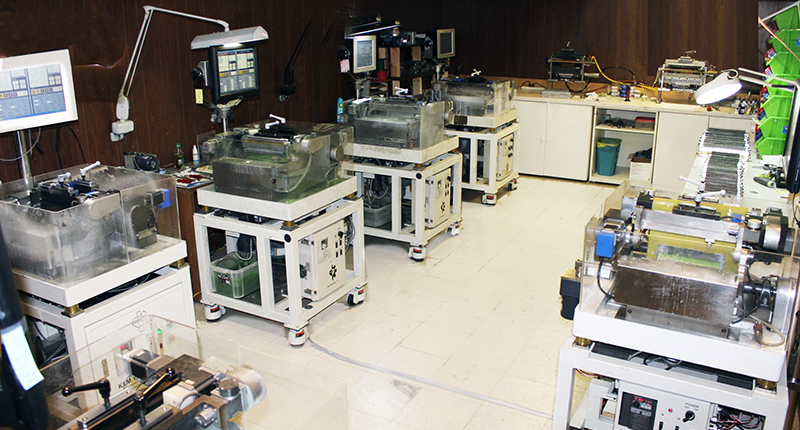
The freestanding robotic machines used at Americut Gems were designed by Kiwon Jang of KLM Technology and used to commercially produce the “All-American Sapphire” in New Jersey.
The facility has six models called the “801,” which feature an 8-inch lap (the rotating disc on a cutting machine that helps create the facets), and cuts one stone of more than 5 mm at a time.
It also has two “1024” models, which feature a 10-inch lap and the ability to cut 24 stones at a time. Abel said it’s ideal for stones in finished sizes of between 3 and 5 mm.
Additionally, there are two “1440” models with a 14-inch lap that cuts about 80 stones at a time, finishing stones of between 1.5 mm and 2.75 mm.
Americut’s technology makes it possible to cut in the U.S. and avoid the necessity of shipping the rough stones overseas, Abel said, allowing it to offer the “All-American Sapphire,” which it says is the first time that sapphires have been mined, cut and polished in all sizes in the U.S.
Americut cuts everything from 1.5 mm upward, and is interested primarily in acting as cutter and dealer to the trade, with Abel noting that they are open to entertaining any partnership.
When it comes to supply for the sapphires from Potentate, Abel said it’s mixed.
Approximately 75 percent of Rock Creek production results in polished gemstones that are smaller than 5 mm and which have a very distinct color. As such, Abel said they are currently in conversation with several designers to create a unique look for this material and help with the sell-through of the smaller sizes.
With larger sizes, there is not enough material available to satisfy demand.
He added, though, that he thinks Rock Creek sapphires “could be a major product category” for the retailer who wants something different.