
test
What an Online Retailer Learns by Going Brick-and-Mortar
Editor-in-Chief Michelle Graff sits down with the founder of Stone & Strand to better understand what the e-tailer hopes to gain by opening a physical space.


I haven’t had the chance yet to ride the Long Island Railroad to Blue Nile’s “webroom” at the Roosevelt Field Mall, but I am curious to learn more about online retailers’ goals in going off-line, so to speak.
So, last evening I hopped on the New York City subway and headed a (very short) distance uptown to sit down with Nadine McCarthy.
Nadine is the founder of Stone & Strand, a jewelry e-tailer that just opened its first physical location, a lovely, very New York City-esque showroom attached to their office in Manhattan’s Tribeca neighborhood.
The company recently relocated its office from SoHo to Tribeca expressly for the purpose of gaining more square footage and opening a store, of sorts.
Here’s why.
1) They can get to know their customers personally. This is the first, and most obvious, of the objectives but a very important one nonetheless. Who are these people buying jewelry on Stone & Strand? What are their interests and hobbies outside of online jewelry shopping? And, how can this inform what trends will appeal to them and, ultimately, what Stone & Strand should buy to sell to its customers?
As I’ve written on this blog before, the Internet will never become a full substitute for human interaction. People always will desire direct contact with other human beings and, perhaps, will crave it as technology becomes even more pervasive and we spend an increasing amount of time each day staring at a screen of some sort.
That is why we are witnessing this current evolution in retail, this blurring of the lines between online and off, and designer/brand and retailer. “The delineations,” Nadine observed, “are not as clear as they used to be,” and she’s right.
Brick-and-mortar retailers might bemoan the overhead costs of operating a store, but the face-to-face interaction with customers that it affords them is very important. It’s what online retailers are finding that they are missing by operating a virtual store.
2) They can test out ideas for potential future expansion. Nadine said the company does not have any plans to be a full-fledged brick-and-mortar retailer but, rather, will always just look at physical locations to support their core business, which is selling jewelry online.
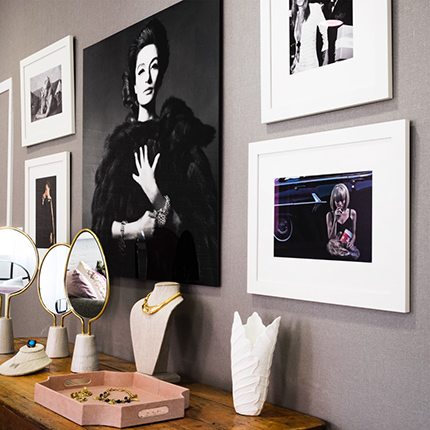
Another shot inside the Stone & Strand showroom. Nadine said the team purchased the vintage prints in Paris.
Still, opening this current store will tell
Right now, customers who come into the showroom can purchase a piece and walk out with it, as along as Stone & Strand has it in stock. But, if they opened more stores, would they all work this way, or would it be a buy-online-only model? Nadine said these are the kind of questions they are hoping this first space will help them answer.
(For everybody reading this article who is wondering about the sales tax impact of this online retailer opening a store, there is none. Stone & Strand already had to collect sales tax here in New York.)
3) They have a space for events that reflects the brand. There’s certainly no dearth of places to throw a great party in New York City but events are, number one, not cheap, and number two, might not exactly reflect one’s brand.
And that’s what Nadine says Stone & Strand likes about having its own space that’s open to the public—it gives them a place to hold events that are decorated exactly like they want it.
The space is on a beautiful cobblestone street in Tribeca and, incidentally, right down the block from both a Shinola store and the Gurhan Atelier. There are vintage fashion prints on the wall and also some modern shots from a well-known fashion photographer with whom Stone & Strand has struck up a partnership.
It’s not too stuffy or old-school, or too urban and hip. It simply says “Stone & Strand.”
The Latest


A monthly podcast series for jewelry professionals

From protecting customer data to safeguarding inventory records, it's crucial to learn how to tackle cybersecurity challenges.

Test Podcast With Video. New interview with Ada Lovelace.

Abstract for tests. New Podcast interview with John Lennon, Jimi Hendrix and Jim Morison.

Ahead of the holiday season, Smith delves into the often subconscious reasons people buy luxury products for themselves or their loved ones.

The GMT-Master “Pepsi” belonging to astronaut Edgar Mitchell is a standout in RR Auction’s online “Space Auction,” going on now.

The ads celebrate the mall culture of the ‘80s and ‘90s.

Retail sales associates can access the video series on mobile to refresh their selling skills.

For 25 years, India’s Gem & Jewellery National Relief Foundation has provided aid in the wake of war, natural disasters, and global crises.

The November auction will feature a collection of jewels owned by Ferdinand I, the first king of modern Bulgaria, and his family.

Commercial production has begun underground at the Canadian diamond mine’s A21 pipe.

Deloitte and Adobe Analytics shared their insights on the season, from the retail sales forecast to the role of generative AI.

The Texas-based jeweler collaborated with luxury clothing brand Uncommon Man on men’s bands designed with European influences.

Industry players have found ways to cope with market conditions while working to reshape themselves in the face of emerging realities.

The sales event, in its second year, features a selection of rare diamonds from the miner’s Argyle and Diavik diamond mines.

A portion of the proceeds from the “Always Dream” collection will go to Yamaguchi's foundation, supporting early childhood literacy.